Published by
Gold Expert
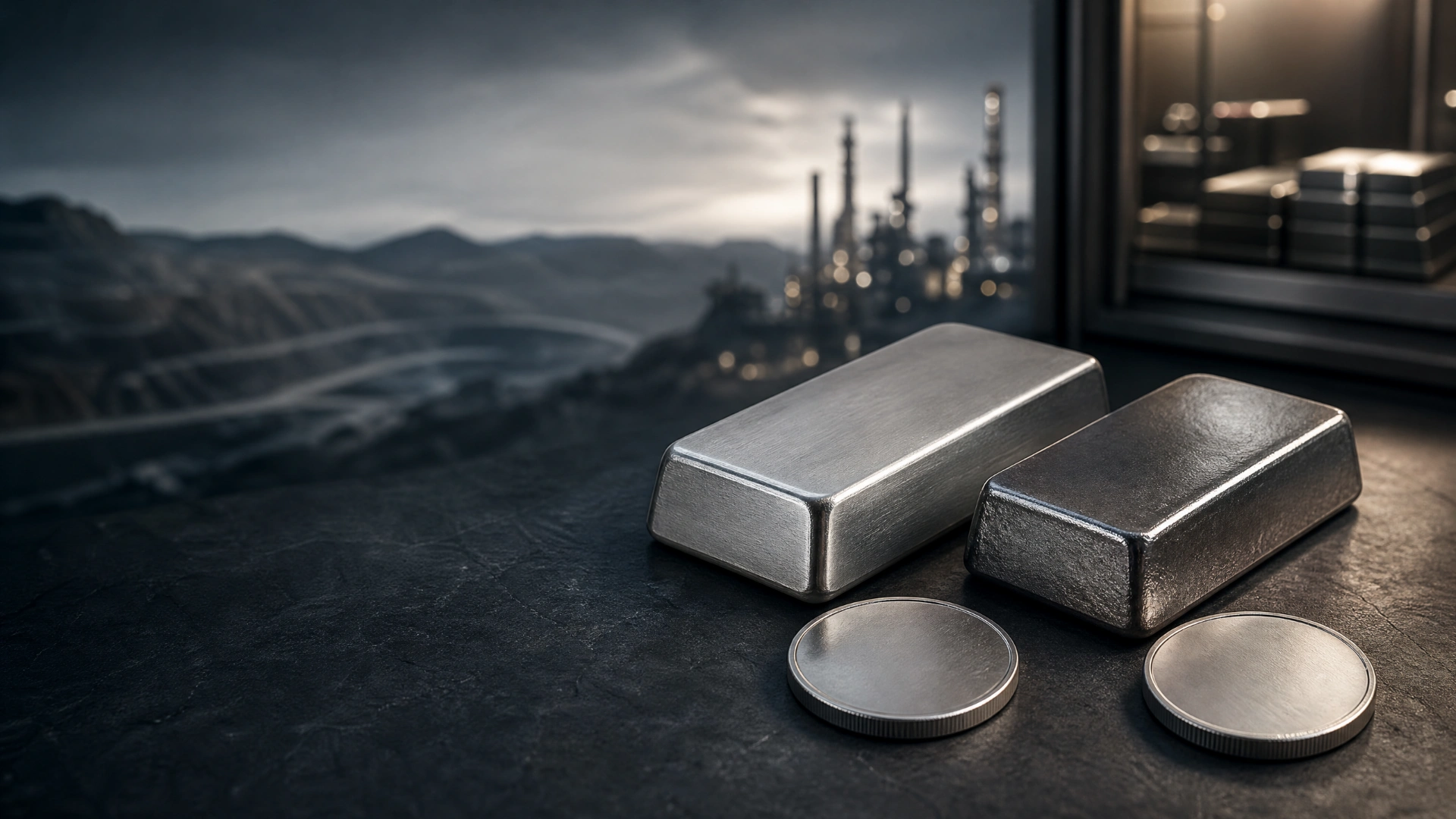
Platinum and palladium sit in the same display case as gold and behave almost nothing like it. They are mined in far smaller quantities, from far fewer countries, and most of what is produced is consumed by industry rather than held. That changes what a buyer meets at a retail counter — fewer products, thinner secondary markets, wider spreads and availability that comes and goes — without making either metal better or worse than gold.
None of that makes either metal better or worse than gold. It makes them structurally different, and the differences are worth understanding before rather than after a purchase. This article covers how the physical market for the two platinum-group metals is put together — where the supply comes from, who consumes it, how the wholesale market is organized, and what actually trades over a counter in Northern Virginia.
How big the platinum and palladium market is
World mine production in 2025 came to roughly 170 metric tons of platinum and 190 tons of palladium, against 3,300 tons of gold. Scale is where the structural differences start.
The figures come from the US Geological Survey's Mineral Commodity Summaries 2026, which estimates 2025 world mine production at 170,000 kilograms of platinum and 190,000 kilograms of palladium. The same publication's gold chapter puts world gold mine production at 3,300 tons for the same year.
Gold's annual mine supply is therefore about nineteen times platinum's. Add to that a very large stock of gold already above ground in coins, bars and jewelry that can come back to market at any time, and the difference in market depth is larger than the mining figures alone suggest.
Depth cuts both ways. A deep market absorbs a large order without moving much, which is the main reason gold quotes look similar wherever you ask and platinum quotes do not. It also means new mine supply is a small fraction of what already exists above ground, so changes in mine output move the gold price relatively little. The platinum-group metals are the reverse case: most of what has ever been mined has been consumed in catalytic converters, refineries and electronics rather than stored, so annual supply and annual demand meet each other far more directly.
Where platinum and palladium come from

Two countries dominate the supply of each metal, where gold has no equivalent concentration. Gold is mined nearly everywhere. USGS lists China, Russia, Australia, Canada and the United States as the top five producers in 2025, and notes that between them they accounted for 41% of global production — meaning the majority came from somewhere else.
The platinum-group metals are the opposite case, on the 2025 estimates.
| Country | Platinum, 2025 est. (kg) | Palladium, 2025 est. (kg) |
|---|---|---|
| South Africa | 120,000 | 70,000 |
| Russia | 20,000 | 84,000 |
| Zimbabwe | 18,000 | 15,000 |
| Canada | 5,000 | 16,000 |
| United States | 1,800 | 6,200 |
| World total | 170,000 | 190,000 |
South Africa alone accounts for roughly seven-tenths of world platinum mine production, and Russia for roughly four-tenths of palladium. USGS puts 2025 US net import reliance at 89% of apparent consumption for platinum and 57% for palladium.
That leaves a supply picture exposed to power supply, labour relations, mine economics and trade policy in a way a diversified commodity is not — and it works in both directions: a disruption tightens supply, and a resolution loosens it.
Who actually uses it
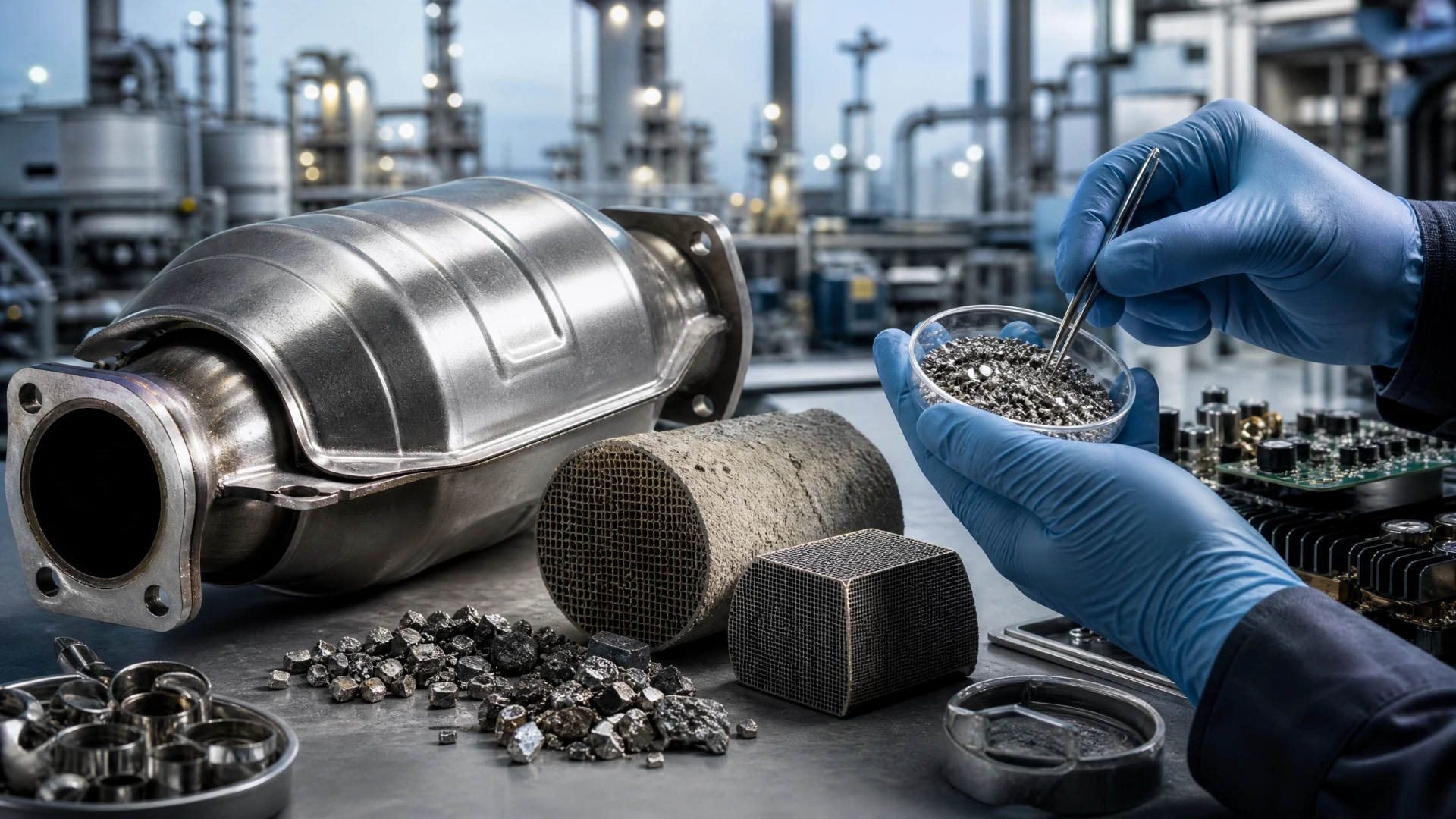
Most platinum and palladium is consumed rather than held, which is the second structural difference and probably the most consequential. USGS names automotive catalytic converters as the leading domestic use for platinum-group metals: the metals sit in the exhaust system of internal-combustion vehicles, converting pollutants. Beyond that they go into chemical and petroleum refining catalysts, electronics, glass manufacturing, laboratory equipment and medical devices. Platinum also has a jewelry market; palladium's is small.
That industrial base has a recycling arm attached to it. USGS estimates about 140,000 kilograms of palladium and platinum were recovered globally from new and old scrap in 2025, including about 50,000 kilograms of palladium and 8,600 kilograms of platinum recovered from automobile catalytic converters in the United States alone. Secondary supply on that scale responds to price and to the number of vehicles being scrapped — another input gold does not have in the same proportion.
The consequence is that platinum and palladium prices carry an industrial-cycle component. Vehicle production, emissions regulation and engine technology all feed into demand for the metal. Gold's demand base is weighted differently, toward jewelry, investment and central bank holdings. Neither structure is superior; they are simply not the same input set, and a buyer who expects platinum to track gold is working from the wrong model.
How the wholesale market is organized
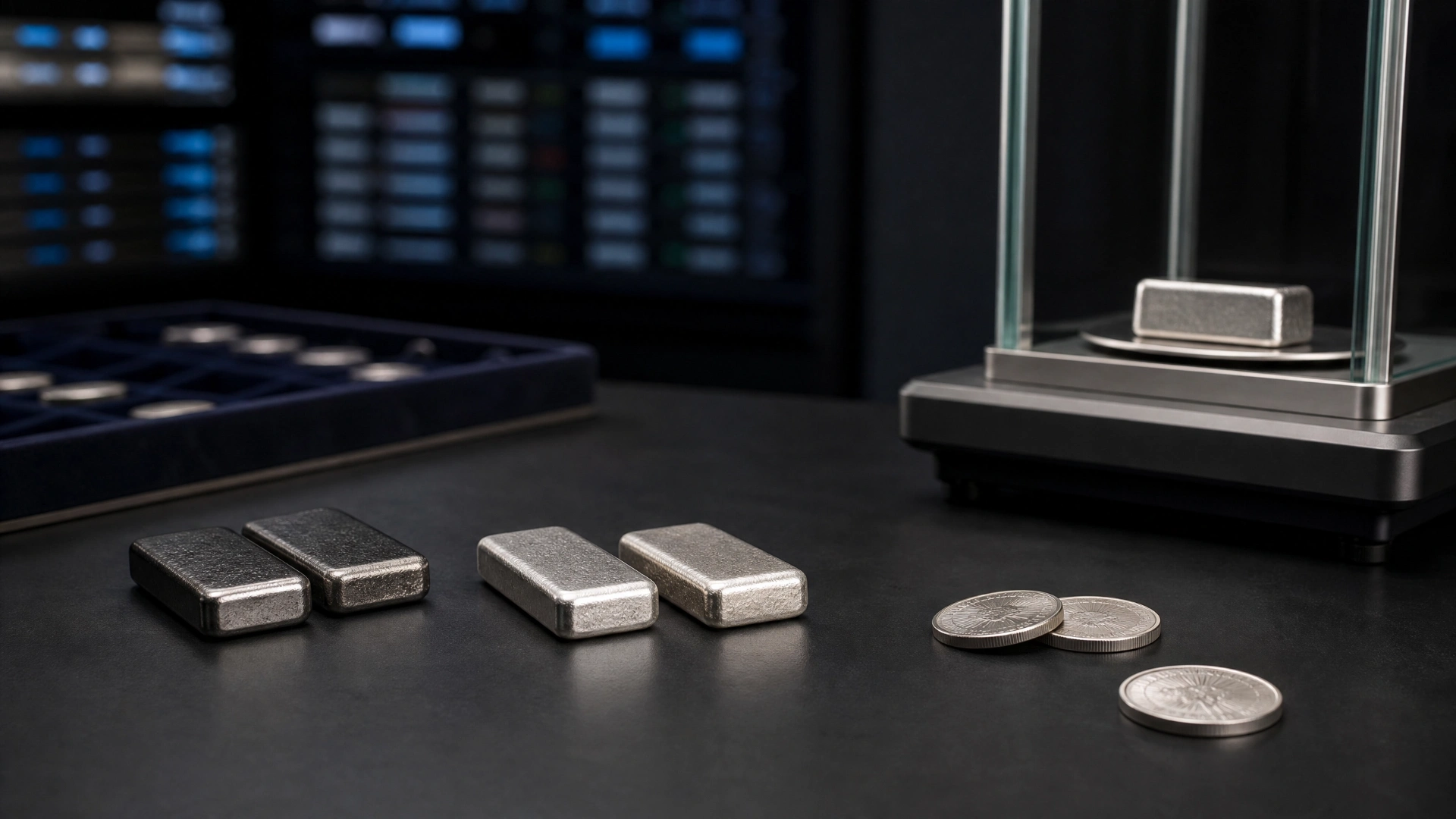
Gold and silver trade through the London bullion market, which has centuries behind it. Platinum and palladium trade through a parallel structure that is much younger.
The London Platinum and Palladium Market is described by the LBMA as "a sister organisation of the LBMA except that its primary responsibility is for platinum and palladium rather than gold and silver." London trading in the two metals was formalized in 1987, quotations became full fixings in 1989, and those were replaced by the LBMA Platinum Price and the LBMA Palladium Price on 1 December 2014. LBMA records that these benchmarks are administered independently by ICE Benchmark Administration, with six accredited price participants contributing.
Six participants is a small number. It is not a criticism of the mechanism — it is a measure of how many firms make markets in these metals at wholesale scale, which is itself the point.
The physical unit differs too. LPPM Good Delivery plates and ingots run between 1 kilogram (32.151 troy ounces) and 6 kilograms (192.904 troy ounces) — a much smaller wholesale unit than the large bar that defines the gold market, reflecting how the metal is actually moved and consumed.
What you can actually buy
Two sovereign coins and a short list of refiner bars is close to the whole retail universe for these metals, and that is where the structure becomes tangible.
The US Mint introduced the one-ounce American Eagle Platinum bullion coin on 23 September 1997, struck at .9995 fine — the first US coins to carry an engraving of their purity. The American Eagle Palladium coin came much later, first released as bullion in 2017 and as proof in 2018, also one troy ounce at .9995 fine, 34.03 millimeters across.
Alongside those sit platinum and palladium bars from private refiners and a small number of sovereign issues from other mints. Compare that with gold, where sovereign coins from a dozen countries, fractional sizes down to a tenth of an ounce and bars from one gram upward all trade actively.
Three things follow for anyone buying or selling physical platinum or palladium:
- Fractional sizes are scarce. The one-ounce coin is the standard unit, so the entry ticket is a full ounce of a metal that is not cheap.
- Premiums and spreads are set in a thinner market. A dealer quotes what they can lay the metal off at. In a market with fewer participants and less inventory turnover, the gap between the buy and sell side is generally wider than on a Gold Eagle, and it moves around more.
- Availability is not constant. Product that is on the shelf one month may be on allocation the next, because refiners and mints size production to industrial and investment demand that changes.
Gold's advantages here are real and worth stating plainly: more products, more sizes, tighter spreads, and a buyer for a Gold Eagle in every coin shop in the country.
The platinum-group metals have concrete advantages of their own on this list. Both American Eagles are struck at .9995 fine, against 22-karat for the gold coin, so the metal in a one-ounce coin is the whole coin. The wholesale unit is far more accessible: an LPPM good-delivery plate starts at one kilogram, where the gold market's is a large bar most people will never handle. Platinum carries two demand bases rather than one, industrial and jewelry. And the recycling channel is substantial and price-responsive — the 140,000 kilograms recovered globally in 2025 is a second source of supply that responds to the market within months.
Their prices also answer to a different input set — vehicle production, emissions rules, refinery catalyst cycles and scrap flows, where gold's answer to jewelry demand, investment flows and central bank buying. Because so little platinum and palladium sits above ground as investment stock, a supply interruption or a demand shift reaches the price without a large held inventory in between.
One Virginia detail worth knowing
Virginia's retail sales and use tax exemption for bullion, at Va. Code § 58.1-609.1(19), names three metals — gold, silver and platinum bullion — and does not name palladium, though the Code text also carries a sunset date that lapsed on paper while budget language kept the exemption running.
That is one provision of a statute we cover in full elsewhere, including how the Code text and the operative expiry came to disagree — see Virginia's bullion sales-tax exemption. The two metals are worded differently in that subdivision. What that means for any particular purchase depends on facts a tax professional needs to see.
Platinum and palladium side by side
| Platinum | Palladium | |
|---|---|---|
| 2025 world mine production | 170,000 kg | 190,000 kg |
| Supply concentration | South Africa ~70% of mine production | Russia ~44%, South Africa ~37% |
| US net import reliance, 2025 | 89% | 57% |
| Main demand | Autocatalysts, chemical and petroleum refining, glass, electronics, jewelry | Autocatalysts, electronics, chemical catalysts; very little jewelry |
| US sovereign coin | American Eagle Platinum, one ounce .9995, since 1997 | American Eagle Palladium, one ounce .9995, since 2017 |
| Retail product range | Narrow, but broader than palladium | Narrower again — few sovereign issues |
| Named in Va. bullion exemption | Yes | Not named |
Read across the table rather than down it. Platinum has the longer coin history, a jewelry outlet palladium lacks, and a named place in the Virginia exemption. Palladium has the larger annual mine supply of the two, a more diversified end-user base in electronics, materially lower US import reliance on the USGS figures, and — through catalytic converter recycling — the larger secondary supply channel. Both are dominated by autocatalyst demand, both are dominated by two producing countries, and both trade in a market a fraction of gold's size.
At our counter

We have been buying and selling precious metals in Northern Virginia since 2008, from two locations in Chantilly and Vienna. We sell platinum and palladium bullion — coins, bars and rounds — alongside gold and silver, and on the buy side we purchase gold, silver and platinum.
When metal comes across the counter it is tested in front of you by X-ray fluorescence analysis, which identifies the metal type and percentage across 26 different metals. Walk-ins are welcome during normal business hours, the offer is made the same day against current precious metals pricing, and if you accept it, payment is provided the same day. You can see what is currently in stock on our bullion pages, and what the buy-side process looks like under cash for gold.
Because platinum and palladium product moves less often than gold, stock in those two metals is thinner and less predictable than in gold and silver.
This article is educational and reflects general information about precious metals and collectible coins. It is not investment, tax or legal advice, and The Bullion Bank is not a registered investment adviser, broker-dealer or tax professional. Metal prices fluctuate and past performance does not indicate future results. Consult a qualified professional about your own situation.
Frequently asked questions
Why is platinum sometimes cheaper than gold?
Because the two metals are priced by different demand structures. Platinum's demand is weighted toward industrial use — autocatalysts, refining catalysts, glass and electronics — while gold's is weighted toward jewelry, investment and central bank holdings. Relative prices have moved a long way in both directions historically, and scarcity in the ground does not set the price on its own.
Is palladium bullion harder to sell than gold?
Generally it takes more work. There are fewer sovereign palladium products, fewer dealers hold inventory in it, and the wholesale market has fewer participants, so the spread between buying and selling prices is usually wider than on a Gold Eagle and can vary more between quotes. It is a liquid metal at wholesale; it is a narrower market at retail.
What fineness are American Platinum and Palladium Eagles?
Both are struck at .9995 fine. The one-ounce Platinum Eagle went on sale on 23 September 1997 and was the first US coin to carry an engraving of its purity. The one-ounce Palladium Eagle was first released as bullion in 2017 and as a proof in 2018, and measures 34.03 millimeters in diameter.
Does Virginia charge sales tax on platinum and palladium?
Va. Code § 58.1-609.1(19) exempts gold, silver and platinum bullion and does not name palladium, though the Code text carries a sunset date that lapsed on paper while budget language kept the exemption in force. Whether a particular purchase is exempt depends on the product and the transaction. Ask a tax professional about your own purchase.
Why do platinum premiums move around more than gold premiums?
Retail premiums reflect what it costs a dealer to replace the item. In a market where annual mine supply is roughly a nineteenth of gold's, refiners and mints size production tightly, and product availability shifts with industrial demand, replacement cost is less stable — so the premium above the metal price is less stable too.
Do you buy palladium?
We buy gold, silver and platinum, and we sell platinum and palladium bullion. If you have palladium to sell, call either store first and we will tell you what we can do on the day rather than have you make the trip on spec.
Two counters in Northern Virginia
Bring what you have, or tell us what you are hunting for and we will say plainly whether we can get it.
Chantilly
The Bullion Bank
4086 Airline Pkwy
Chantilly, VA 20151
(703) 705-5151
Vienna
The Bullion Bank
131 Maple Ave W
Vienna, VA 22180
(703) 705-5252
Both locations: Mon–Fri 11:00–18:00 · Sat 11:00–17:00 · Sun closed