Published by
Gold Expert

If you are asking yourself whether you should buy physical gold or a gold ETF, you are not alone. Many savers compare these options as they look to protect savings, hedge inflation, and diversify their portfolios with gold exposure. Both physical bullion and gold ETFs track the gold price, but they differ significantly in ownership, risks, costs, and how they behave in crises.
This guide explains the key differences between owning physical gold and buying a gold ETF, why some investors still prefer real coins and bars over "paper gold," what risks exist if you only hold ETFs, and how to decide which mix may be right for your portfolio.
Physical Gold vs Gold ETFs: What's the Actual Difference?
Before deciding whether to buy physical gold or a gold ETF, it helps to understand what each really represents.
How Physical Gold Is Owned and Stored
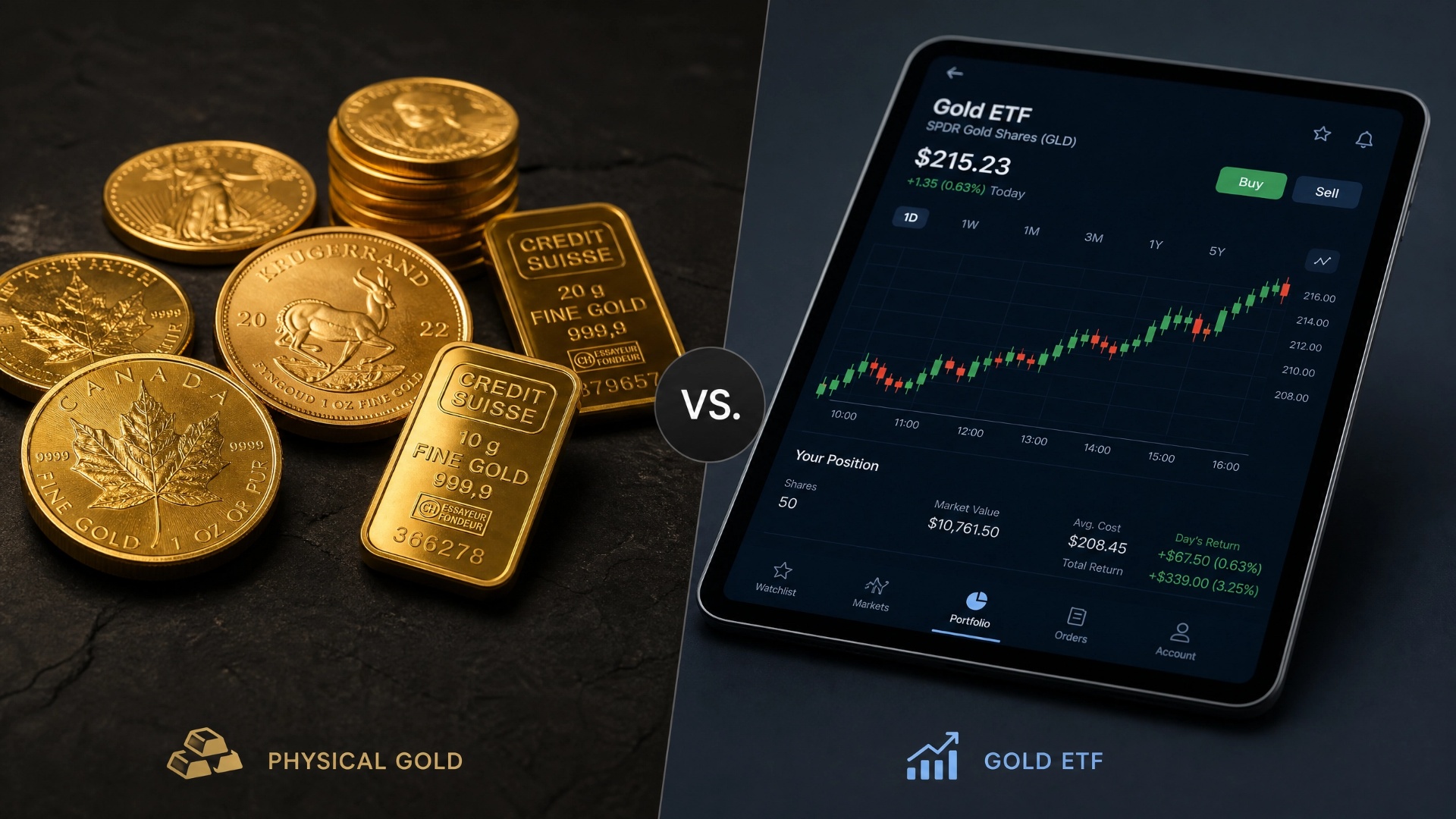
Physical gold includes coins, bars, and rounds you can hold in your hand. When you buy bullion, you directly own the metal itself, not a claim or a contract. Many investors store it:
- In a home safe they control
- In a bank safe deposit box
- In a professional vault or secure storage facility
With physical gold, you typically pay a one-time premium over the spot price at purchase. After that, there are no built‑in management fees. Your long‑term cost basis is the price you paid plus any storage or insurance you choose to add.

How Gold ETFs Work
Gold ETFs (exchange‑traded funds) trade on stock exchanges like regular stocks. When you buy a gold ETF, you own shares in a fund that holds gold or uses derivatives to track the gold price. You do not own specific coins or bars; you own a financial product tied to gold.
Gold ETFs require a brokerage account, trade during market hours, and charge an annual expense ratio (often around 0.05–0.3%), plus any brokerage commissions. Most retail investors cannot redeem ETF shares for physical gold, even when the ETF is physically backed.
Why Many Investors Prefer Real Gold Coins Instead of Paper Gold
Despite the convenience of ETFs, many investors still prefer real gold coins and bars over purely financial gold products.
Direct Ownership and No Counterparty Risk
With physical gold, you hold the asset directly. There is no fund manager, custodian, or financial institution between you and your metal. That means:
- You are not exposed to the solvency of a fund sponsor or custodian.
- You are less reliant on market functioning or brokerage platforms during crises.
This is a major reason why some investors prefer real gold coins instead of paper gold: physical bullion largely removes counterparty risk from the equation.
Privacy, Control, and Tangibility
Physical gold can be held privately (subject to local laws), stored where you choose, and passed on as inheritance without relying on electronic systems. Many savers also value the psychological benefit of owning something tangible that has held value across centuries. The ability to see, weigh, and test a coin or bar gives some investors more confidence than a digital statement balance.
Risks of Holding Only Gold ETFs Without Physical Bullion
Gold ETFs can be a useful tool, but relying exclusively on them introduces several risks that physical bullion helps offset.
Counterparty and Structural Risks
Gold ETFs depend on multiple layers of institutions: fund sponsors, custodians, trustees, and regulators. If there is mismanagement, legal action, or operational failure, the fund could deviate from its intended behavior. Some structures may also use derivatives or lending arrangements that add complexity.
Fees and Long‑Term Return Erosion
ETFs charge annual management fees that compound over time. Over a long holding period, these fees can noticeably reduce net returns compared with holding physical gold, where the main cost is the initial premium plus any optional storage or insurance.
Limited Access to Physical Metal
Most gold ETFs do not allow typical retail investors to redeem shares for physical bullion. Even with physically backed funds, redemption is often restricted to large institutional blocks. This means you cannot simply "swap" your ETF units for coins or bars if you decide you want direct possession.
Market Dislocation and Crisis Scenarios
If markets temporarily freeze, trading halts, or there is a major financial shock, ETF liquidity can be affected. In these situations, ETF prices may diverge from the underlying net asset value. Physical bullion you already hold is not dependent on exchange trading or brokerage operations to be accessible.
How Physical Gold Behaves Compared to Financial Gold Products
Both physical gold and gold ETFs provide exposure to the spot price, but their behavior differs in practice.
Pricing, Premiums, and Liquidity
- Physical gold typically trades at spot price plus a dealer premium. When selling, you receive spot minus a buy‑back spread.
- Gold ETFs trade at market prices that usually sit very close to net asset value, with tight bid‑ask spreads on liquid funds.
ETFs offer high liquidity for quick trades within market hours. Physical gold requires finding a buyer (such as a dealer), but for common bullion products the secondary market is active and straightforward. Many investors use ETFs for short‑term or tactical exposure and physical coins/bars for long‑term wealth storage.
Crisis Performance and Historical Examples
In major crises, gold has often behaved differently from stocks and many other assets:
- 1970s inflation: During the high inflation of the 1970s, US inflation averaged around 8–9% a year, while gold prices rose dramatically, with some analyses estimating average gains of over 30% per year in that period. Gold's performance far outpaced consumer price increases, helping preserve purchasing power.
- 2008 financial crisis: During the 2008 crisis, gold drew significant safe‑haven demand. While global equity markets fell sharply, gold prices rose over the period of the crisis as investors moved away from risk assets into perceived stores of value.
- 2020 COVID‑19 crash: In early 2020, gold initially sold off with other assets during the liquidity scramble, but then rebounded and went on to reach record highs as central banks cut rates and deployed stimulus, reinforcing gold's role as a crisis hedge.
In all these episodes, the underlying metal's behavior was driven by safe‑haven demand and inflation concerns. Gold ETFs and physical bullion both reflected this price action, but investors holding physical metal also had the reassurance of direct possession, independent of brokerage or fund infrastructure.

Tax Treatment: Physical Gold vs Gold ETFs (US Context)
Tax treatment is an important—and often overlooked—difference between physical gold and gold ETFs for US investors.
How Physical Gold Is Taxed
In the US, most physical gold (coins, bars, bullion) is classified as a collectible for federal tax purposes. Key points include:
- There is generally no federal tax when you buy physical gold, though state sales tax may apply depending on where you live and transaction size.
- When you sell, your capital gain equals sale price minus your cost basis (what you paid, including premiums and certain costs).
- If you hold physical gold more than one year, gains are typically taxed as long‑term collectible gains, with a maximum federal rate of up to 28%, which is higher than the 15–20% rate that applies to most long‑term stock or bond investments.
- If you hold it one year or less, gains are taxed as short‑term capital gains at your ordinary income tax rate.
Always consult a qualified tax professional for personalized advice.
How Gold ETFs Are Taxed
Tax rules for gold ETFs depend on their structure:
- Many popular physically backed gold ETFs are treated similarly to owning the underlying metal, meaning gains can also be taxed as collectible gains up to 28% for long‑term holdings.
- Some commodity ETFs or notes that use futures or special structures may face hybrid rules (such as the 60/40 rule for futures: 60% long‑term, 40% short‑term, regardless of holding period) or can be taxed as ordinary income in certain cases.
Because different funds have different tax statuses, it is essential to review the ETF's prospectus and speak with a tax advisor to understand exactly how any gain will be taxed in your situation.
Gold IRAs: Using Gold for Retirement Accounts
Another frequently searched area around physical gold and ETFs is how they fit into retirement planning through gold IRAs.
What Is a Gold IRA?
A gold IRA is a self‑directed individual retirement account that allows you to hold approved precious metals—such as specific gold and silver coins or bars—inside a tax‑advantaged retirement account. Instead of owning only stocks, bonds, or mutual funds, a gold IRA can hold IRA‑eligible bullion that meets IRS purity and storage rules.
Physical Gold vs ETFs Inside an IRA
Within an IRA, you can typically choose between:
- Physical bullion in a gold IRA:
- Metals must meet IRS fineness requirements and be stored with an approved custodian.
- Gains inside the IRA grow tax‑deferred (traditional IRA) or potentially tax‑free (Roth IRA), but withdrawals are taxed according to IRA rules, not collectible rates at the time of sale.
- Gold ETFs in a traditional or Roth IRA:
- Gold ETFs can usually be held in a standard brokerage IRA.
- Tax treatment occurs when you withdraw from the IRA (as ordinary income for traditional IRAs; qualified withdrawals are tax‑free for Roth IRAs), rather than at each sale inside the account.
For investors deciding between physical gold and a gold ETF, considering whether the investment will be held in taxable accounts or IRAs is a key part of the overall strategy.

Should I Add Physical Gold if I Already Own Gold ETFs?
If you already have a gold ETF and are wondering whether you should add physical gold, the answer for many investors is yes—at least for a portion of their gold allocation.
Diversifying Your Gold Exposure
Holding only ETFs concentrates your gold exposure within the financial system. Adding physical bullion can:
- Reduce reliance on brokerage platforms and fund structures
- Provide a form of "crisis insurance" that is not dependent on market trading
- Broaden your mix between liquid trading tools (ETFs) and long‑term tangible stores of value (coins/bars)
Many investors choose a blended approach—for example:
- Using ETFs for short‑term trades or tactical positioning
- Holding physical gold for long‑term wealth protection, legacy planning, and systemic risk hedging
The right balance depends on your time horizon, risk tolerance, and how much value you place on direct ownership versus convenience.
How to Start Buying Physical Gold Safely
If you decide that physical bullion belongs alongside your gold ETF holdings, follow a careful process.
Step 1: Research Reputable Precious Metals Dealers
Look for dealers with:
- Strong reviews and industry reputation
- Clear pricing close to spot plus a transparent premium
- Educational resources explaining spot price, premiums, and product types
Step 2: Understand Products and Purity
Focus on widely recognized bullion coins and bars with:
- Minimum 99.9% purity for gold bullion
- Visible hallmarks, mint marks, and assay certificates
- Good resale markets and recognizable brands
Step 3: Compare Total Ownership Costs
Consider:
- Purchase premium over spot
- Shipping and insurance
- Optional storage and insurance costs if using vaults or safe deposit boxes
Step 4: Plan Your Storage and Documentation
Decide where you will store your gold and keep:
- Purchase receipts
- Certificates and assay cards
- Any serial number records for bars
This documentation helps with future resale and insurance. When the time comes to liquidate, you can also sell your gold back to a reputable dealer quickly and at a transparent price.
FAQ: Physical Gold vs Gold ETFs
What's the main difference between physical gold and a gold ETF?
Physical gold is tangible coins and bars you own directly. A gold ETF is a tradable fund that tracks the gold price, giving you financial exposure but not possession of specific metal. With physical gold, you control the asset itself; with an ETF, you own fund shares tied to gold.
Why do some investors prefer real gold coins instead of paper gold?
Investors who want direct ownership, no counterparty risk, and privacy often prefer real coins and bars. Physical gold is outside the brokerage and fund system, can be held in your own custody, and offers psychological comfort during market stress.
What are the risks of holding only gold ETFs without physical bullion?
Relying solely on ETFs exposes you to fund‑level risks (such as custodian or sponsor issues), ongoing management fees, and limited access to physical metal. In extreme market disruptions, ETF prices and liquidity can be affected, while physical bullion you already own remains in your control.
How does physical gold behave compared to financial gold products during crises?
Historically, gold has tended to hold or increase its value during major crises and inflationary periods. Both ETFs and bullion reflect this price action, but physical gold also gives you the security of direct possession, independent of brokerage platforms or exchange trading.
Should I add physical gold to a portfolio that already has ETFs?
Many investors choose to add physical gold even if they already hold ETFs. A typical approach is to use ETFs for liquidity and tactical moves, and physical coins or bars for long‑term wealth preservation and systemic risk protection. The exact mix depends on your goals and risk tolerance.
Are gold ETFs backed by real gold?
Many physically backed gold ETFs do hold bullion in vaults, but retail investors usually cannot redeem shares for specific bars or coins. You own shares in the fund, not the metal itself. Some specialized vehicles and trusts operate differently, so it is important to read the prospectus.
Which is better: physical gold or a gold ETF?
Neither is universally better. Gold ETFs are generally better for low‑cost, high‑liquidity exposure and short‑ to medium‑term positioning. Physical gold is often better for long‑term wealth protection, crisis hedging, and investors who value direct, tangible ownership. Many portfolios combine both.
Next Steps: Clarify Your Gold Strategy
If you are still deciding whether to buy physical gold or a gold ETF—or how to combine them—start by clarifying your time horizon, risk tolerance, and how much you value direct ownership versus convenience. From there, you can choose a mix of bullion and ETFs that matches your long‑term goals and comfort level.