Published by
Gold Expert
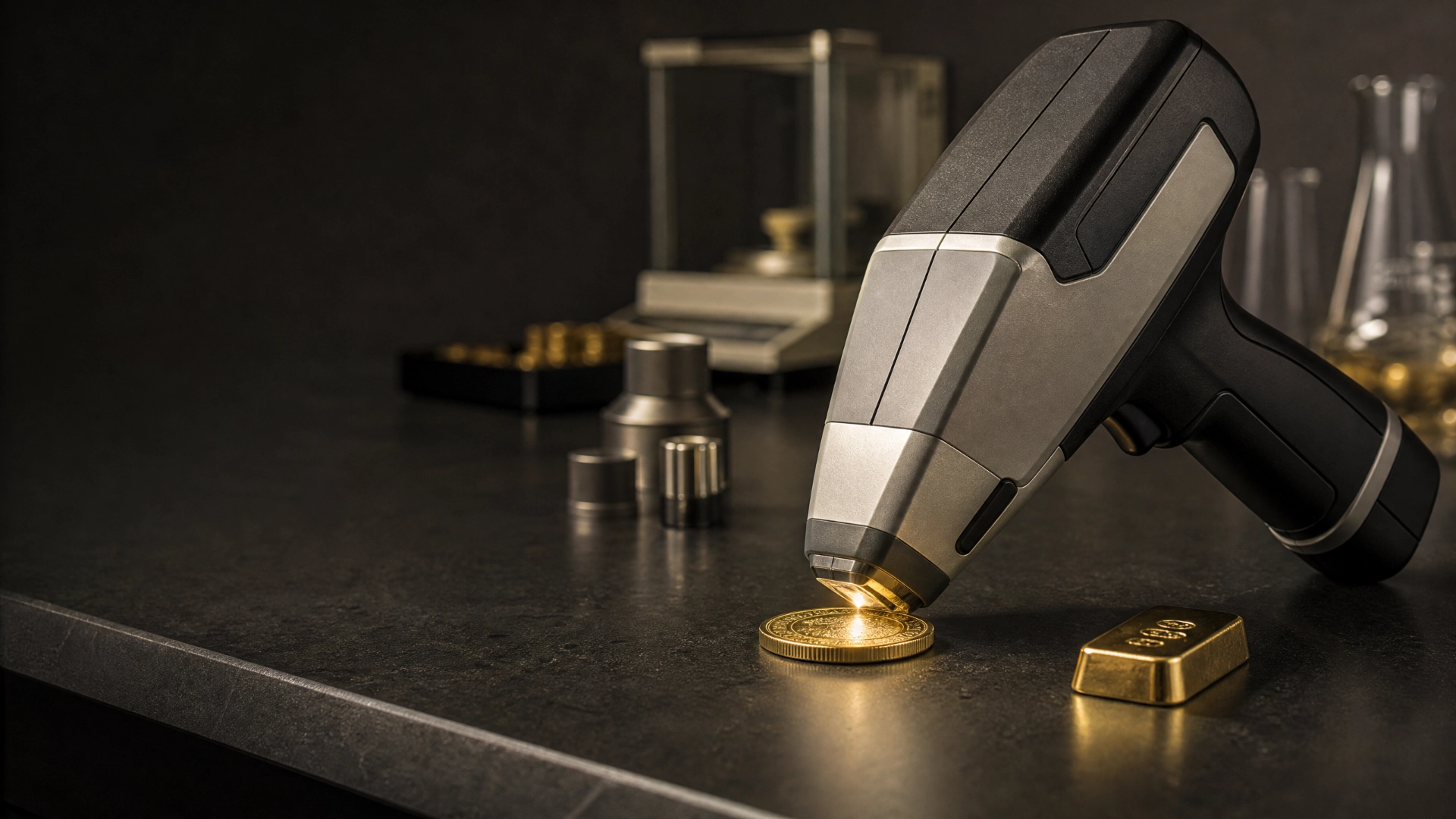
An XRF analyzer tells you which elements are present in the surface layer of the item pointed at it, and in what proportions, in seconds and without marking the piece. That is a genuinely useful answer, and it is a narrower one than most people assume. The gun reads a skin. It does not read what is underneath the skin, and the counterfeits that matter most are built precisely to exploit that.
This is an explanation of what the physics actually measures, what the number on the screen is and is not, the specific situations where an XRF reading can be misleading, and what closes the gap. It applies to gold jewelry, scrap and bars alike.
What the gun actually does
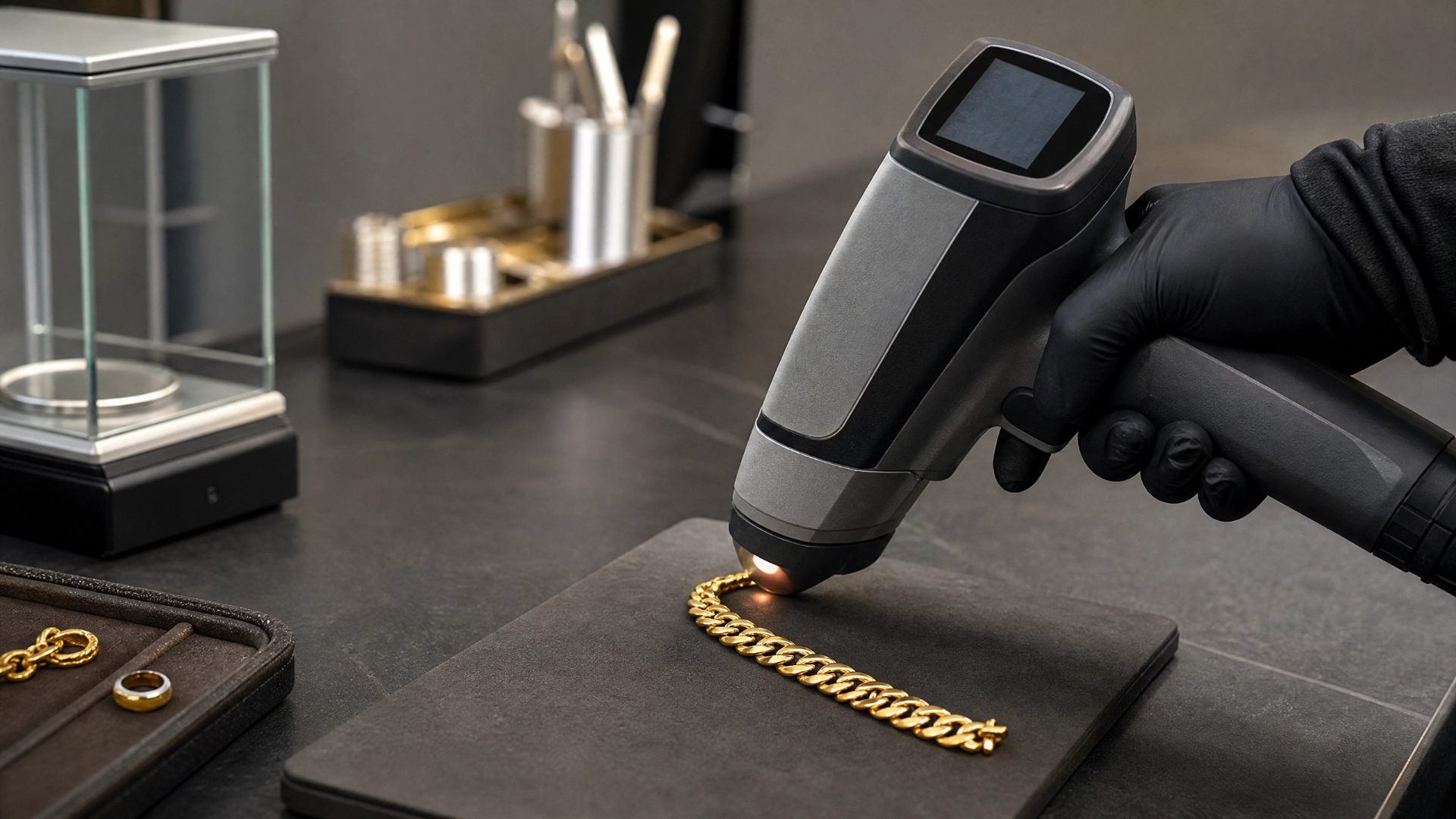
XRF stands for X-ray fluorescence. The instrument generates a beam of X-rays and directs it at the item. As the LBMA describes it, the beam "causes the atoms in its surface layer to emit characteristic X-rays" — every element emits at energies unique to it, so the detector can identify which elements are present and calculate what percentage of the material each one accounts for. Gold, silver, copper, zinc, nickel and palladium all announce themselves separately.
Nothing is removed, dissolved or scratched. The Goldsmiths' Company Assay Office in London, which hallmarks under statute, describes XRF as an "entirely non-destructive technique" that "gives the fineness of the metal in less than 30 seconds", and says it is used for the vast majority of its assaying work. That combination — fast, quantitative, harmless to the item — is why it sits on the counter of many buying operations, including ours.
What the reading on the screen is
The screen shows an elemental breakdown of the surface layer, usually expressed as percentages and often converted to a karat or a fineness. A reading of 75.2% gold with the balance in copper and silver is consistent with 18-karat gold. A reading that returns mostly copper and zinc with a thin gold signal is consistent with plated base metal.
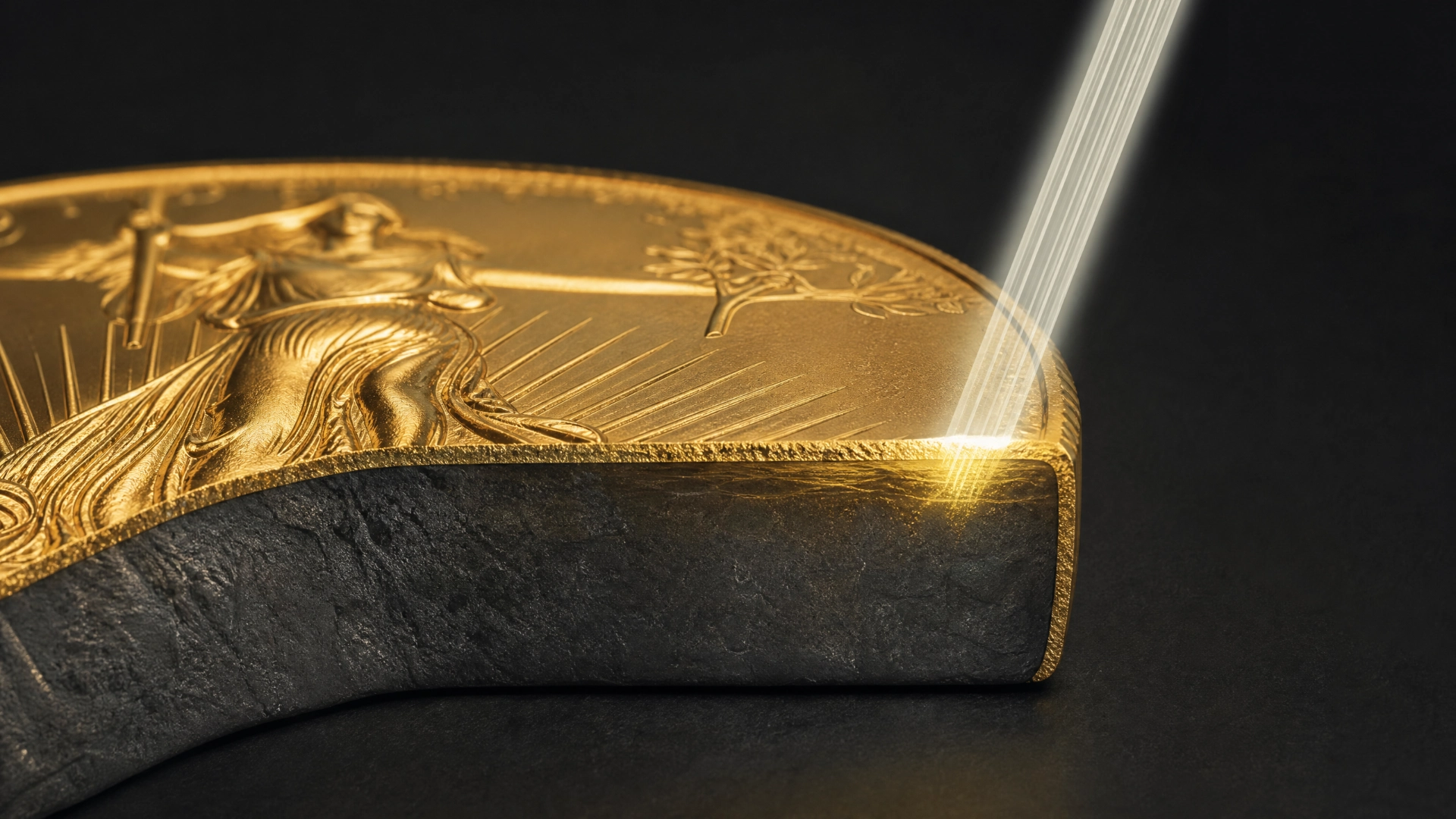
Two things that reading is not. It is not a valuation — composition is one input into what an item is worth, alongside weight, the metal market on the day, and whether the piece is worth more as an object than as metal. And it is not a statement about the interior. The LBMA is explicit on the point: "XRF testers only indicate the composition of the outermost surface layer", and to establish bulk composition the piece "must be cut to allow the internal surface to be examined". The same page notes the technique is "not as accurate as other forms of analysis", its advantage being speed rather than final authority.
Where an XRF reading can be fooled
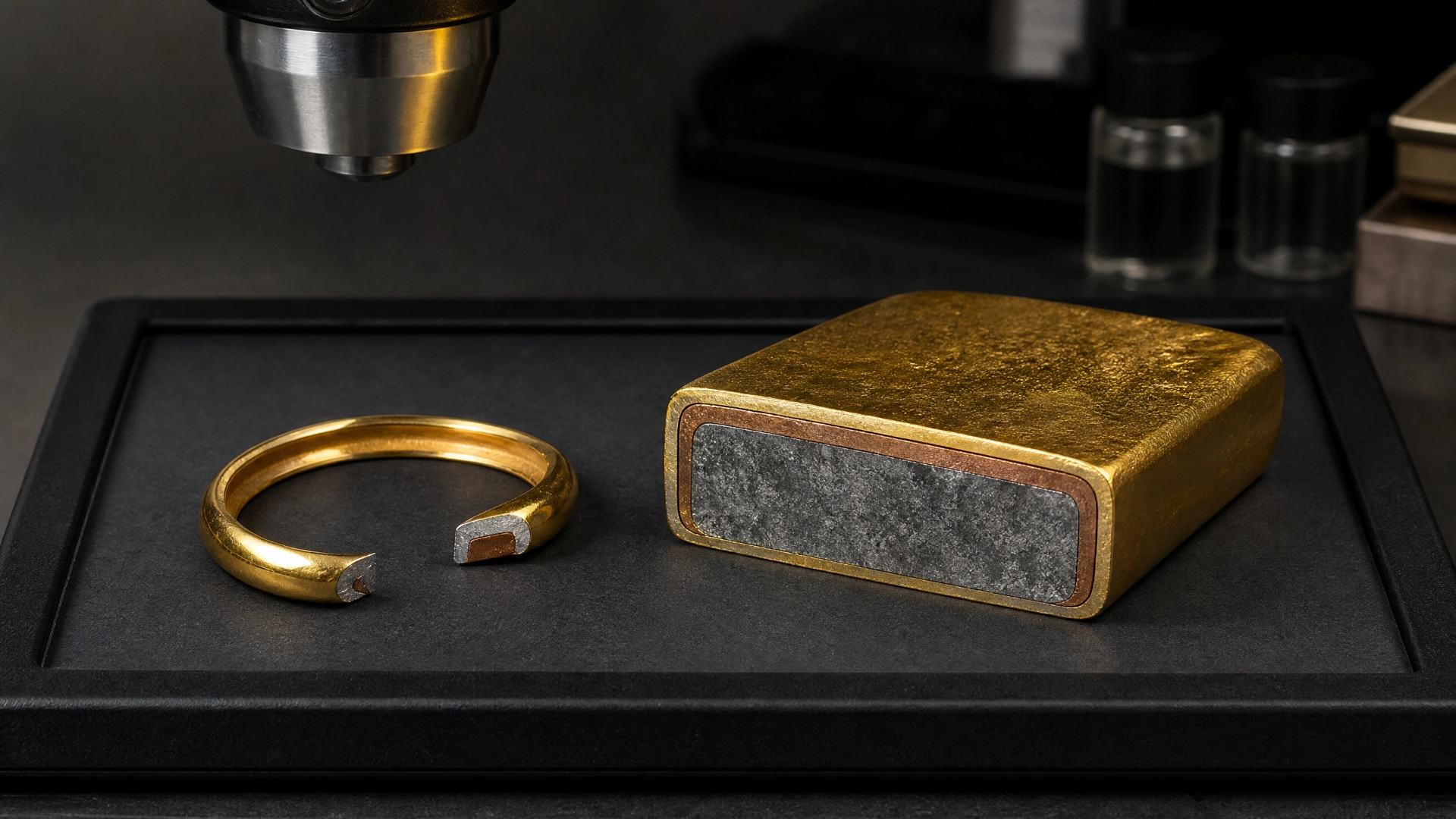
Every item in this table produces a confident, plausible number on the screen. The problem in each case is that the number is true about the surface and untrue about the object.
| Situation | What the gun sees | Why it is a problem |
|---|---|---|
| Heavy gold plating over base metal | Gold, at high purity | Where the plating is thicker than the layer the instrument samples, the base metal beneath contributes little or nothing to the reading. |
| Gold-clad tungsten or lead cores in bars | Gold, at the stated fineness | Tungsten's density is close to gold's, so weight-and-dimension checks pass too. The fill is beyond the gun's reach. |
| Surface-enriched cast or worked pieces | More gold than the alloy contains | Some manufacturing and finishing processes leave a gold-rich surface over a leaner interior. The Assay Office notes that "on occasion it may be necessary to remove the surface layer to ascertain the alloy underneath". |
| Rhodium, nickel or other coatings on jewelry | The coating, prominently | White-gold jewelry is routinely rhodium-plated. The reading needs interpreting rather than reading off. |
| Solder joints, settings and mixed construction | Whatever the beam happened to land on | A clasp, a solder seam and the body of a chain can be three different alloys. One shot is one spot. |
| Small, thin, curved or dirty surfaces | A distorted reading | Geometry, coatings of dirt or polish, and pieces smaller than the measurement window all degrade accuracy. |
Note what these have in common. None of them is a failure of the instrument — the gun answers the question it was built to answer, correctly, every time. The failure mode is human: treating a surface measurement as a statement about the whole object. A buyer who understands that is hard to deceive. A buyer who thinks the gun settles the matter is exactly who a gold-clad tungsten bar is made for.
XRF versus the acid test
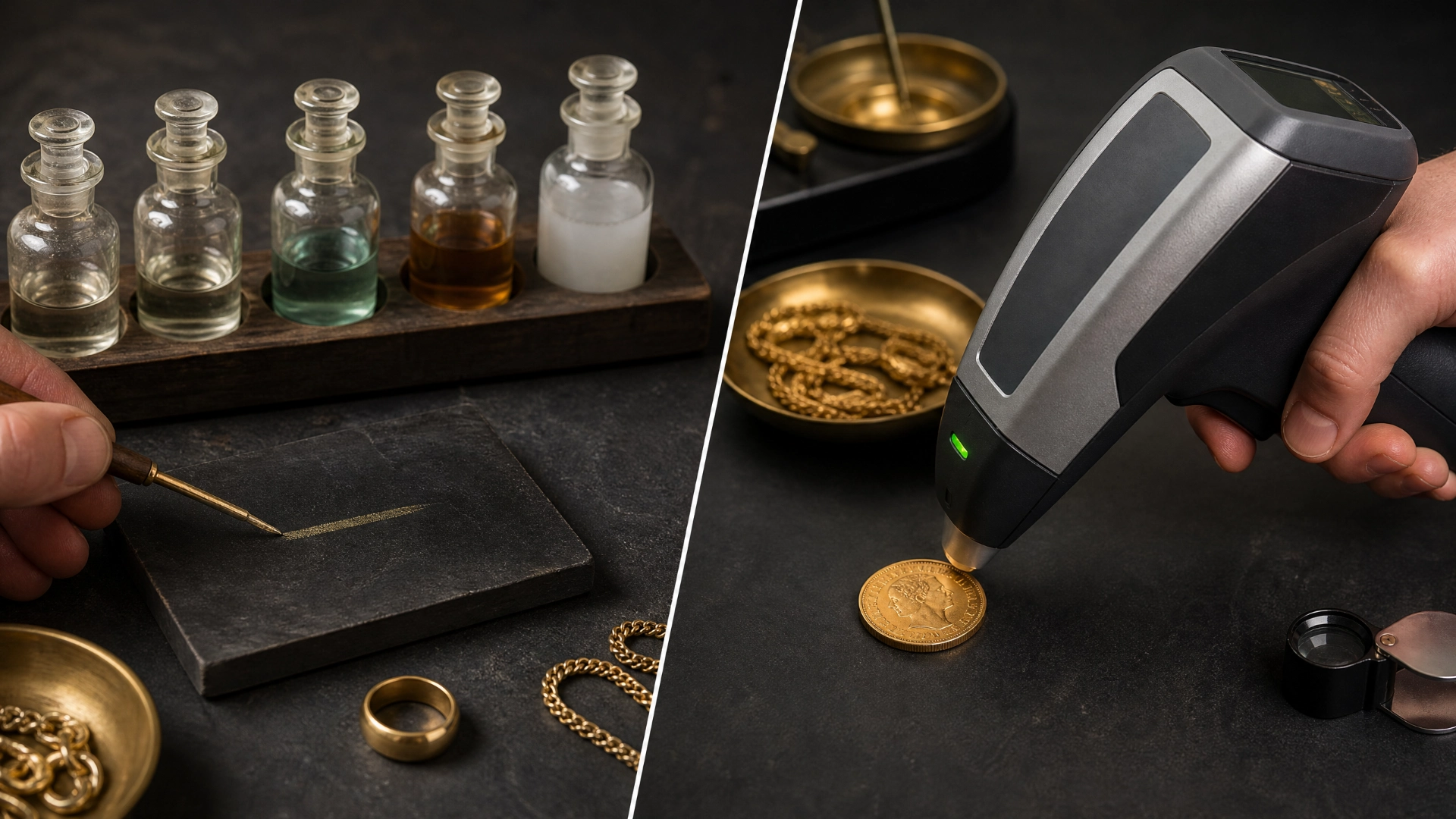
The acid or touchstone test is the older method and still in wide use. A small amount of metal is rubbed onto a stone and acids of graduated strength are applied; the mark survives or dissolves, placing the metal in a karat bracket. It is cheap, portable and needs no power.
| Acid / touchstone test | XRF analysis | |
|---|---|---|
| Result | A karat bracket — above or below a threshold | Percentages for each element detected |
| Effect on the item | Requires a rub or scratch; leaves a mark | Non-destructive; nothing is removed |
| Depth reached | Surface, unless deliberately filed deeper | Surface layer only |
| Other elements | Not identified | Identified and quantified |
| Speed | Minutes, per test | Seconds |
| Fooled by plating? | Yes, unless the tester files through it | Yes |
The honest summary is that XRF is faster, quantitative and leaves no mark, while a filed acid test — one where the tester deliberately cuts below the surface first — reaches deeper than an unaided XRF shot does. They fail in the same place for the same reason, which is why neither is the last word on a sealed bar.
What closes the gap
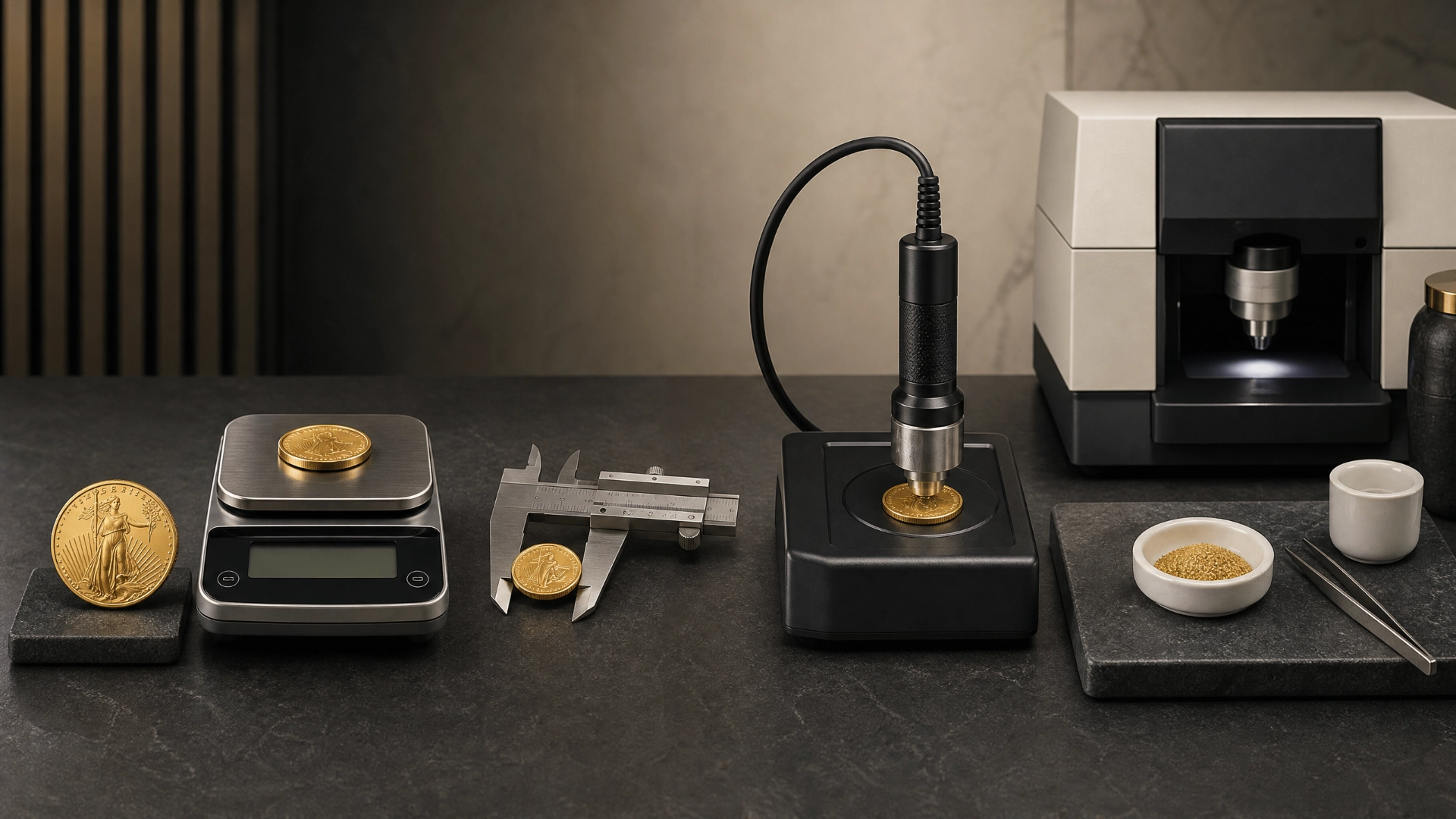
Where XRF cannot settle the question, the industry's toolkit divides into checks that leave the item intact and methods that do not.
- Weight and dimensions against published specifications. Sovereign coins are struck to tight tolerances that the issuing mint publishes; a piece that is off-weight or off-diameter has already answered the question.
- Specific gravity. Density is a bulk property rather than a surface one, which is what makes it a useful complement — though it is defeated by fills chosen for density, tungsten being the obvious case.
- Ultrasonic and conductivity testing. Both probe below the surface without damaging the item, and both are read alongside the XRF result rather than instead of it.
- Cutting or drilling. Crude, conclusive, and the LBMA's stated route to a bulk composition on a finished bar.
- Fire assay (cupellation). Fire assay is the referee method — the one used to settle a dispute between other results — and is standardized internationally as ISO 11426. A sample is melted and the gold separated and weighed. The LBMA's own account of refining practice calls fire assay the method that "remains the 'gold' standard for accuracy" for those producing, purchasing or toll-treating doré bars — the impure bars a mine or refinery ships before final refining.
- ICP analysis. ICP is inductively coupled plasma spectrometry: the sample is dissolved and analyzed in a plasma torch, giving trace-level detail that XRF cannot reach.
The last three destroy or damage the sample, so they are not a first step at a retail counter. The sequence that works is: non-destructive tests first, and escalate only where they disagree with each other or with the item's appearance.
To be plain about our own counter: we test by XRF, in front of you. Where a piece needs more than XRF can settle, that is work for an assayer or a refiner rather than for a retail counter — and we will say so rather than guess.
This article is educational and reflects general information about precious metals and collectible coins. It is not investment, tax or legal advice, and The Bullion Bank is not a registered investment adviser, broker-dealer or tax professional. Metal prices fluctuate and past performance does not indicate future results. Consult a qualified professional about your own situation.
What testing looks like at a Northern Virginia counter
We assess metal content and purity by XRF analysis in front of the customer, rather than taking the item into a back room, and we make an offer against live market pricing on the day, with payment on acceptance; what we take at the counter is listed on our cash for gold page. Watching the reading happen is part of the point: you see the same screen we do, and you can ask what a given line means.
Two things you should expect that have nothing to do with the testing. First, identification. Under Code of Virginia § 54.1-4102, a precious metals dealer must see an unexpired government photo ID showing your current legal address, plus corroborating identification, and § 54.1-4101 requires the dealer to record the transaction, keep a digital image of that identification for 24 months, and deliver the record to local law enforcement within 24 hours. Second, the item stays put: § 54.1-4104 requires a purchased item to be kept unaltered, unsold, and inside the county, city or town where it was bought for at least 15 calendar days, counted from the day the local chief law-enforcement officer receives the bill of sale.
That holding period applies to us and what we may do with the item. It does not delay your payment, which is settled when you accept the offer.
If you want the background reading first, we have written separately on authenticating gold and silver coins, and on how to read spot prices, premiums and dealer spreads.
Frequently asked questions
How accurate is an XRF analyzer on gold?
On a clean, flat, homogeneous surface it is accurate enough that the London Assay Office uses it for the vast majority of its assaying work. Accuracy degrades on curved, tiny, coated or dirty surfaces, and the result describes only the surface layer regardless of how precise it is. Precision and representativeness are different things: a very exact measurement of a plated skin is still a measurement of a plated skin.
Can XRF detect a tungsten-filled gold bar?
Not on its own, if the gold layer is thicker than the depth the instrument samples — the reading comes back as gold because the gold is what the beam reaches. Tungsten also has a density close to gold's, so a weight-and-size check does not catch it either. Detection normally means a method that reaches the interior: ultrasonic testing, cutting the bar, or assay.
Does XRF damage a coin or piece of jewelry?
No. Nothing is removed, dissolved or scratched, which is why it is used on hallmarked goods and graded coins. This is its main practical advantage over acid testing, which needs a rub on a stone and leaves a mark.
Is XRF better than the acid test?
For most purposes at a buying counter, yes — it is faster, it quantifies every element rather than giving a pass-or-fail bracket, and it leaves no mark. But both read the surface, so both can be misled by plating in the same way. An acid test performed after filing through the surface reaches deeper than an unaided XRF shot.
Why does the dealer need my ID to sell a gold bracelet?
Because Virginia law requires it. § 54.1-4102 sets the identification standard, § 54.1-4101 requires the record and the digital image of the ID to be kept for 24 months and reported to law enforcement within 24 hours, and § 54.1-4103 prohibits purchases from anyone under 18. It is a statutory requirement on the dealer, not a shop policy, and it applies to every precious metals dealer operating under Chapter 41, which under § 54.1-4108 requires a permit from the chief law-enforcement officer of each jurisdiction where the dealer buys.
Bring it in and watch the reading
Whether you are checking an inherited bracelet, a bar bought online or a coin you are unsure about, the test takes seconds and you can watch it happen. Both locations do this at the counter.
Chantilly
The Bullion Bank
4086 Airline Pkwy
Chantilly, VA 20151
(703) 705-5151
Monday–Friday 11:00 a.m. – 6:00 p.m. · Saturday 11:00 a.m. – 5:00 p.m. · Sunday closed
Chantilly location
Vienna
The Bullion Bank
131 Maple Ave W
Vienna, VA 22180
(703) 705-5252
Monday–Friday 11:00 a.m. – 6:00 p.m. · Saturday 11:00 a.m. – 5:00 p.m. · Sunday closed
Vienna location