Published by
Gold Expert
24K gold is the top of the karat scale, but the fineness behind "24K" on jewelry varies by market: India's highest hallmark grade is 24KS(995), or 99.5% gold, and a 1999 World Gold Council paper put Chinese-market 24K at a minimum of 99.0%, while 22K is 22 parts in 24, or 91.67%. The gold price per gram for either starts with the day's price per troy ounce divided by 31.1035, then multiplied by the purity. A jeweler's price per gram and a buyer's offer per gram both sit away from that figure, for different reasons, and knowing why is most of what you need before you buy or sell high-karat jewelry.
Is 24K gold pure?
24K gold is as close to pure as jewelry gets, but it is a range rather than a single number. A karat is one twenty-fourth part, so 24 karat means 24 parts gold in 24, and 22 karat means 22 parts gold in 24.
In US advertising rules the word is precise. Under the FTC Jewelry Guides, using the word "gold" without qualification is misleading for a product that is not composed throughout of fine (24 karat) gold, per 16 CFR 23.3(b)(1). What "fine" means in practice depends on the market and the product:
- US bullion: the US Mint describes the American Gold Buffalo as 99.99% gold and as its first .9999 fine 24-karat coin, on its bullion coin programs page
- Indian hallmarked jewelry: the Bureau of Indian Standards lists its highest jewelry grade as 24KS(995), meaning 99.5% gold, in its hallmarking FAQ
- Chinese-market 24K jewelry: known as chuk kam, it was defined at the time as a minimum of 99.0% gold in the main markets of the region, and 99.5% or higher elsewhere, according to a 1999 Santa Fe Symposium paper by Christopher Corti of the World Gold Council
So 24K jewelry is high-purity gold, but the last decimal place varies. For the full karat-to-fineness table, see karat versus fineness.
24K vs 22K vs 18K: what changes in the jewelry
The lower the karat, the more alloy metal there is, and the alloy is what makes gold harder. Pure gold is soft; adding silver, copper and other metals trades some gold content for strength and changes the color.
| Karat | Gold share | Fineness mark | Annealed hardness (Corti, 1999) |
|---|---|---|---|
| 24K | 99.0% or more in jewelry, by market; 99.99% in the Gold Buffalo | 990 or 995 and up in jewelry; 9999 on the Gold Buffalo | about HV 20-30 (chuk kam) |
| 22K | 91.67% | 916 | about HV 52 (standard yellow) |
| 18K | 75% | 750 | about HV 150 (standard yellow) |
HV is the Vickers hardness number, a laboratory measure of how far a material resists an indenter; a higher number means a harder metal. The figures are Corti's for annealed (softened) metal. Work-hardening during manufacture raises all three, and in his figures 24K still finishes well below the other two.
That gap is the practical answer to "24K gold vs 18K". An 18K piece contains three-quarters gold and is several times harder in Corti's figures; a 24K piece contains nearly all gold and dents and scratches far more easily. Corti noted that a 24K gold with better strength and hardness would be welcomed by consumers, which is the problem his paper on microalloyed 24K golds set out to address. 22K sits between them, and it is one of the standard grades in the Indian hallmarking scheme.
How a 24K or 22K price per gram is worked out
The gold price is quoted per troy ounce, and a troy ounce is about 31.1035 grams, as our troy ounce guide explains. Divide the day's price per troy ounce by 31.1035 and you have the value of one gram of pure gold.
From there, multiply by the purity:
- 24K at 999: price per gram of pure gold × 0.999
- 22K: price per gram of pure gold × 0.9167
- 18K: price per gram of pure gold × 0.75
If a gram of pure gold were 100 units on a given day, a gram of 22K would contain 91.67 units of gold and a gram of 18K would contain 75. The ratio holds whatever the price does. Today's figure is on the live price ticker on our homepage; we do not print a price here because it would be out of date by tomorrow.
That calculation gives the metal value per gram. It is not what a jeweler charges, and it is not what a buyer pays, and confusing the three is where most disappointment at resale comes from.
| Price per gram | What it includes | Where you see it |
|---|---|---|
| Metal value | Gold content at the day's price, nothing else | Your own calculation from the spot price |
| Retail jewelry price | Gold content plus a making charge for design and workmanship, and the seller's margin | A jewelry store's tag or invoice |
| Buyer's offer | Fine gold content at a buy price, after refining cost and the buyer's margin | A dealer's or refiner's written offer |
Making charges are explained in our article on Diwali and Dhanteras gold, and where a buyer's margin sits is covered in how a scrap gold offer is calculated.
Hallmarks on Indian 22K and 24K gold jewelry
Indian gold jewelry hallmarked under the Bureau of Indian Standards scheme carries three marks: the BIS logo, the purity grade, and a six-digit alphanumeric code called the HUID. The purity grade combines karat and fineness, as in 22K916.
The BIS lists six jewelry grades: 14K(585), 18K(750), 20K(833), 22K(916), 23K(958) and 24KS(995). The HUID, short for Hallmark Unique Identification, is unique to each hallmarked item and traceable, and the BIS FAQ says it was introduced on 1 July 2021. Consumers can check an HUID with the "Verify HUID" feature in the BIS Care app.
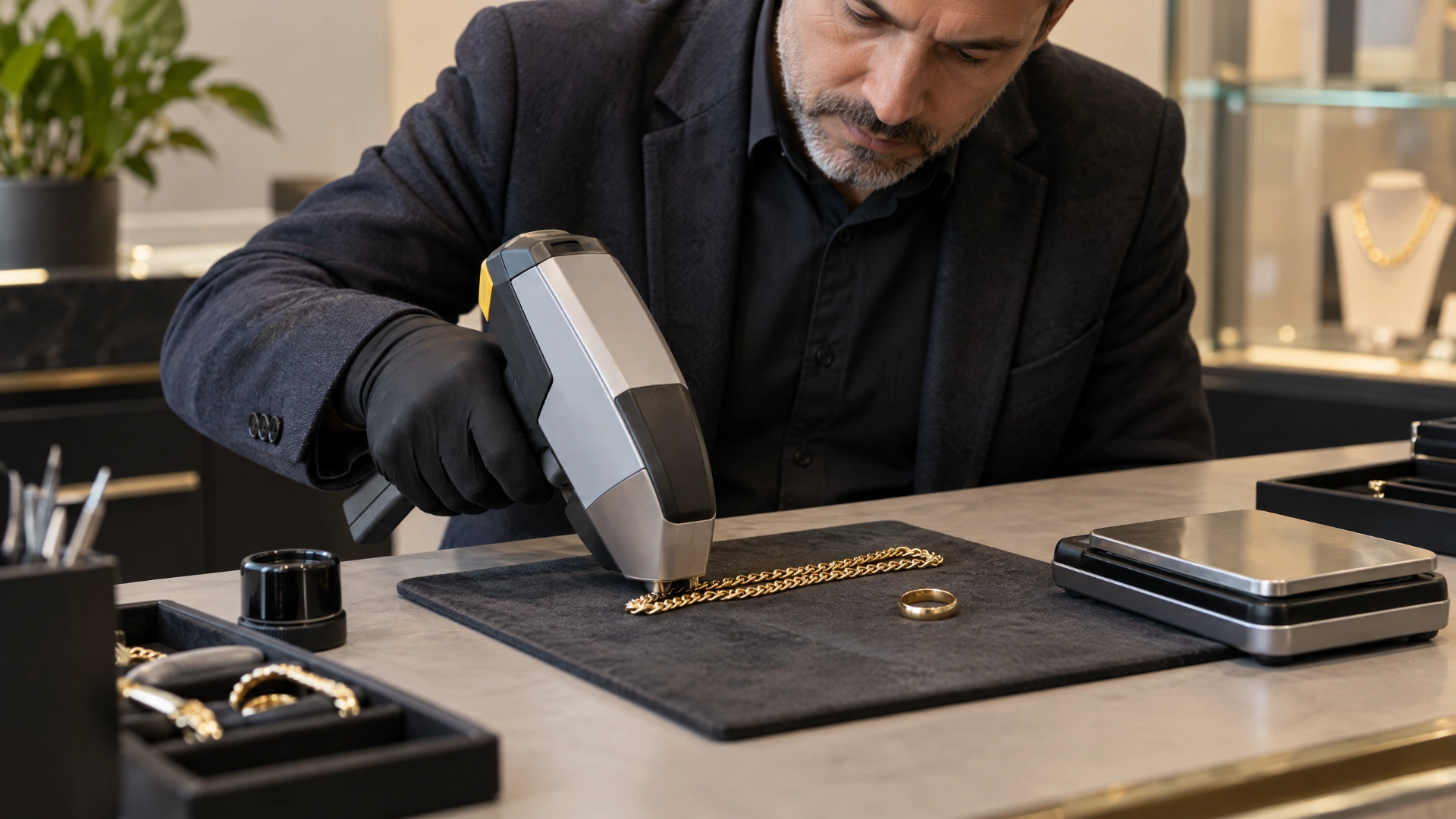
Two things follow. A piece made before mid-2021 may carry an older hallmark with no HUID, which does not by itself mean anything is wrong. And any hallmark is the maker's or assayer's statement of purity, not a test done in front of you, which is why at our counter we measure the piece rather than rely on the mark.
In the US the National Gold and Silver Stamping Act sets how far a marked article may fall short of its mark. Tested without solder, gold may be no more than three parts per thousand below the stated fineness; tested as a whole article including solder, ordinary jewelry may be no more than seven parts per thousand below, under 15 U.S.C. § 295. A soldered 22K chain can therefore assay slightly under 916 overall and still sit within the US standard. Pieces bought abroad were marked under that country's rules.
What a buyer measures when you resell 22K or 24K jewelry
A buyer pays for fine gold, which is the weight of gold alone after purity is applied, not for the gross weight of the piece. Anything in a 22K or 24K piece that is not gold is set aside before the gold is valued.
- Stones, beads, enamel and cords: weighed out or estimated, because they add weight but no gold
- Hollow or filled pieces: a filling adds weight and no gold, and a hollow piece contains less gold than its size suggests
- Clasps, springs and findings: sometimes a lower karat or a different metal from the body of the piece
- Solder: part of the whole-article fineness, as the Stamping Act tolerance reflects
What does not come back at resale is the making charge. The workmanship you paid for when you bought a 22K necklace is real, but a gold buyer prices metal, so the offer reflects gold content rather than the original invoice. Pieces with genuine design or brand value are a separate conversation from melt value.
At our counter, metal content and purity are measured by X-ray fluorescence (XRF) analysis, which can identify 26 different metals. XRF reads the surface of an item, which is why plated and filled pieces need care; our article on XRF gold testing covers what it can and cannot see.
Selling jewelry in Virginia comes with an identification requirement that coins do not. Under Va. Code § 54.1-4102, a dealer must see an unexpired government photo ID with your current legal address and at least one other corroborating form of identification, and take a statement of ownership from you. If the ID does not show your current address, you present other documentation verifying it. The rest of the state's dealer rules are in our guide to Virginia precious metals dealer law.
Bringing 22K or 24K gold to The Bullion Bank
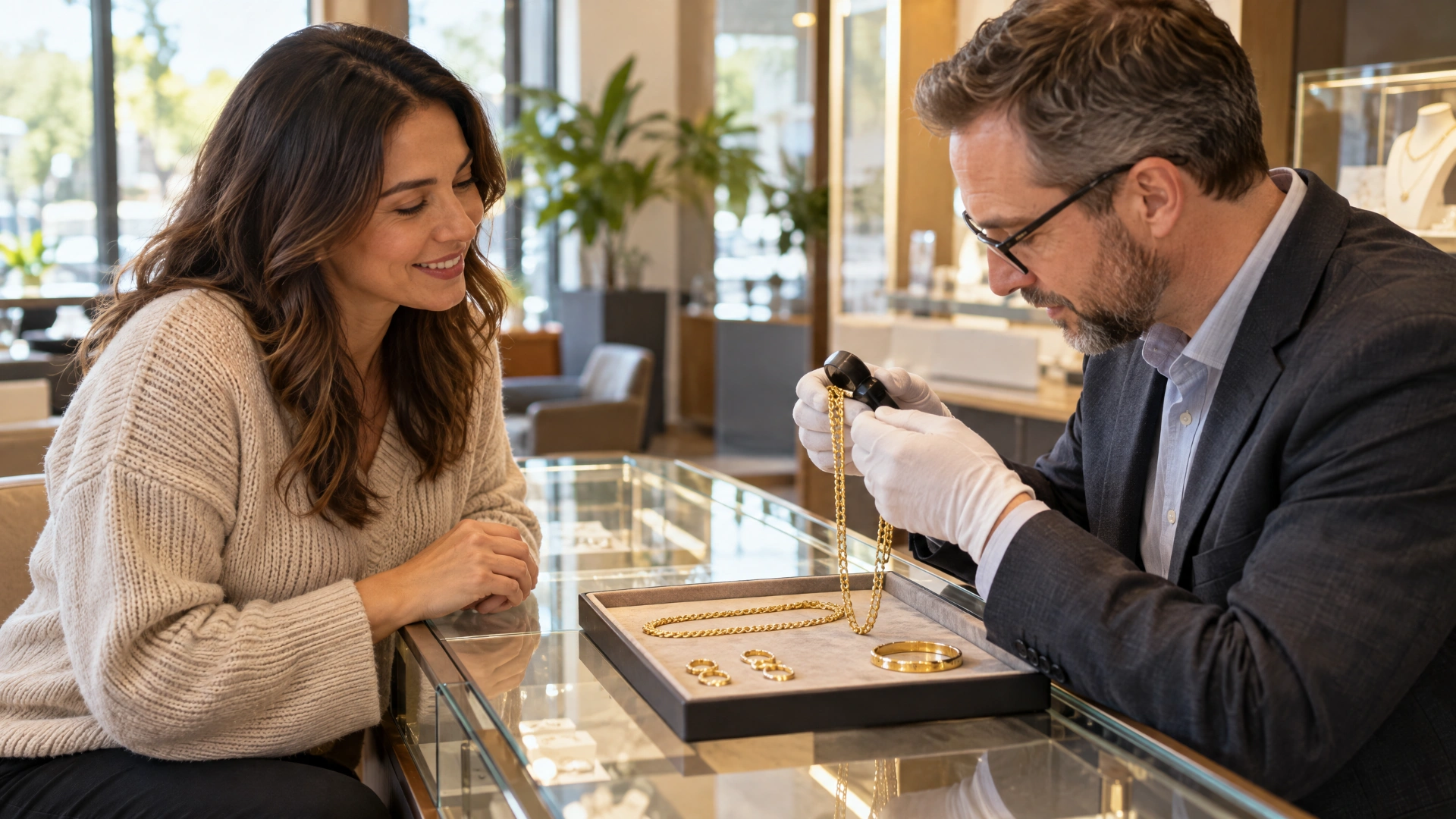
We buy gold jewelry at both our Chantilly and Vienna counters, including broken, tangled or mismatched pieces. We test and evaluate everything in front of you, make a same-day offer based on current precious metals prices, and pay the same day if you accept the offer. Asked whether an appointment is needed, our FAQ answers: "No. Walk-ins are welcome during normal business hours."
Our site says "The only thing we do not buy is gold plate." If a piece may be gold-filled or vermeil, ask at the counter; our guide to gold-filled versus gold-plated jewelry explains the difference. Jewelry can also be converted to bullion rather than cash. If you are comparing high-karat jewelry with coins, the American Gold Eagle is struck to the 22-karat standard, at 91.67% gold with 3% silver and the balance copper per the US Mint, and the American Gold Buffalo is 24-karat at .9999.
This article is educational and reflects general information about precious metals and collectible coins. It is not investment, tax or legal advice, and The Bullion Bank is not a registered investment adviser, broker-dealer or tax professional. Metal prices fluctuate and past performance does not indicate future results. Consult a qualified professional about your own situation.
Frequently asked questions
Is 24K gold pure?
24K gold is the top of the karat scale and is treated as fine gold, but its exact purity depends on the product and market. US Gold Buffalo coins are .9999, Indian hallmarked jewelry tops out at the 24KS(995) grade, and Chinese-market 24K jewelry was described in a 1999 World Gold Council paper as a minimum of 99.0%. Read the fineness number, not only the karat.
How do I calculate the 24K gold price per gram?
Divide the day's gold price per troy ounce by 31.1035 to get the value of one gram of pure gold, then multiply by 0.999 for 24K stamped 999. That is the metal value only. A jeweler's price per gram adds a making charge and margin, and a buyer's offer per gram is lower because it reflects refining and the buyer's costs.
What is the 22K gold price per gram compared with 24K?
22K gold is 22 parts in 24, or 91.67% gold, so its metal value per gram is about 91.67% of the value of a gram of pure gold on the same day. The ratio stays the same whatever the gold price does. Retail prices for 22K jewelry also include making charges, which vary from piece to piece.
What is the difference between 24K and 18K gold?
18K gold is 75% gold and 25% other metals, while 24K is essentially all gold. The alloy makes 18K much harder: in figures published by Christopher Corti of the World Gold Council, annealed 18K yellow gold measured about HV 150 against about HV 20-30 for 24K chuk kam. 24K is richer in gold but marks and bends more easily.
Does The Bullion Bank buy Indian 22K gold jewelry?
Yes. We buy gold jewelry, including broken pieces, at our Chantilly and Vienna counters, and test every piece by XRF in front of you before a same-day offer. Bring an unexpired government photo ID plus one other form of identification, as Va. Code § 54.1-4102 requires for jewelry; if your ID shows an old address, also bring a document showing your current one. Ask how any stones will be handled.
Visit The Bullion Bank in Chantilly or Vienna
Bring your 22K or 24K pieces to either store and we will show you how the offer is built from the gold they contain.
The Bullion Bank - Chantilly
4086 Airline Pkwy
Chantilly, VA 20151
(703) 705-5151
Monday-Friday 11:00 AM-6:00 PM · Saturday 11:00 AM-5:00 PM · Sunday closed
The Bullion Bank - Vienna
131 Maple Ave W
Vienna, VA 22180
(703) 705-5252
Monday-Friday 11:00 AM-6:00 PM · Saturday 11:00 AM-5:00 PM · Sunday closed