Published by
Gold Expert
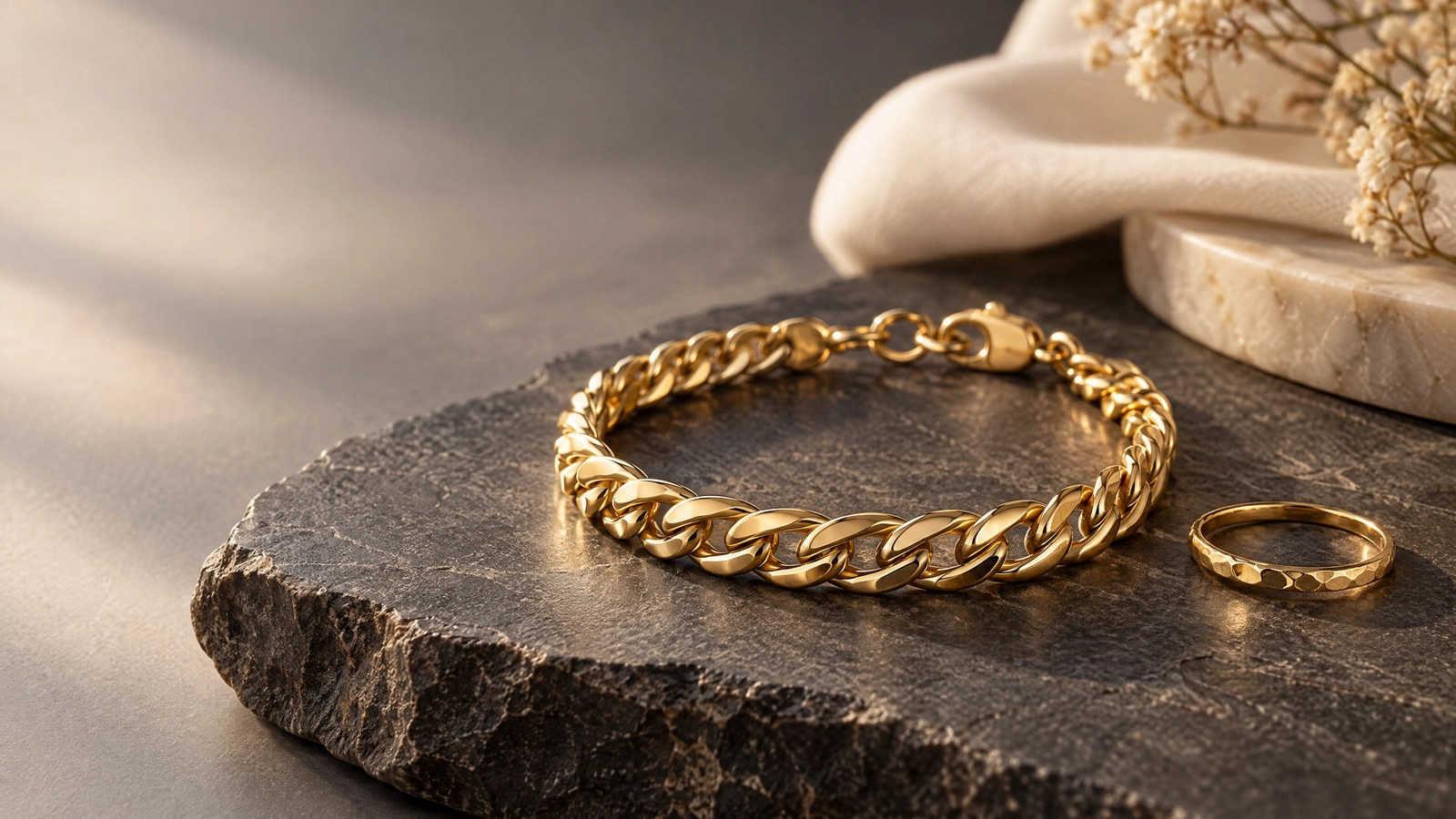
Gold-filled and gold-plated jewelry both have a gold surface, usually over a base-metal core, but gold-filled usually carries far more gold: under the Federal Trade Commission's jewelry guides, a gold-filled layer must make up at least 1/20 of the item's metal weight, while a gold electroplate can be as thin as 0.175 microns. Gold-filled has a measurable gold content; plated jewelry has very little.
The stamp tells you which one you have, and the numbers in it let you work out roughly how much gold is there. This guide reads each common mark, including 1/20 12K GF and HGE, and explains what that means if you want to sell.
What the federal rules say each term means
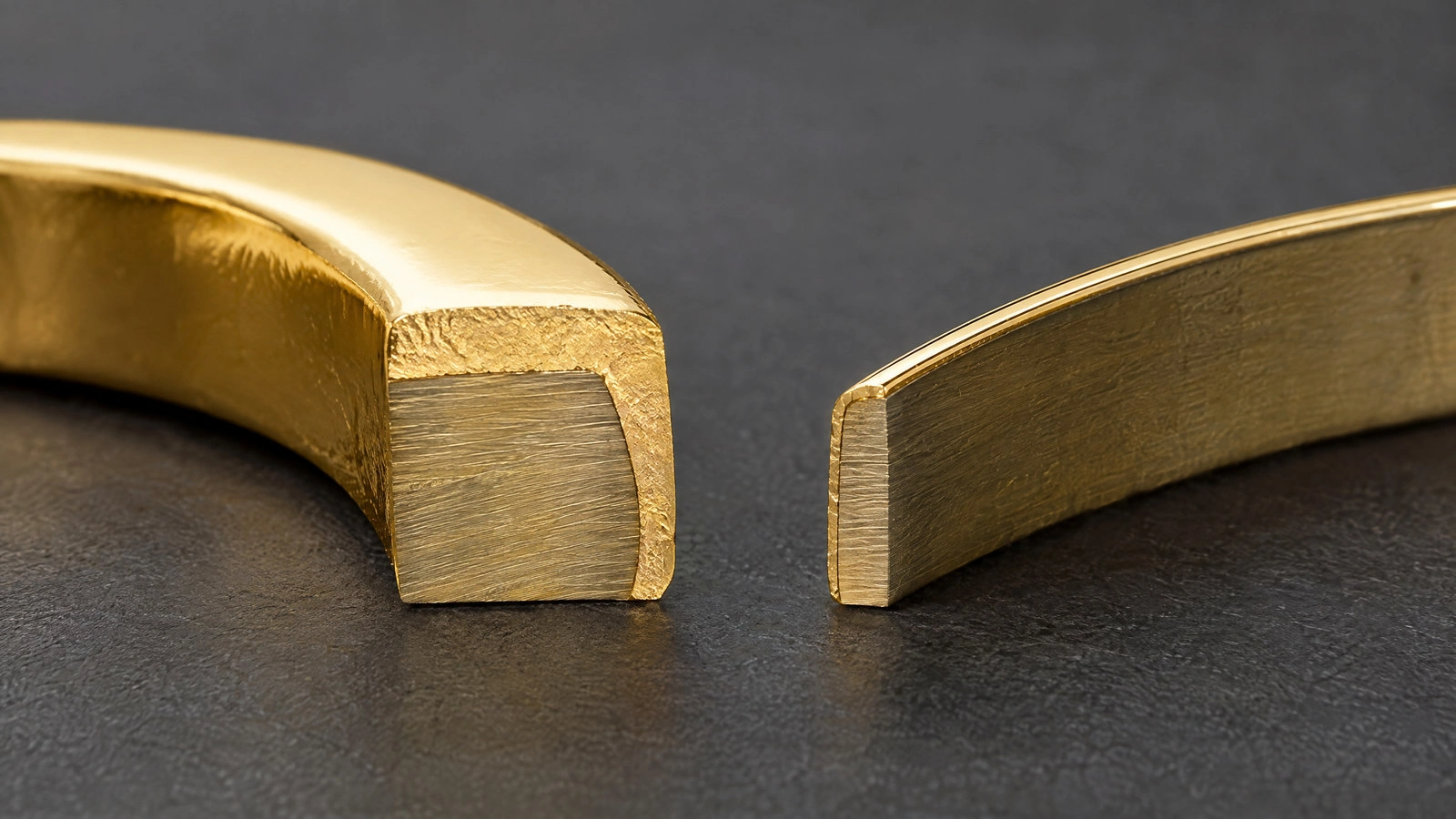
The definitions come from the FTC's Guides for the Jewelry, Precious Metals, and Pewter Industries, 16 CFR § 23.3, which sets out what a seller may call gold-filled, rolled gold plate or gold electroplate. Vermeil has its own section, § 23.4. For gold-filled, rolled gold plate, electroplate and vermeil, the gold layer must be at least 10 karat.
| Mark | Term | How the gold is applied | Minimum gold |
|---|---|---|---|
| GF, G.F. | Gold filled | Karat gold sheet bonded mechanically to a base metal | At least 1/20 of the item's metal weight |
| RGP, R.G.P. | Rolled gold plate, gold overlay | The same mechanical bonding, but a thinner layer | At least 1/40 of the metal weight |
| GEP, G.E.P. | Gold electroplate | Deposited by electrolysis | 0.175 microns of fine gold, about 7 millionths of an inch |
| HGE | Heavy gold electroplate | Deposited by electrolysis | 2.5 microns of fine gold, about 100 millionths of an inch |
| GP | Gold plate, gold plated | Any process | No number. The rule requires "reasonable durability" |
| Vermeil | Vermeil | Gold over a sterling silver base | 2.5 microns of fine gold, over sterling |
The key split is between the first two rows and the rest. Gold-filled and rolled gold plate are measured as a share of the item's weight. Electroplate is measured as a thickness. A weight share scales with the size of the piece, while a thickness of a few microns stays tiny however large the piece is.
What 1/20 12K GF means
The mark "1/20 12K GF" means that 12-karat gold makes up at least one-twentieth of the item's metal weight. It is two fractions multiplied together: the share of the item that is the gold layer, and the share of that layer that is pure gold.
- 1/20 means the gold layer is 5% of the metal weight.
- 12K means the layer is 12 parts gold in 24, or 50% gold.
- Together: 5% × 50% = 2.5% of the item's weight is fine gold.
A worked example: a 30-gram gold-filled bracelet marked 1/20 12K GF has a 1.5-gram layer of 12-karat gold. Half of that is pure gold, so 0.75 grams, or about 0.024 troy ounces. The other 28.5 grams are base metal, usually brass.
The same arithmetic works for any mark. 1/20 14K GF comes to about 2.9% fine gold. 1/10 14K GF, often seen on older watch cases, comes to about 5.8%. 1/40 10K RGP comes to about 1%.
What the HGE stamp means
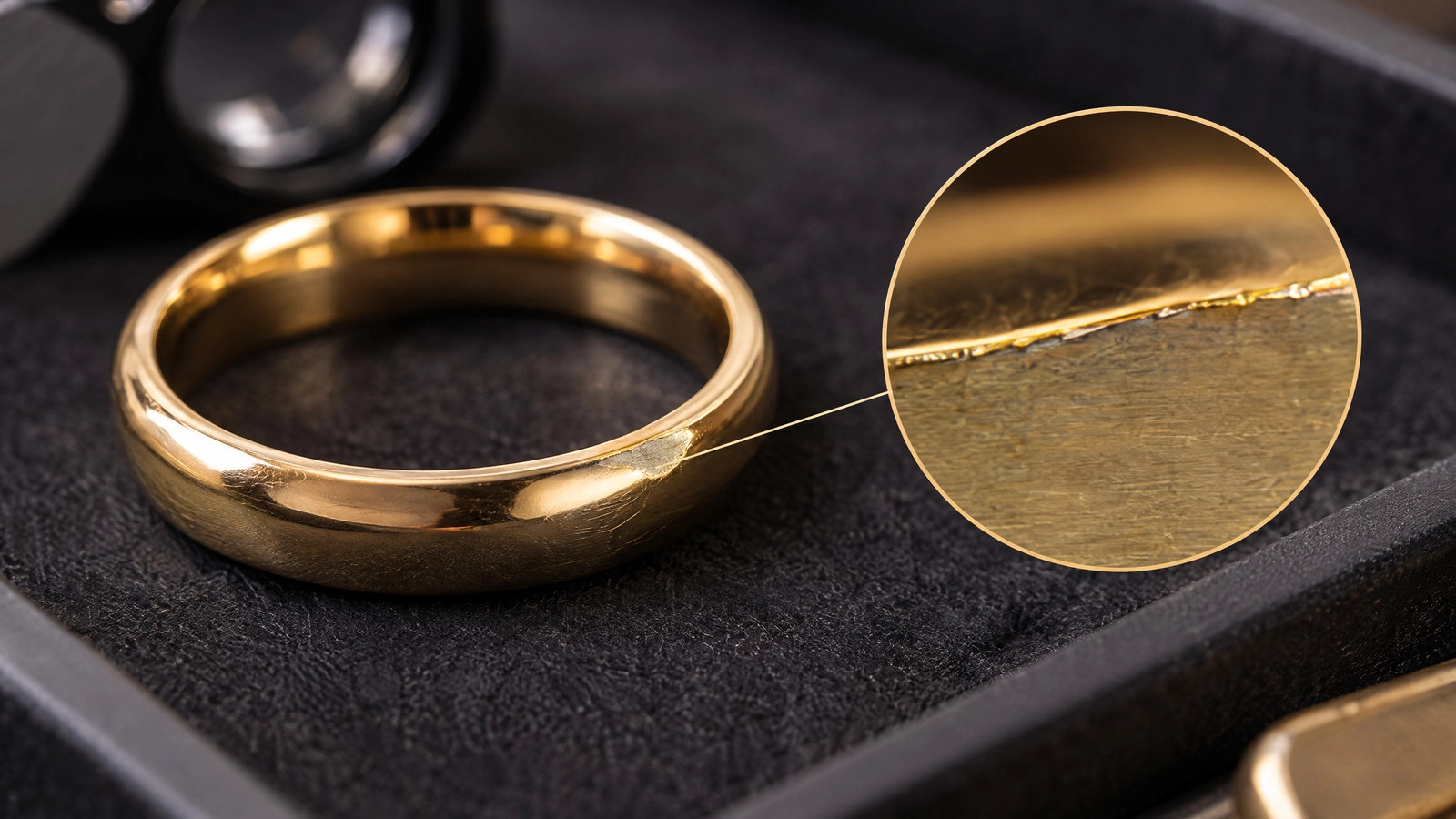
HGE stands for heavy gold electroplate: an electroplated layer at least 2.5 microns thick, measured as fine gold. A micron is a thousandth of a millimeter. That is roughly 14 times the 0.175-micron minimum for ordinary gold electroplate, which is why it is called heavy, but it is still a very thin film.
To show the scale, take a plain ring band with about 5 square centimeters of plated surface. Gold weighs about 19.3 grams per cubic centimetre. A 2.5-micron layer over that area holds roughly 0.024 grams of gold. The same ring with a 0.175-micron plate holds under 0.002 grams. These are illustrations with an assumed surface area, not a measurement of any particular piece, but the order of magnitude holds: an HGE ring carries a few hundredths of a gram of gold.
Compare that with the bracelet above. On a bracelet-sized piece, gold-filled gold is counted in tenths of a gram and plated gold in hundredths or thousandths; on very small items such as earrings, the gap narrows.
Why a karat mark on plated jewelry must say "plated" or "filled"

Federal law does not allow a plated or filled article to carry a bare karat mark. The National Gold and Silver Stamping Act, 15 U.S.C. § 297(a), says that a mark "usually employed to indicate the fineness of gold" must be accompanied by words showing that the article is gold plate, rolled gold plate, gold electroplate or gold filled. That is why you see "14K GF" or "12K HGE" rather than "14K" alone on these pieces.
Two practical consequences follow:
- Look at the whole stamp. A tiny "GF", "RGP" or "HGE" next to the karat number changes the gold content by a factor of twenty or more. It is often worn, so use a loupe.
- A stamp is a claim, not a test. Marks can be worn away, misapplied or false. A buyer confirms the metal before making an offer.
Testing layered pieces has its own trap. X-ray fluorescence (XRF) reads the surface, so a gold layer can read as karat gold even when the core is brass. We explain why in how XRF gold testing works, including what a reading can and cannot show on a layered piece.
Is gold-filled worth anything?
Gold-filled jewelry has real gold content, but it is a small share of the weight. That 30-gram bracelet holds 0.75 grams of fine gold, the same as about 1.3 grams of 14-karat jewelry. Its metal value is a fraction of a solid-gold piece of the same size, and that is before any buyer's costs of separating the gold from the base metal.
Whether a particular buyer takes gold-filled pieces at all, and on what basis, varies from buyer to buyer. At The Bullion Bank, ask at the counter whether gold-filled is accepted, and call ahead if you have a large lot. Some gold-filled pieces, such as signed vintage watch cases or period jewelry, may be worth more as items than as metal, and that is worth checking before anything is sold for scrap.
Can you sell gold-plated jewelry?
As scrap metal, generally not. A plated piece holds hundredths or thousandths of a gram of gold, too little for recovery to be worthwhile. Our cash for gold page states it directly: "The only thing we do not buy is gold plate."
That does not make plated jewelry worthless, only worthless as metal. Designer costume jewelry and well-made vintage pieces can have a resale market as jewelry, where condition, design and maker matter and the gold content does not.
Vermeil is the exception worth knowing. Its core is sterling silver, which is 92.5% silver, so a vermeil piece carries silver value in its sterling content even though its gold layer is as thin as heavy electroplate. Because vermeil is gold-plated silver, ask at the counter whether it is accepted. How silver items are weighed and priced is covered in sterling vs silverplate.
Bringing mixed jewelry to The Bullion Bank

Most jewelry boxes hold a mix of solid gold, gold-filled and plated pieces. At our Chantilly and Vienna counters, metal content is assessed by XRF analysis, which identifies 26 different metals. You receive a same-day offer based on live market pricing, and payment is made when you accept. Walk-ins are welcome during normal business hours.
Gold-filled jewelry is not a coin, and Virginia's dealer statute covers items composed in whole or in part of gold, so the identification rules in Va. Code § 54.1-4102 apply when you sell it: an unexpired government photo ID showing your current address, plus a second, corroborating form of identification. The full set of rules is explained in Virginia's precious metals dealer law.
This article is educational and reflects general information about precious metals and collectible coins. It is not investment, tax or legal advice, and The Bullion Bank is not a registered investment adviser, broker-dealer or tax professional. Metal prices fluctuate and past performance does not indicate future results. Consult a qualified professional about your own situation.
Frequently asked questions
What is the difference between gold-filled and gold-plated?
Gold-filled has a thick layer of karat gold bonded mechanically to a base metal, at least 1/20 of the item's weight under FTC rules. Gold-plated has a thin layer deposited by electroplating, with a minimum of 0.175 microns for "gold electroplate." Gold-filled therefore usually contains several to many times more gold than a plated piece of the same size.
What does 1/20 12K GF mean?
It means 12-karat gold makes up at least one-twentieth of the item's metal weight. Multiply the two fractions: 1/20 is 5%, and 12 karat is 50% gold, so about 2.5% of the item's weight is fine gold. A 30-gram piece marked this way holds about 0.75 grams of pure gold.
What does HGE stamped on jewelry mean?
HGE means heavy gold electroplate: a plated layer at least 2.5 microns thick, measured as fine gold, under 16 CFR § 23.3. It is thicker than ordinary electroplate but still a thin film. On a plain ring band it amounts to a few hundredths of a gram of gold, too little to be worth melting.
Is gold-filled jewelry worth anything?
Yes, it has real gold content, but usually only a few percent of its weight. The value depends on the fraction and karat in the stamp and on the piece's weight. Whether a buyer accepts gold-filled, and on what terms, varies, so ask before bringing a large lot. Some signed vintage pieces are worth more as jewelry.
Will The Bullion Bank buy my gold-plated jewelry?
No. Our cash for gold page states, "The only thing we do not buy is gold plate." Plated pieces hold too little gold to recover. If you are not sure which pieces in a box are plated, filled or solid, bring them in; metal content is assessed by XRF analysis at the counter.
Bring a Mixed Jewelry Box to The Bullion Bank
We have been buying and selling precious metals in Northern Virginia since 2008. Bring your jewelry to either location; no appointment is needed.
The Bullion Bank — Chantilly
4086 Airline Pkwy
Chantilly, VA 20151
(703) 705-5151
Mon–Fri 11:00 am–6:00 pm · Sat 11:00 am–5:00 pm · Sun closed
The Bullion Bank — Vienna
131 Maple Ave W
Vienna, VA 22180
(703) 705-5252
Mon–Fri 11:00 am–6:00 pm · Sat 11:00 am–5:00 pm · Sun closed