Published by
Gold Expert
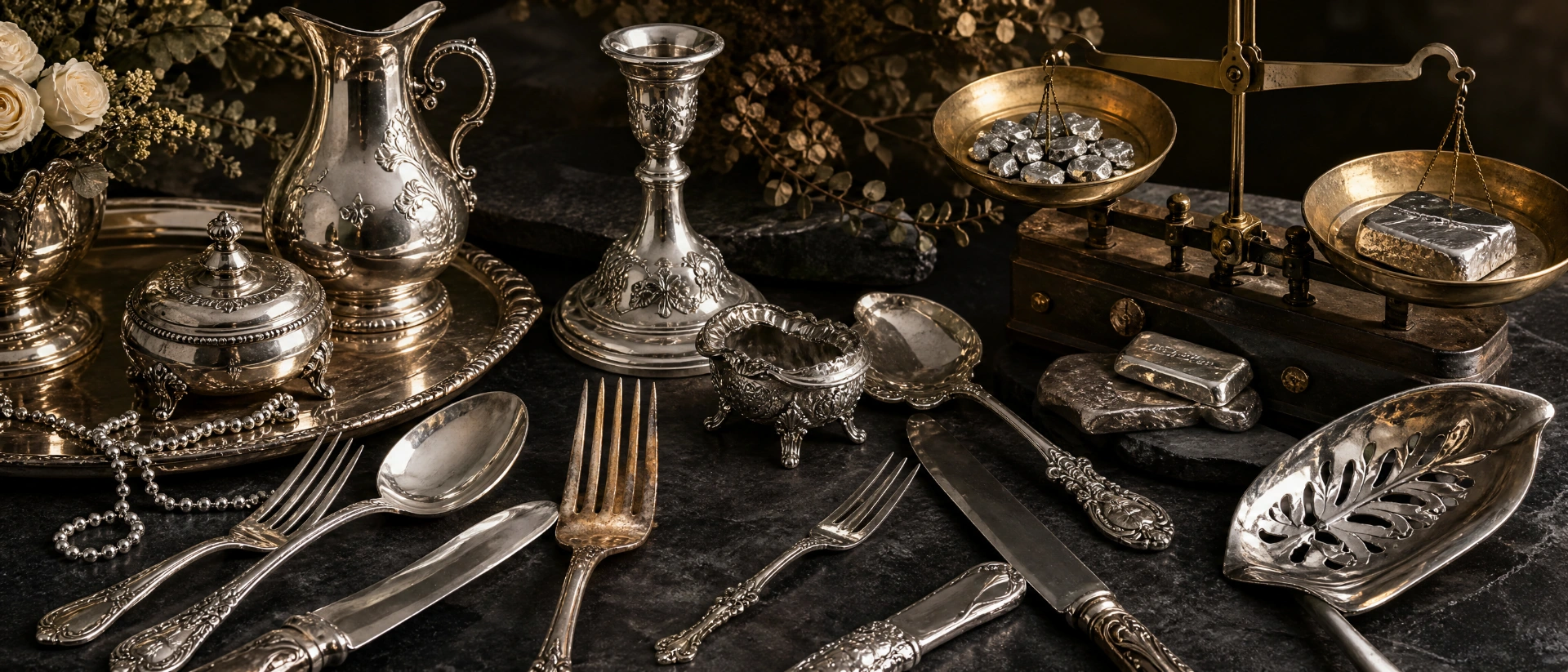
Sterling flatware is solid silver alloy throughout — 925 parts silver per thousand — and it is bought on weight. Silverplate is a base metal object with a microscopically thin layer of silver deposited on the surface, present in quantities that are not economically recoverable at normal refining costs, so it is bought — when it is bought at all — as tableware rather than as metal. The fastest way to tell them apart is the mark, and federal law is what makes the mark reliable: a plated article may not legally be stamped "sterling" or "coin". This article explains the standards, the marks, what a weighted handle does to the scale, and how a flatware or hollowware lot is actually worked out at the counter.
This article is educational and reflects general information about precious metals and collectible coins. It is not investment, tax or legal advice, and The Bullion Bank is not a registered investment adviser, broker-dealer or tax professional. Metal prices fluctuate and past performance does not indicate future results. Consult a qualified professional about your own situation.
What "sterling" means as a legal standard
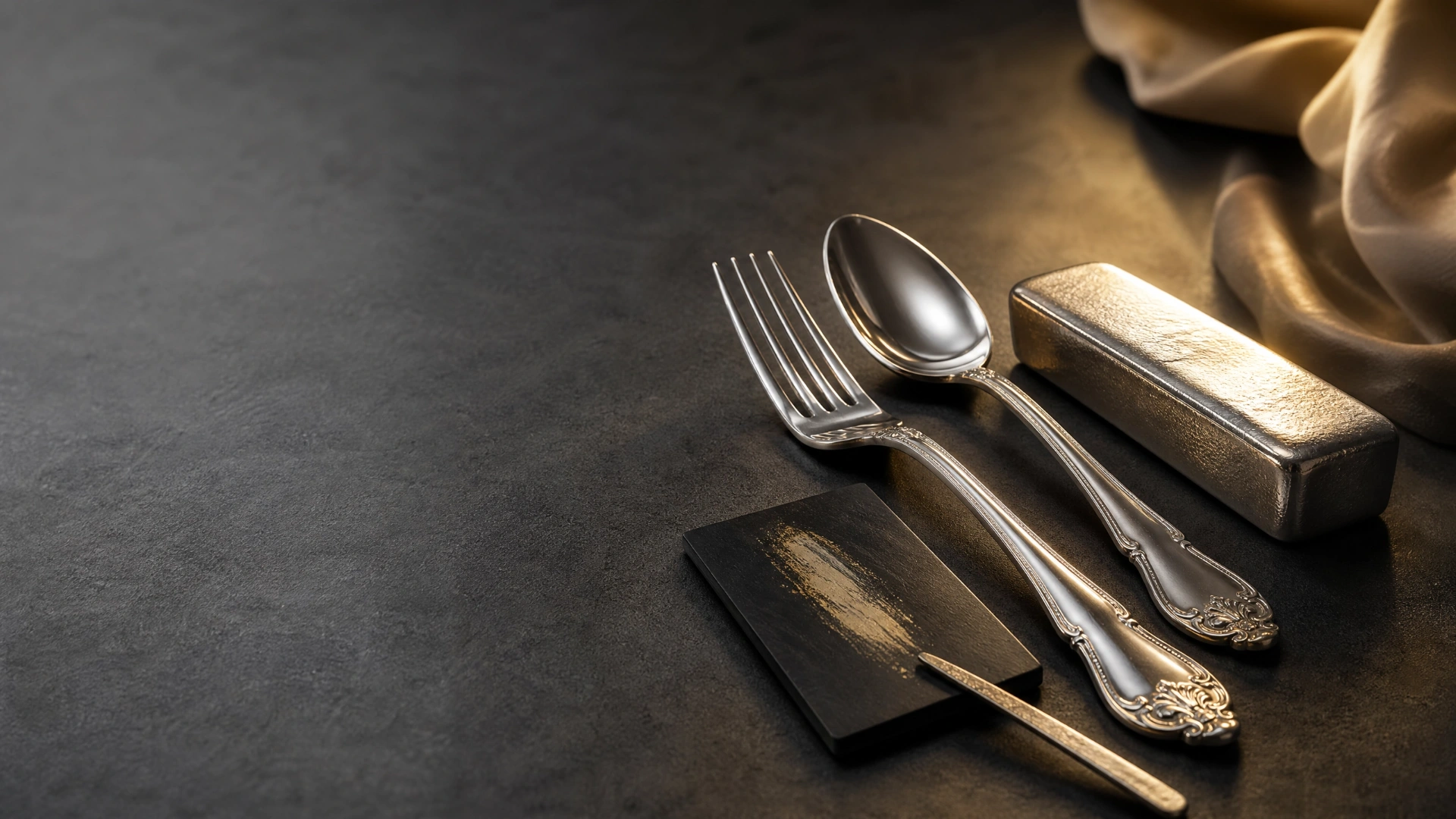
Sterling is a fineness standard, not a brand or a quality adjective. Under 15 U.S.C. § 296, an article marked "sterling" or "sterling silver" must contain "nine hundred and twenty-five one-thousandth parts pure silver" — 92.5% — and the statute allows "a divergence in the fineness of four one-thousandth parts" from that standard.
The same section deals with the practical problem that a fork is not a single casting. Where the whole article is assayed as one piece, including "all solder and inferior alloys used for brazing", the fineness "shall not be less by more than ten one-thousandth parts than the fineness indicated by the mark". In other words, the law already anticipates that joints, solder and fittings dilute the average, and it sets a wider tolerance for the assembled object than for the metal alone.
Coin silver is a separate standard in the same statute: 900 parts pure silver per thousand, with the same four-part divergence. It turns up on American flatware made before sterling became the domestic norm, and it is real silver — slightly less of it per ounce than sterling.
Sterling vs silverplate: why the law is the quickest test
Silverplate is an article of base metal — usually nickel silver, copper or brass, sometimes over a steel core — onto which silver has been electroplated. The plating is measured in microns. It is a surface, not a content.
The most useful fact for anyone sorting a drawer is in 15 U.S.C. § 297: no plated article "shall be stamped, branded, engraved, or imprinted with the word 'sterling' or the word 'coin', either alone or in conjunction with other words or marks." Those two words are reserved by federal law for solid silver of the stated standard. A piece marked STERLING is claiming to be solid; a piece marked with a plating trade name is claiming the opposite, and the manufacturers were not being coy about it.
Reading the marks
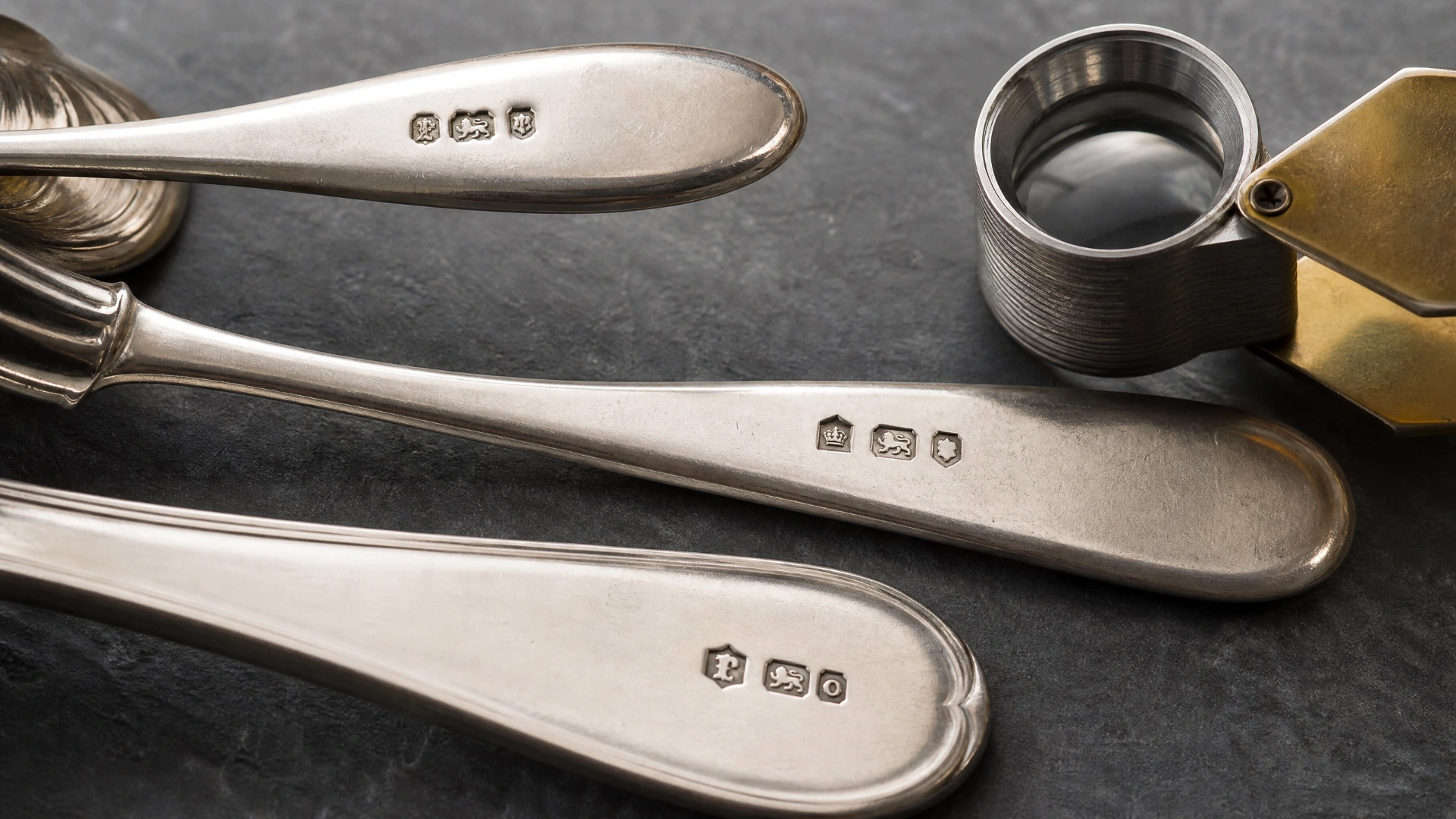
Turn the piece over. Marks are on the back of the handle on flatware, and on the underside of hollowware.
| Mark | What it indicates |
|---|---|
| STERLING, STER, 925, .925 | Solid silver at the 925 standard |
| COIN, COIN SILVER, 900 | Solid silver at the 900 standard |
| EP, EPNS, EPBM | Electroplate; EPNS is electroplated nickel silver, EPBM electroplated Britannia metal |
| A1, AA, TRIPLE, QUADRUPLE PLATE | Trade grades describing how much silver was deposited — all plate |
| SILVER ON COPPER, NICKEL SILVER, GERMAN SILVER, ALPACA | Base metal; nickel silver and German silver contain no silver at all |
| 800, 830, 835, 900, 950 | Continental and other national standards, expressed as parts per thousand |
| A lion passant, a leopard's head, a date letter | British hallmarks; the lion passant indicates the 925 standard |
Three cautions. "Nickel silver" and "German silver" are copper-nickel-zinc alloys with no silver content, and the names are historical rather than descriptive. A pattern name alone — Chantilly, Grande Baroque, Francis I — tells you the maker and the design, not the metal, because most popular patterns were produced in both sterling and plate. And a piece with no mark at all is not automatically plate; unmarked solid silver exists, which is what testing is for.
Troy ounces, not kitchen ounces
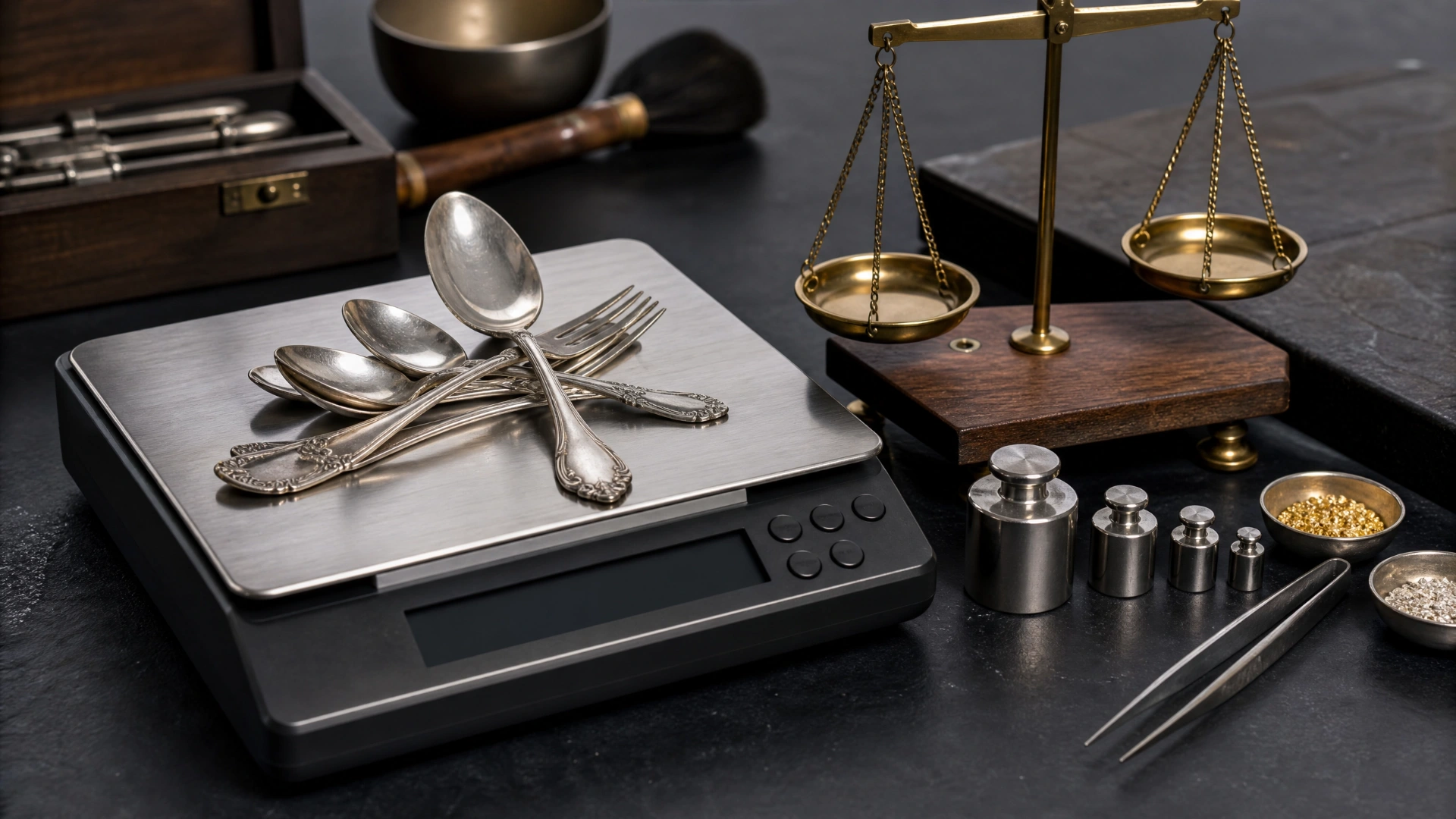
Silver is weighed in troy ounces, and a troy ounce is heavier than the ounce on a kitchen scale: the National Institute of Standards and Technology gives it as 480 grains exactly, or 31.103 grams, against 28.350 grams for the avoirdupois ounce, with a troy pound at 12 troy ounces and a pennyweight — the unit older flatware inventories are written in — at 1.555 grams. The practical consequence is that a set weighed at home on a postal scale reads about 10% heavier in ounces than it will in troy ounces, and a "pound" of silver flatware is not sixteen troy ounces. There is more in our guide to what a troy ounce is and why it matters.
Weighted handles and loaded bases: why the scale is not the answer
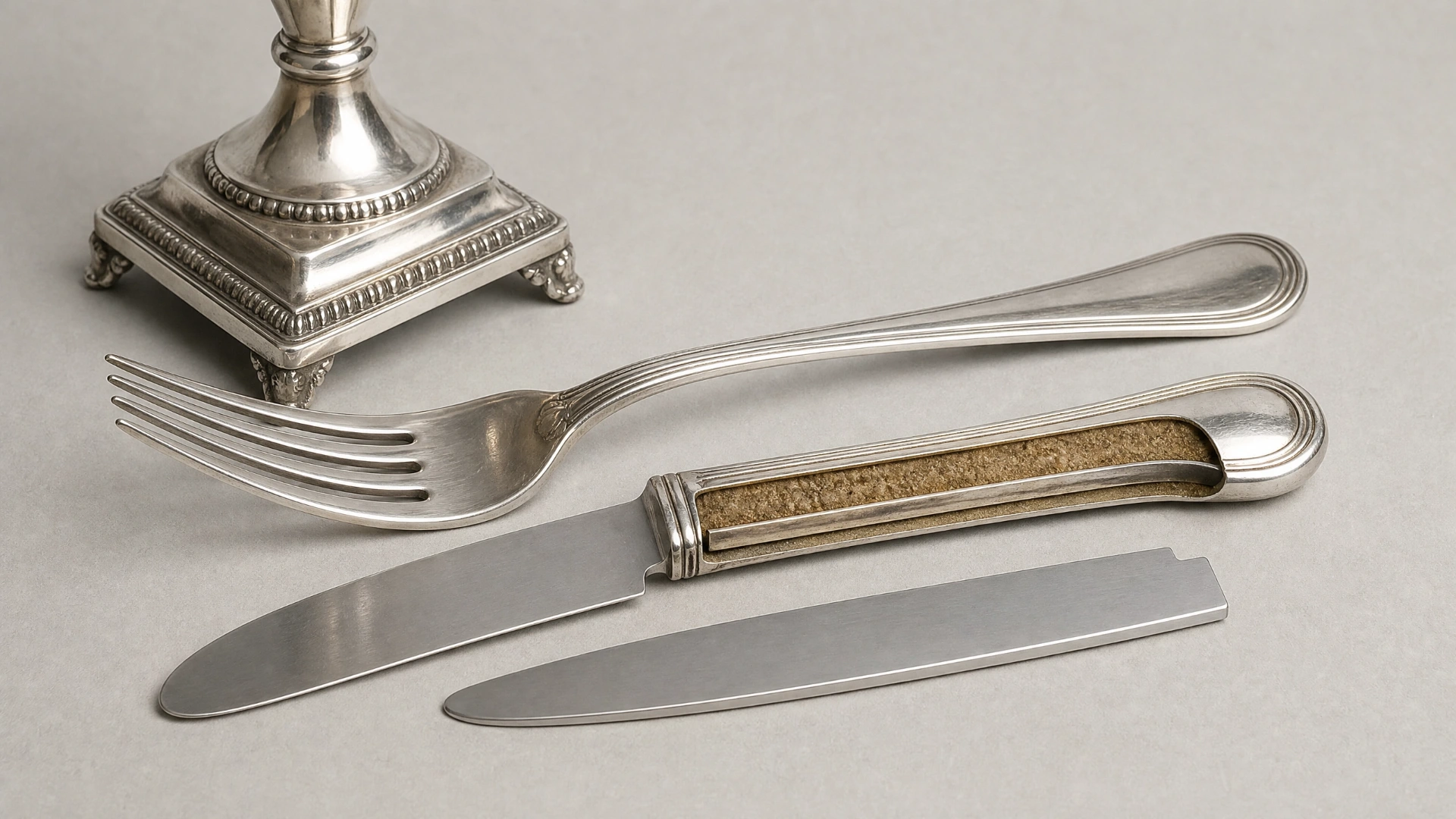
Two categories of sterling are heavier than their silver content, and this is where home estimates go furthest wrong.
Knives. Sterling table knives are typically made with a hollow sterling handle filled with a hard cement or resin, into which a stainless or carbon steel blade is set. The blade is not silver and the filler is not silver. A dozen sterling knives can weigh as much as a dozen sterling forks and contain a fraction of the metal.
Weighted hollowware. Candlesticks, salt and pepper shakers, bud vases and some trophy bases are made from thin sterling sheet over a filler — pitch, plaster or cement — that gives the piece stability. These are usually marked "weighted", "reinforced" or "sterling weighted" on the base, and the marking is a statement that the object's weight is not its silver weight.
The handling is the same for both: they are separated from the main lot, weighed on their own, and assessed on the recoverable silver rather than on gross weight. A single gross weighing is faster, and on a box that is plainly all forks and spoons it reaches the same number; it stops being reliable the moment knives, weighted hollowware or plate are in the box, which is worth knowing before you compare two quotes on speed alone.
How a flatware lot is actually worked out
The arithmetic has four steps, and it is worth seeing them separated because the difference between them is where most confusion lives.
- Sort by standard. Sterling, coin, continental standards and plate go into separate piles. Plate is set aside — it is not part of the metal calculation.
- Separate the weighted pieces. Knives, weighted candlesticks and anything with a filled base come out of the main pile and are assessed on their own.
- Weigh the solid material in troy ounces. That gives gross weight of sterling.
- Convert gross to fine. Sterling is 92.5% silver, so gross troy ounces multiplied by 0.925 gives the fine silver content. Coin silver is multiplied by 0.900. Fine weight against the market on the day is the melt basis the offer is built from.
A worked example, using round numbers rather than a live price: 100 troy ounces gross of sterling forks and spoons contains 92.5 troy ounces of fine silver. The same 100 troy ounces made up largely of knives contains far less, because most of that weight is steel and cement. Two boxes with identical scale readings are not two identical offers, and neither figure is the final offer — refining, handling and the spread between buying and selling all sit between melt basis and a cash number.
One more separation matters before any of this: some flatware is worth more as flatware than as metal. Complete services in sought-after patterns, unusual serving pieces, early American coin-silver by a known maker, and anything with a maker's mark that collectors follow can carry a premium over melt. A melt-only assessment is quick, easy to check against the market on the day, and gives a number that transfers between buyers; what it will not capture is a pattern premium where one exists, so it costs nothing to ask whether a set was looked at both ways.
Sterling vs silverplate at melt: why plate has almost none
The silver on a plated fork is a coating a few microns thick. Recovering it means chemically stripping the plating from the base metal, and the yield per piece is a fraction of a gram against the cost of the process. That is why a dealer who buys sterling all day will decline a box of EPNS: the metal is there in a technical sense and not in an economic one.
Plate is not worthless — good plated hollowware, complete services and decorative pieces have a resale market as tableware and as antiques. It is simply a different market, priced on pattern, maker, condition and completeness rather than on weight, and generally not one a bullion counter operates in.
What Virginia law requires when a dealer buys silverware
Virginia regulates precious metals dealers under Title 54.1, Chapter 41 of the Code of Virginia, and the definition is worth reading carefully because flatware sits squarely inside it. Section 54.1-4100 defines "precious metals" as "any item except coins composed in whole or in part of gold, silver, platinum, or platinum alloys". Silver flatware and hollowware are exactly that, which means a silverware sale is handled under stricter rules than a coin sale in this state.
What follows from that is identification, a recorded purchase reported to the locality, and a hold on the item before it can be sold or altered. Those duties fall on the dealer rather than on you, and we set them out section by section in what Virginia law requires when you sell gold.
Two things follow for a seller. Bring the ID and a second document — that is the statute, not any dealer's formality. And the fifteen-day hold applies to what the dealer may do with the item, not to when you are paid.
How The Bullion Bank handles a silverware lot
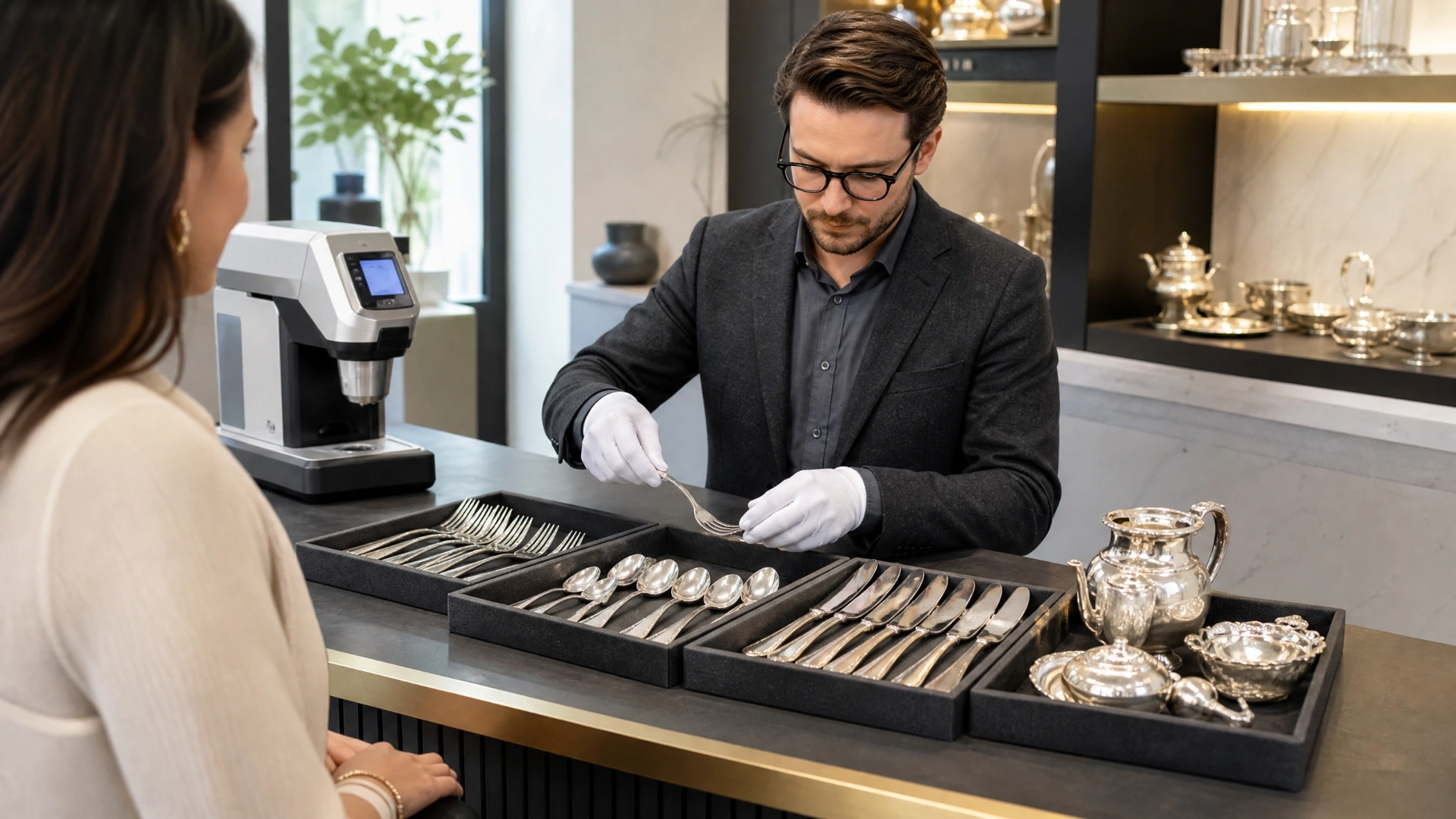
The Bullion Bank has been buying and selling precious metals in Northern Virginia since 2008, with counters in Chantilly and Vienna. Silver flatware and jewelry are among the items bought at the counter, alongside gold jewelry, coins and scrap, estate pieces and dental gold.
Metal content and purity are assessed by X-ray fluorescence (XRF) analysis in front of you, which is worth understanding for what it is: XRF reads the composition of the surface it is aimed at, so on a plated item it can report the plating rather than what is underneath. That is why marks, wear patterns, weight and the response of the base metal all form part of the assessment rather than a single instrument reading. The site states that walk-ins are welcome during normal business hours and no appointment is necessary, that testing is followed by a same-day offer based on current precious metals prices, and that payment is provided the same day if you accept.
Frequently asked questions
Is my silverware real silver?
Look at the mark on the back of the handle or the underside. STERLING, STER, 925 or a British lion passant indicate solid silver at the 925 standard; COIN or 900 indicate the coin-silver standard. EP, EPNS, A1, TRIPLE PLATE, "silver on copper", nickel silver or German silver all indicate plate or base metal. Federal law bars a plated article from being marked "sterling" or "coin".
How can I tell sterling from silverplate without a mark?
Unmarked pieces need testing rather than guessing. Plate often shows a coppery or yellowish tone at worn edges, on the backs of spoon bowls and along the high points of the pattern, where the plating has rubbed through. That is a strong indicator but not proof. An unmarked piece needs a test — acid, specific gravity or XRF, each with its own limits on a plated item — rather than a judgement by eye.
Does silverplate have any melt value?
Practically, no. The plating is a few microns thick, and recovering it costs more than the silver recovered is worth. Good plated hollowware and complete services can have resale value as tableware or antiques, which is a different market priced on pattern, maker and condition rather than on weight.
Why are sterling knives worth less than sterling forks?
Sterling table knives are typically made with a hollow sterling handle filled with cement or resin and a stainless or carbon steel blade. The filler and the blade are not silver, so a knife's scale weight substantially overstates its silver content. Knives are weighed and assessed separately from the rest of a set for this reason.
How do you calculate the silver content of sterling flatware?
Gross weight in troy ounces multiplied by 0.925 gives the fine silver content, because sterling is 92.5% silver by the standard in 15 U.S.C. § 296. Coin silver is multiplied by 0.900. Weighted pieces are excluded from the gross figure and assessed separately, and the fine weight is the melt basis rather than the offer.
Do I need identification to sell silverware in Virginia?
Yes. Va. Code § 54.1-4102 requires an unexpired government photo identification showing your current legal address, plus at least one other corroborating means of identification. Silverware sits inside the chapter's definition of precious metals; coins do not. The hold that follows governs what the dealer may do with the item, not when you are paid — see what Virginia law requires when you sell gold.
Bring the whole drawer
The useful visit is the one where you bring everything — sterling, plate, knives, the weighted candlesticks, the odd serving pieces and the box they came in — and let it be sorted at the counter. You will see the marks read and the XRF results as they come up, and the offer is made the same day, with payment the same day if you accept it. No appointment is necessary — the site states that walk-ins are welcome during normal business hours. There is more on how the counter works on our cash for gold page, and our bullion and numismatics ranges are on the site.
Chantilly
The Bullion Bank
4086 Airline Pkwy
Chantilly, VA 20151
(703) 705-5151
Mon–Fri 11:00–18:00 · Sat 11:00–17:00 · Sun closed
Vienna
The Bullion Bank
131 Maple Ave W
Vienna, VA 22180
(703) 705-5252
Mon–Fri 11:00–18:00 · Sat 11:00–17:00 · Sun closed