Published by
Gold Expert
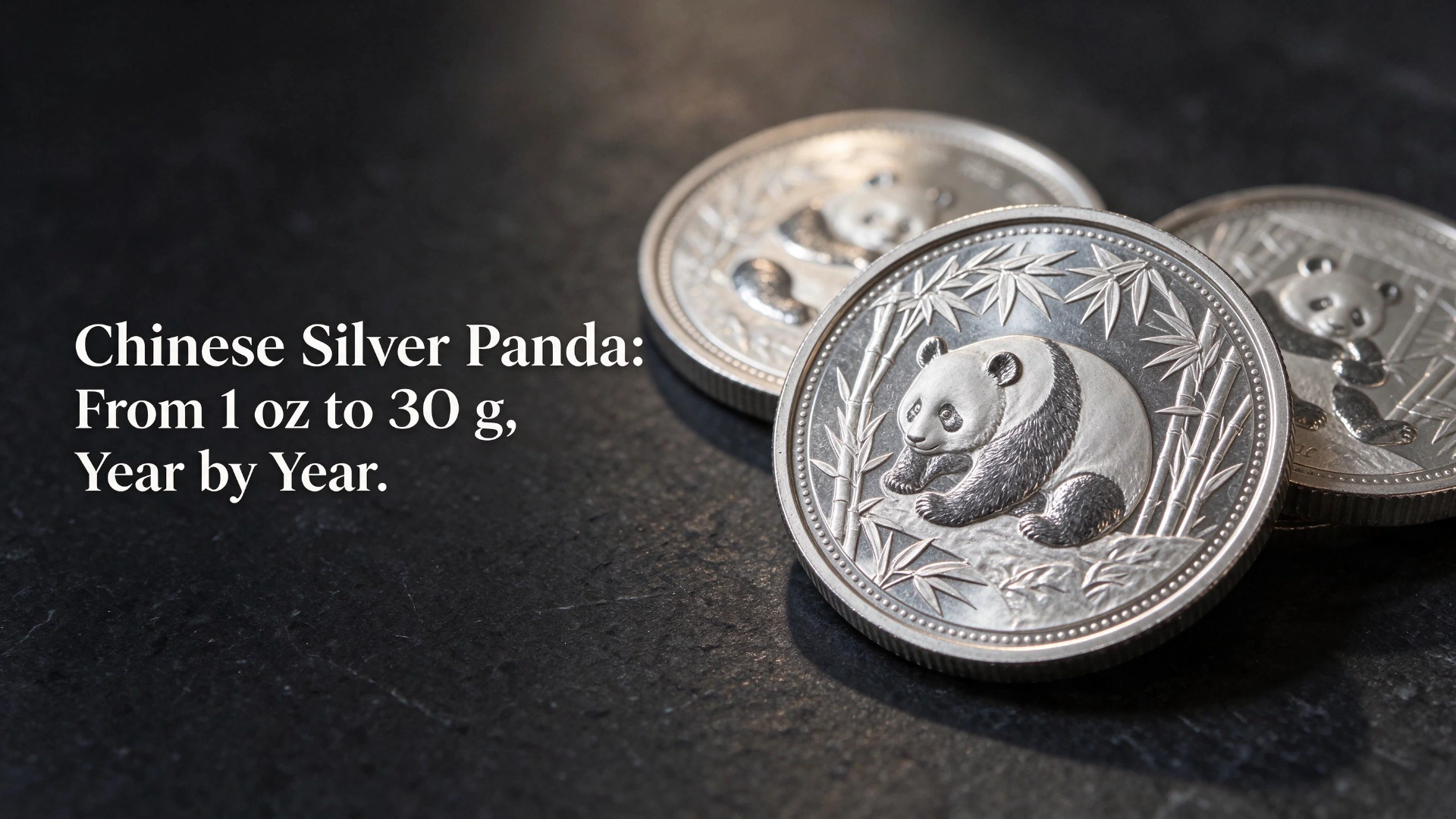
The Chinese silver Panda coin is the People's Republic of China's 10 yuan silver coin, first struck in 1983. It has been made to three weight standards: 27 grams of .900 silver on the 1983-1985 proofs, one troy ounce of .999 silver from 1987 to 2015, and 30 grams of .999 silver from 2016 onward. The panda on the reverse changes every year, with one repeat, and the 2015 coin dropped the weight and fineness from its design.
One coin, three weight standards
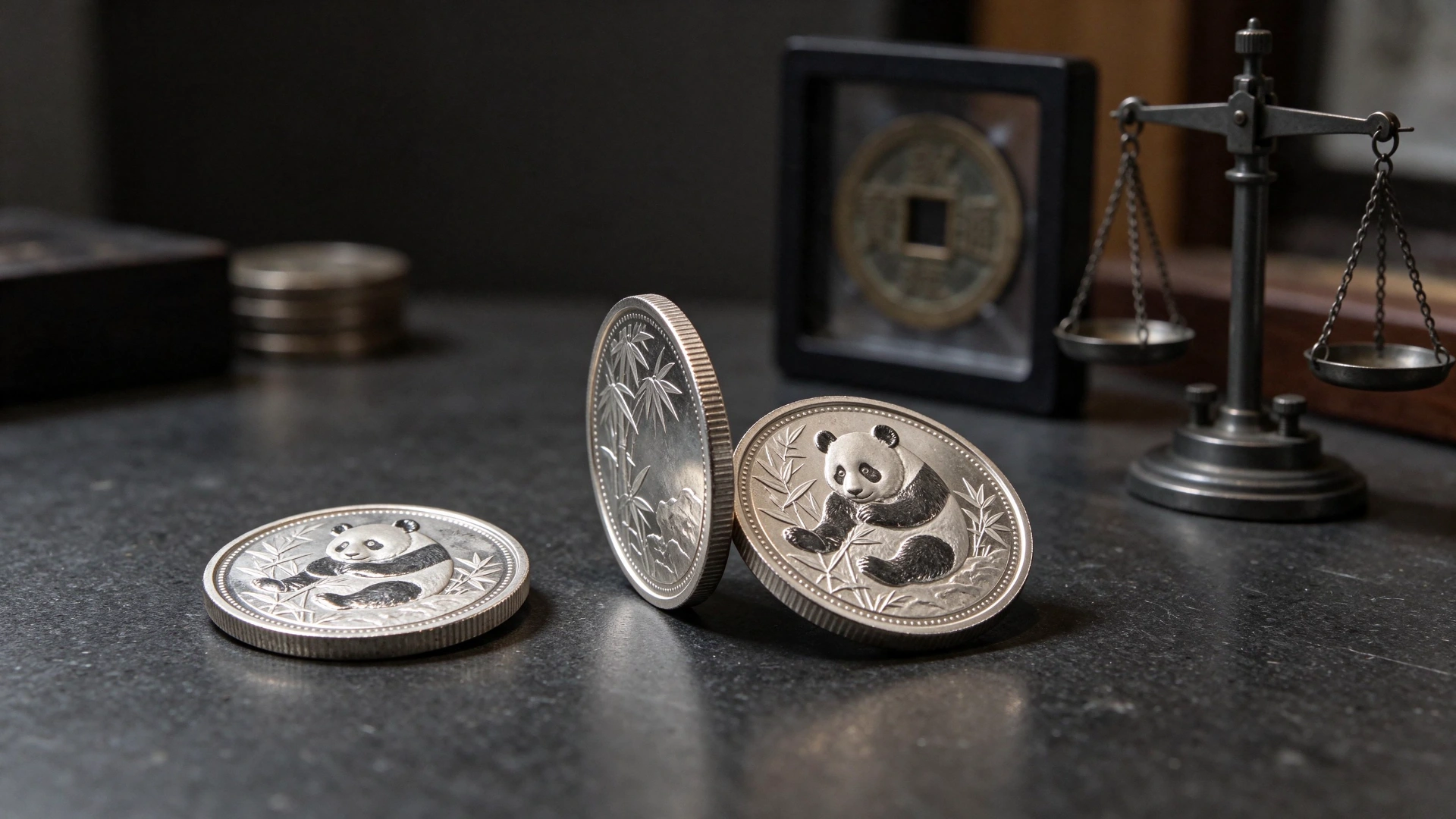
The date on a silver Panda tells you how much silver is in it, because the standard changed twice. A 1983 coin holds about 22% less silver than a 1 oz coin, and a 2016 coin holds about 3.5% less. Every year's obverse shows the Temple of Heaven in Beijing, with the country name and the date.
| Standard | Years | Gross weight | Fineness | Pure silver |
|---|---|---|---|---|
| 27 g proof | 1983, 1984, 1985 | 27 g | .900 | 24.3 g (0.781 troy oz) |
| 1 oz | 1987, then 1989-2015 | 31.1 g (1 troy oz) | .999 | 31.07 g (0.999 troy oz) |
| 30 g | 2016 to date | 30 g (0.9645 troy oz) | .999 | 29.97 g (0.964 troy oz) |
The 27 gram weight comes from Peter Anthony's signed notes in NGC's price guide on the 1983 coin and the 1985 coin; NGC's own specification fields give .900 fineness and 38.6 mm. The 30 gram change is documented in Coin World's December 2015 report on the 2016 issue.
One hundred 30 gram Pandas hold about 3.5 troy ounces less silver than one hundred 1 oz Pandas, the silver in three and a half 1 oz coins.
Every 10 yuan silver Panda date from 1983 to 2026
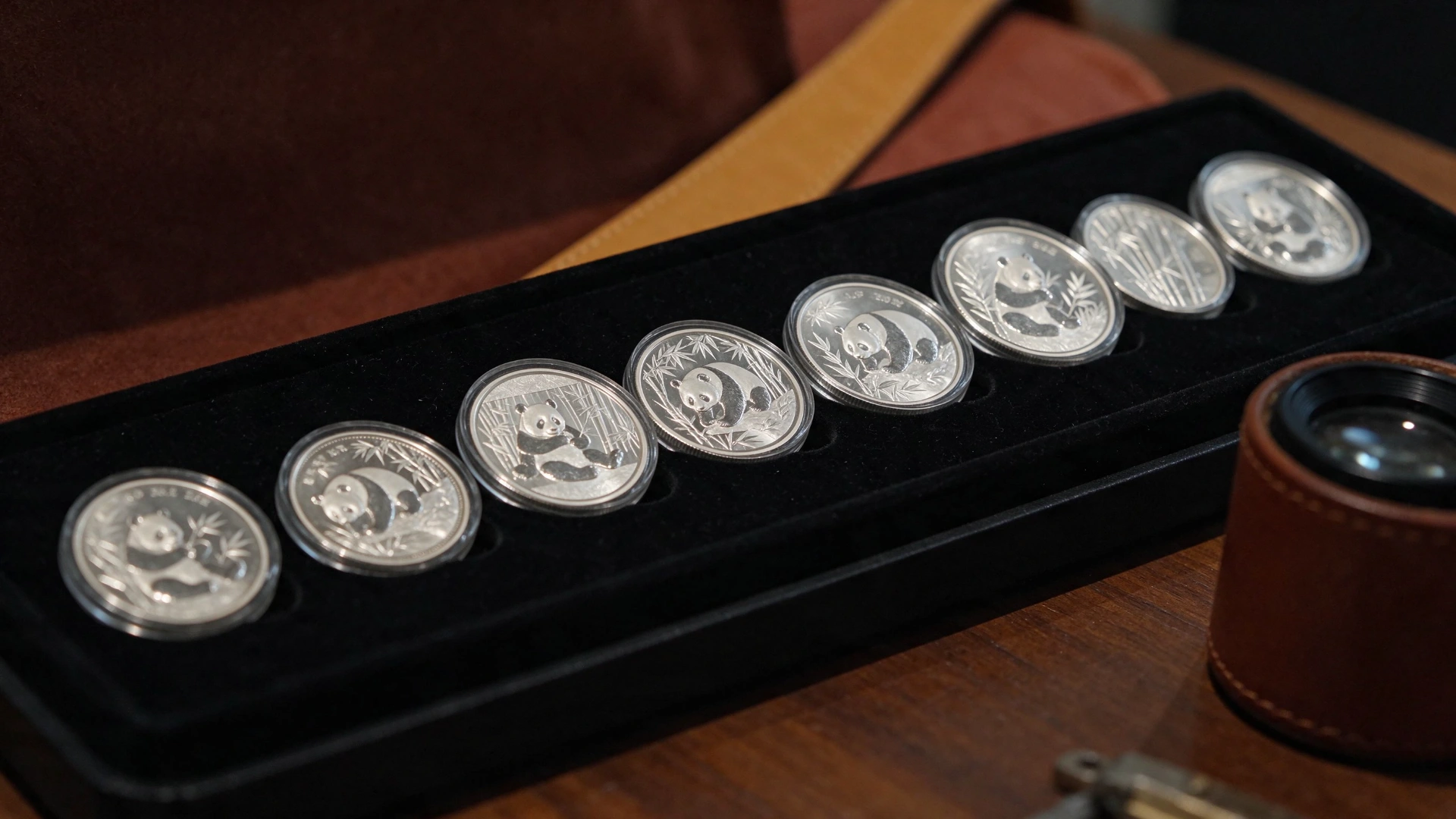
The 10 yuan silver Panda has been issued every year since 1983 except 1986 and 1988, when NGC lists no 10 yuan coin, and NGC lists at least two varieties for every year from 1990 to 2000. A variety is a recognized difference within the same date, such as the size of the numerals, and mintages below are given only where NGC's price guide states one.
| Year | Standard and strike | What to know about the year |
|---|---|---|
| 1983 | 27 g, .900, proof only | The first silver Panda. NGC lists a mintage of 10,000, and Peter Anthony, in his signed note in NGC's guide, credits the design to Yu Min. |
| 1984 | 27 g, .900, proof only | Mintage of 10,000, per Peter Anthony's note on the 1985 coin. |
| 1985 | 27 g, .900, proof only | Mintage of 10,000. Peter Anthony's note credits the design, an adult panda with a cub climbing on its back, to Xie Lie. |
| 1986 | No 10 yuan coin listed | NGC's guide lists a 5 yuan World Wildlife Fund panda coin for 1986, not a 10 yuan Panda. |
| 1987 | 1 oz, .999, proof | Peter Anthony calls it the first 1 oz .999 silver Panda, issued for the fifth anniversary of Panda coins, with a mintage set at 31,000. |
| 1988 | No 10 yuan coin listed | NGC lists only 5 oz and 12 oz silver Panda proofs for 1988. |
| 1989 | 1 oz, .999, BU and proof | Peter Anthony calls it the first coin in the BU series. NGC gives the BU coin a mintage of 255,000, and he notes that the grid background by Luo Yonghui is unique to 1989. |
| 1990-1992 | 1 oz, .999 | Each year comes in a small date and a large date variety. |
| 1993 | 1 oz, .999 | Small and large date, plus a frosted version of each in NGC's listings. |
| 1994 | 1 oz, .999 | Small date and large date varieties. |
| 1995 | 1 oz, .999 | NGC splits the year into large twig and small twig coins, with the small twig in two date sizes. |
| 1996-1998 | 1 oz, .999 | Small date and large date varieties each year. |
| 1999 | 1 oz, .999 | Small date, plus a large date with either a plain or a serif "1". |
| 2000 | 1 oz, .999 | Frosted ring and mirrored ring varieties. |
| 2001 | 1 oz, .999 | NGC gives a mintage of 500,000 and lists D-marked coins with a large D and a small D. China tried to freeze the design this year. |
| 2002 | 1 oz, .999 | The same reverse design as 2001, so check the date. NGC gives a mintage of 500,000. |
| 2003 | 1 oz, .999 | Annual design changes resume. Frosted bamboo and mirrored bamboo varieties; NGC gives the frosted bamboo coin a mintage of 600,000. |
| 2004-2014 | 1 oz, .999 | A new design each year. NGC also lists bank anniversary and coin expo versions of many of these years as separate entries. |
| 2015 | 1 oz, .999 | No weight or fineness on the coin. The last 1 oz year. |
| 2016 | 30 g, .999 | First metric year. Weight and fineness return to the design, now in grams. |
| 2017-2026 | 30 g, .999 | The 30 gram standard continues. Greysheet's catalog marks the 2018 coin as a 35th anniversary issue and the 2022 coin as a 40th anniversary issue. |
The year-by-year detail comes from NGC's silver Panda price guide, with Peter Anthony's signed notes on the 1987 and 1989 coins. The small and large date split for 1990-1999 also appears in Greysheet's catalog, which carries a 10 yuan Panda entry for every year from 1989 through 2026. The 2001 freeze and the 2003 restart are recounted in Tyler Rossi's history of the Gold Panda for CoinWeek, which notes that the silver Panda's reverse changes every year as the gold coin's does.
Because most of those years come in two date sizes, a coin from 1990 to 1999 is identified by variety as well as by year before it is priced. In most of those years the variety is the date size; in 1995 it is the twig size first, and the date size only within the small twig coins. How the annual design change affects Gold Panda premiums, and where it does not, is covered in our article on the Gold Panda's annual design.
2015: the year the weight came off the coin
The 2015 silver Panda is a 1 oz, .999 coin with no weight or fineness anywhere on it. The 2015 designs dropped those specifications, and Coin World reported that the move was unpopular and was reversed with the 2016 release. The coin shows its 10 yuan denomination and says nothing about its metal.
The missing inscription can cause two mix-ups. A 2015 coin can be taken for a fake by someone who expects to see "Ag .999" on it, and it can be taken for a 30 gram coin by someone who knows the series went metric around then. A scale tells the two standards apart: a 2015 coin should weigh about 31.1 grams, a 2016 or later coin about 30 grams. It cannot tell a genuine 2015 coin from a well-made copy, which is what the checks in the next section are for.
2016 onward: why the coin weighs 30 grams
From 2016 China issued the Pandas in grams, and the silver coin went from one troy ounce to 30 grams while keeping its 10 yuan face value. Coin World's report said the change was meant to meet Asian demand for gram-weight products. The 2016 program ran to 12 coins, with silver from 30 grams up to 1 kilogram, and the report noted that the kilo coins were unaffected.
Packaging changed with the weight. The same report noted that delivery sheets went from 30 coins to 15, and a full box from 600 coins to 450. A buyer comparing a 30 gram coin with a 1 oz coin should compare the price per troy ounce of silver, not the price per coin.
Checking a silver Panda by weight and size
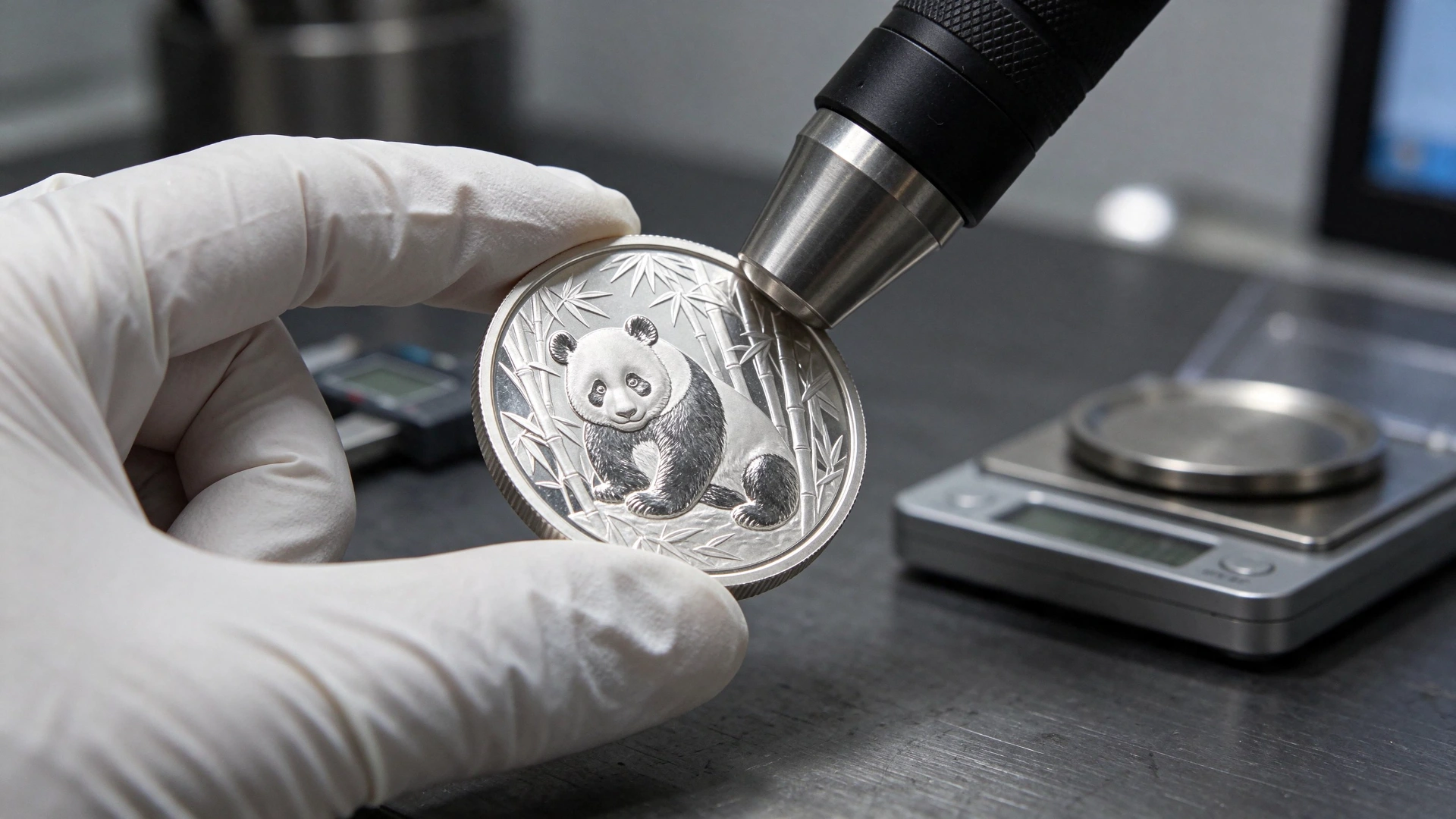
Each standard has its own weight, so a scale sorts a Panda by standard before anything else. Diameter backs it up: NGC lists the 27 gram proofs at 38.6 mm and the 1 oz coins at 40 mm.
- 1983-1985 proof: 27 grams, 38.6 mm
- 1987 and 1989-2015: about 31.1 grams, 40 mm
- 2016 to date: 30 grams
Writing on the 1985 coin, Peter Anthony noted that its simple design has attracted counterfeiters and recommended buying it graded and authenticated. A base-metal copy can be struck to 31.1 grams, so the scale sorts the standards and the metal still needs testing. X-ray fluorescence, or XRF, is a test that reads a metal's composition from its surface, and our article on what XRF testing can and can't tell you explains where it stops.
Buying or selling a silver Panda at The Bullion Bank
The one Panda in our online catalog is an Any Year 1 oz Chinese silver Panda, in stock on 17 November 2026. The date is not picked online, and the listing describes a 1 oz coin, so ask either location before ordering whether the coin will be a 1 oz date (1987 or 1989-2015) or a 30 gram date (2016 on). No 2015 coin or 27 gram proof was listed online that day.
The Panda's product page also shows The Bullion Bank's buy price next to the sell price, so the spread is visible before you decide. Selling works the way our cash for gold page describes: XRF testing in front of you, an offer the same day against live market pricing, and payment on acceptance. No appointment is needed; walk-ins are welcome during normal business hours.
This article is educational and reflects general information about precious metals and collectible coins. It is not investment, tax or legal advice, and The Bullion Bank is not a registered investment adviser, broker-dealer or tax professional. Metal prices fluctuate and past performance does not indicate future results. Consult a qualified professional about your own situation.
Frequently asked questions
How much silver is in a 30 gram silver Panda?
A 30 gram Panda at .999 fine holds 29.97 grams of pure silver, about 0.964 troy ounce. That is roughly 3.5% less than a 1 oz Panda, which holds 0.999 troy ounce. China made the change with the 2016 issue, and every 10 yuan silver Panda since then has been struck to the 30 gram standard.
Why does the 2015 silver Panda have no weight on it?
China removed the weight and fineness from the 2015 Panda designs. Coin World reported that the change was unpopular and was reversed with the 2016 release, when the specifications again appeared on the coins. The 2015 coin is still a 1 oz, .999 coin, weighing about 31.1 grams, and it is the last 1 oz silver Panda.
What was the first silver Panda?
The first was the 1983 10 yuan proof in .900 silver, which NGC lists with a mintage of 10,000; Peter Anthony's signed note in NGC's guide gives its weight as 27 grams. He calls the 1987 proof the first 1 oz .999 silver Panda and the 1989 coin the first of the brilliant uncirculated series, with a mintage NGC gives as 255,000.
Does every year of the silver Panda have a different design?
Every year except one. China tried to freeze the design in 2001, so the 2002 coin repeats the 2001 reverse and only the date separates them. Annual changes resumed in 2003. Every year's obverse shows the Temple of Heaven in Beijing with that year's date.
Does The Bullion Bank buy silver Pandas?
Yes. Bring them to the Chantilly or Vienna store during business hours, no appointment needed. We test the metal by XRF in front of you, make an offer the same day against live pricing, and pay on acceptance. If a Panda is in an NGC or PCGS holder, bring it as it is and ask how the grade is treated in the offer.
Silver Pandas in Chantilly and Vienna
Bring a Panda to either counter for an XRF test and a same-day offer, or call to ask about a particular year.
The Bullion Bank, Chantilly
4086 Airline Pkwy
Chantilly, VA 20151
(703) 705-5151
Monday-Friday 11:00am-6:00pm, Saturday 11:00am-5:00pm, Sunday closed
The Bullion Bank, Vienna
131 Maple Ave W
Vienna, VA 22180
(703) 705-5252
Monday-Friday 11:00am-6:00pm, Saturday 11:00am-5:00pm, Sunday closed