Published by
Gold Expert
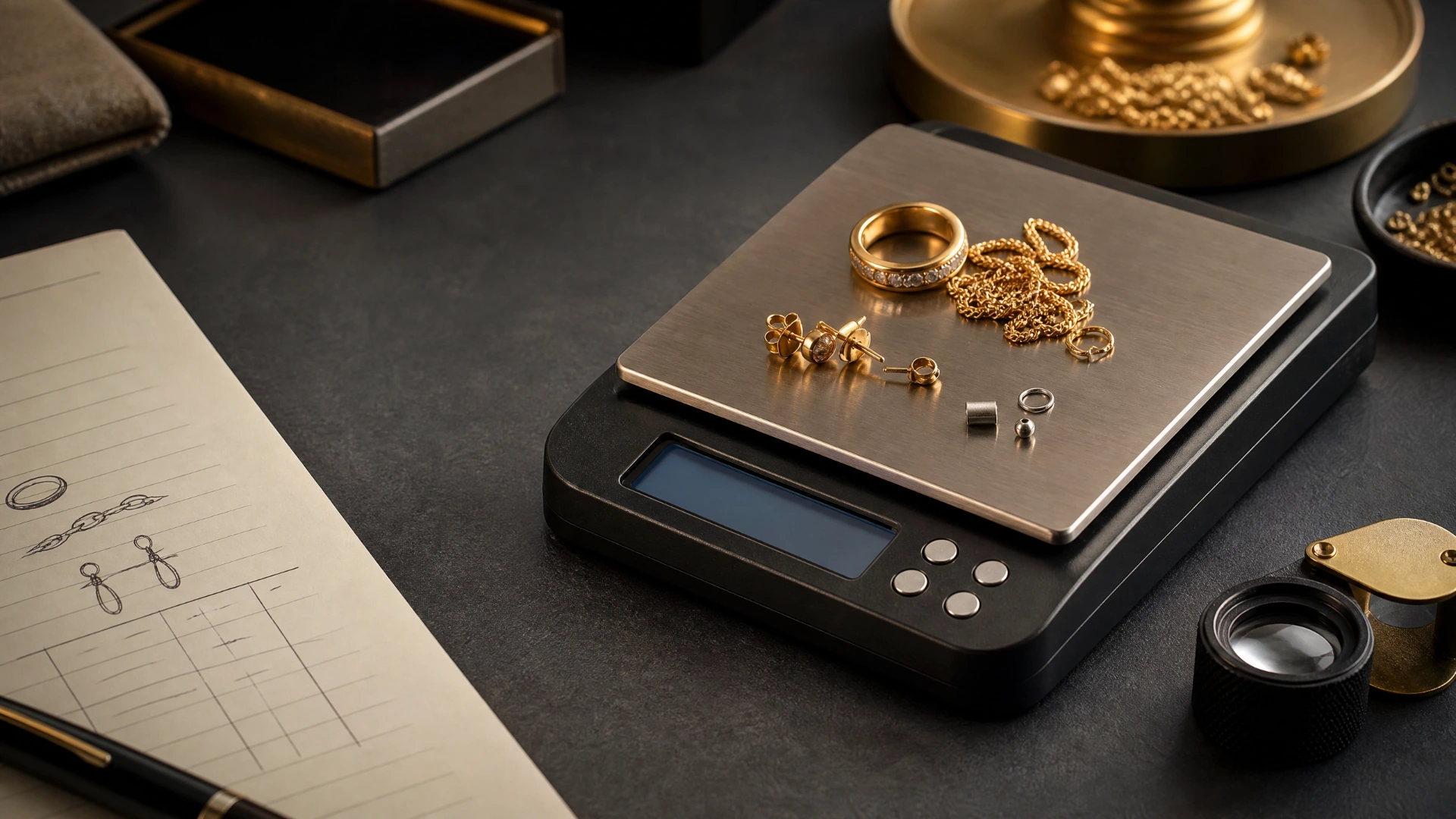
A scrap gold offer is four numbers multiplied together. Take the weight of the gold after anything that is not gold has been removed, multiply it by the purity to get the weight of fine gold in the lot, multiply that by the market price of gold on the day, and multiply the result by the buyer's payout percentage. That is the whole calculation, and every term in it is something you can ask a buyer to show you. This article walks through each one, with a worked example you can run on your own jewellery before you take it anywhere.
Karat and fineness are the same measurement written two ways
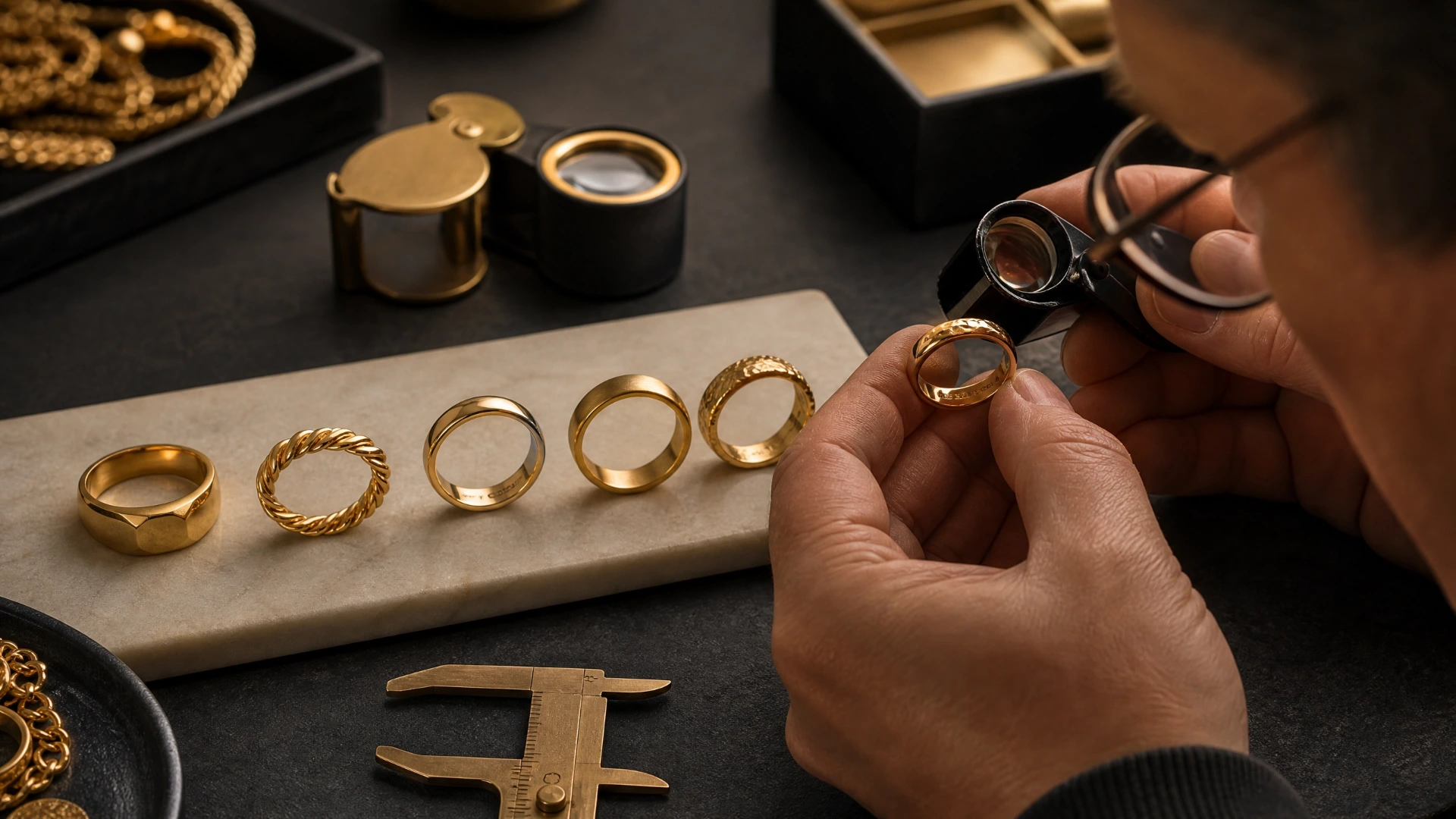
Karat is purity expressed in parts of 24; fineness is the same purity expressed in parts of 1,000. A piece marked 18K is 18 parts gold in 24, which is 75% gold, which is written as 750 fineness. Nothing changes except the notation — American jewellery is usually marked in karats and European jewellery in fineness, and a buyer converts between them without thinking about it.
| Karat mark | Parts gold in 24 | Exact percentage | Conventional fineness mark |
|---|---|---|---|
| 10K | 10/24 | 41.67% | 417 |
| 14K | 14/24 | 58.33% | 583 or 585 |
| 18K | 18/24 | 75.00% | 750 |
| 22K | 22/24 | 91.67% | 916 or 917 |
| 24K | 24/24 | 100% nominal | 999 |
Two rows need a note. 24K is nominally pure; refined bullion is conventionally marked 999 or 9999 rather than 1000, because absolute purity is not achievable in practice. And fourteen twenty-fourths is exactly 58.33%, while the conventional European mark is 585 — slightly above the exact figure. Both 583 and 585 appear on genuine 14K goods, and these are marking conventions rather than exact equivalences.
The stamp is a claim, not a measurement
The number stamped inside a ring is a representation about the goods, and it is regulated as one. The FTC's Guides for the Jewelry, Precious Metals and Pewter Industries at 16 CFR § 23.3(a) make it unfair or deceptive "to misrepresent the presence of gold or gold alloy in an industry product, or the quantity or karat fineness of gold or gold alloy contained in the product."
Those Guides also carry a tolerance. Section 23.3(d) makes the quality-mark provisions subject to the tolerances of the National Stamping Act, which permits a variance of three parts per thousand from the marked fineness for an article without solder, and seven parts per thousand where solder is present. So a marked piece is allowed to test very slightly under, by design, and a buyer tests rather than assumes.
Then there is the category that is not solid gold at all. Section 23.3(b)(3) prohibits describing a surface-plated product as "Gold" unless the description is qualified to show that it is only surface-plated, which is what marks like GP (gold plated), GF (gold filled) and HGE (heavy gold electroplate) are doing: telling you there is a layer of gold over a base metal core. A gold-filled piece contains real gold and can be refined, but the recoverable quantity is a fraction of what the same weight in solid 14K would yield.
Unmarked pieces, worn-away marks and foreign marks in unfamiliar systems all turn up regularly. None of them is a problem — they are simply tested rather than read.
Gross weight is not fine weight
You are paid for the gold in the piece, not for the piece. Gross weight is what the whole item weighs on the scale. Fine weight is the weight of pure gold inside it, and it is gross weight multiplied by fineness.
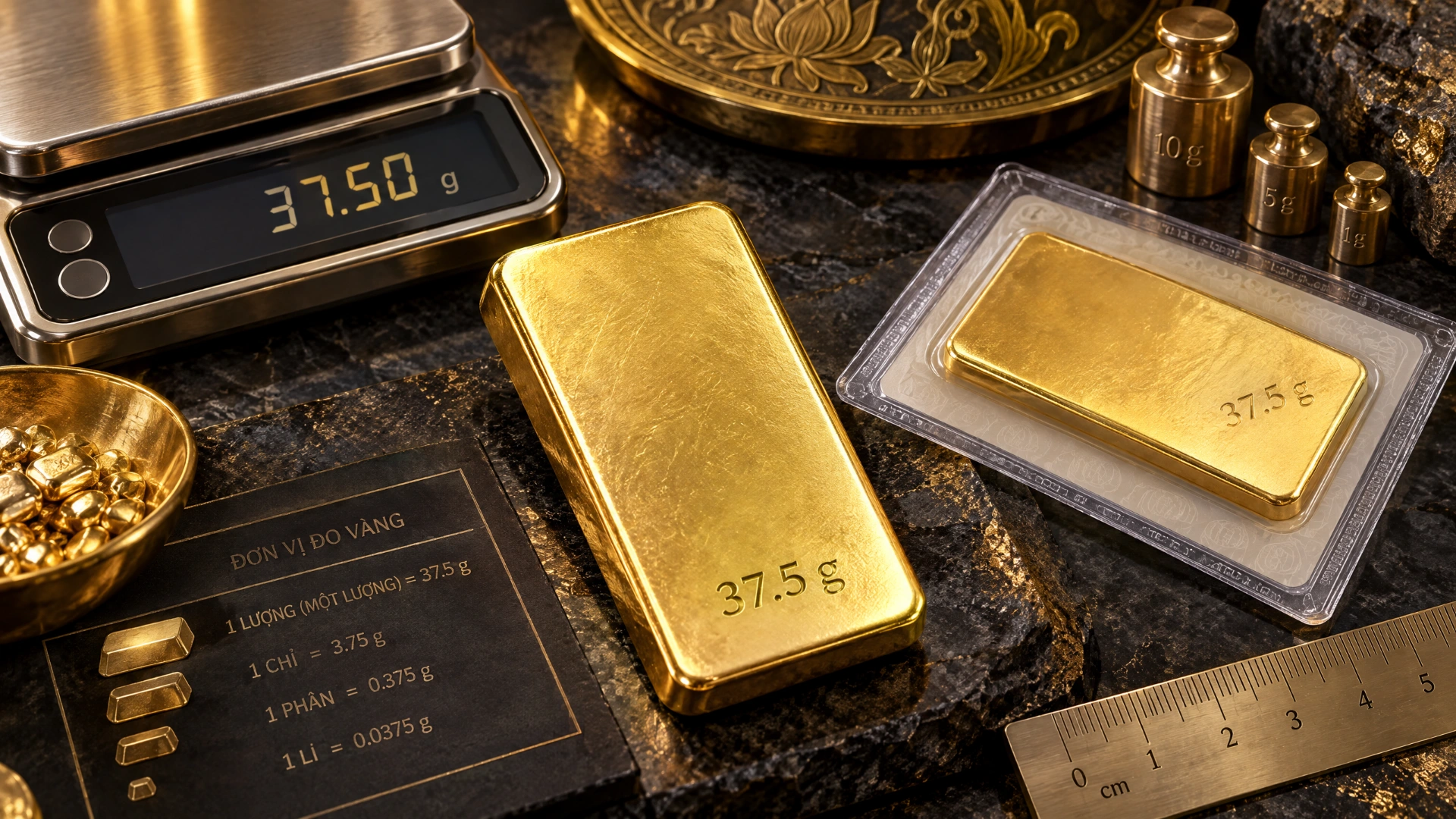
Three units are in play, and mixing them up is where most confusion at a counter begins: the gram, which most US counters weigh in; the troy ounce, which gold is priced in, at 31.1034768 grams per NIST; and the pennyweight, an older trade unit some buyers still quote in, at 1.55517384 grams, with exactly 20 to the troy ounce. Our guide to the troy ounce covers the unit itself in more depth.
One consumer protection here is worth knowing, and it is rarely mentioned in guides to selling scrap: NIST Handbook 130's uniform method-of-sale regulation, which individual states adopt, provides that when precious metals are sold by metric weight a conversion chart to troy units must be prominently displayed so that buyers can compare prices. If a counter weighs in grams and quotes in troy ounces, the means of checking the conversion is meant to be visible to you.
How scrap gold is tested at the counter
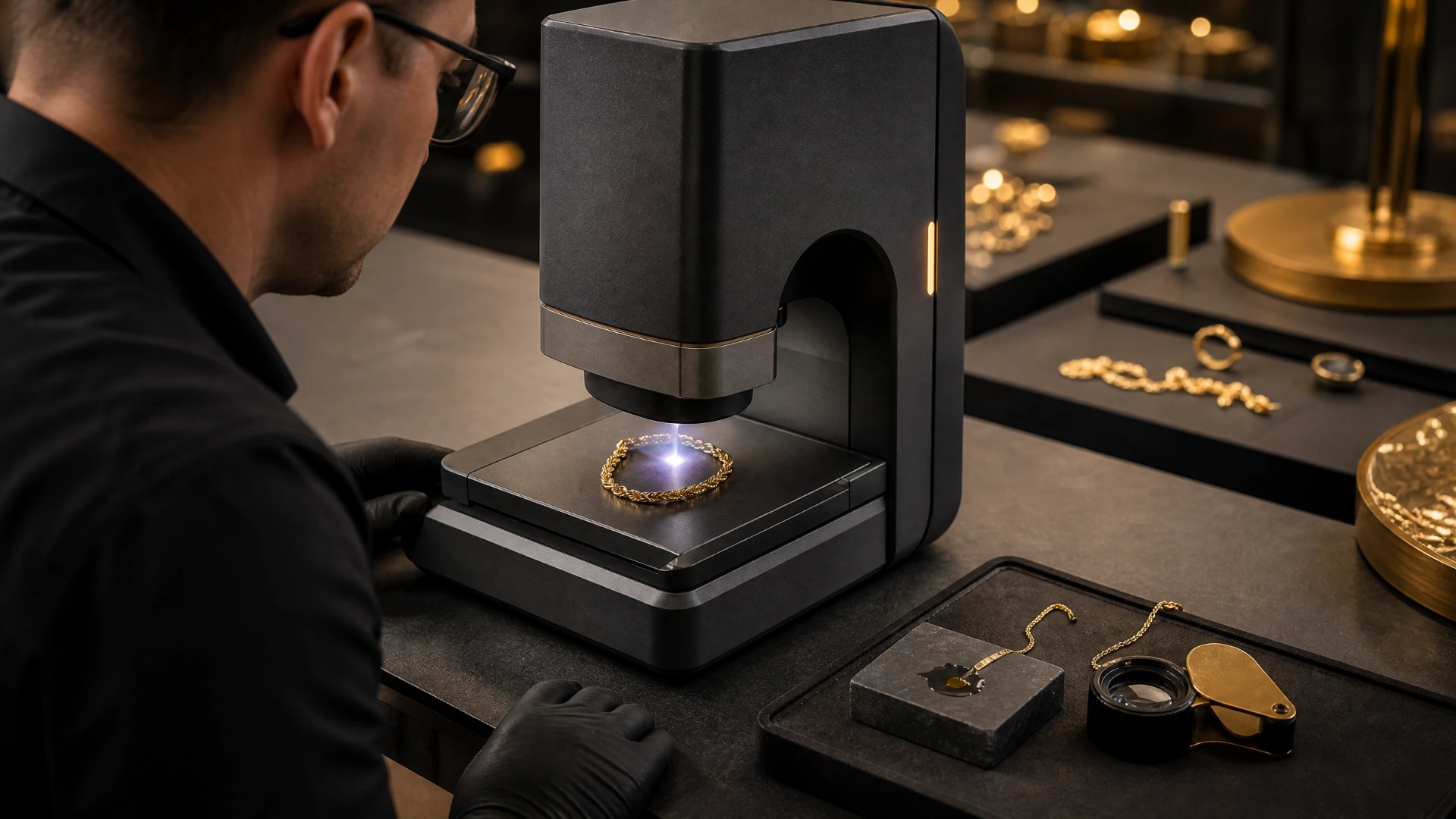
Testing starts with X-ray fluorescence and moves on only where XRF cannot see. XRF is a non-destructive method that reads a material's elemental composition by measuring the characteristic X-rays it emits under excitation — it tells you which metals are present and in what proportion, without cutting or dissolving anything.
Its limitation is the one that matters for jewellery: XRF reads at and near the surface. A gold-plated brass ring can read convincingly gold on the outside, which is why a plated or filled piece is identified by other means — weight against size, a magnet on the findings, a file cut into an inconspicuous area followed by acid on the exposed metal, or specific gravity, which compares the item's weight against the volume of water it displaces.
Fire assay is the definitive method: it melts the sample and separates the gold quantitatively, and it consumes what it measures — which is why it is run on a homogenised lot at the refinery rather than on your grandmother's brooch at a counter.
What comes off before the arithmetic starts
Anything that is not gold is removed or deducted before weighing. That includes gemstones and their settings where the stones are held mechanically, spring mechanisms and clasps made of steel, base-metal findings, watch movements, and the solder at every joint — solder being lower in karat than the piece it joins is the reason the stamping tolerance widens where it is present.
Stones are worth raising separately. A diamond or coloured stone of any consequence is generally better removed and returned to you, or valued on its own terms, than melted with the mount — which is also the difference between scrapping a piece and converting gold jewellery to bullion.
The scrap gold calculation, worked
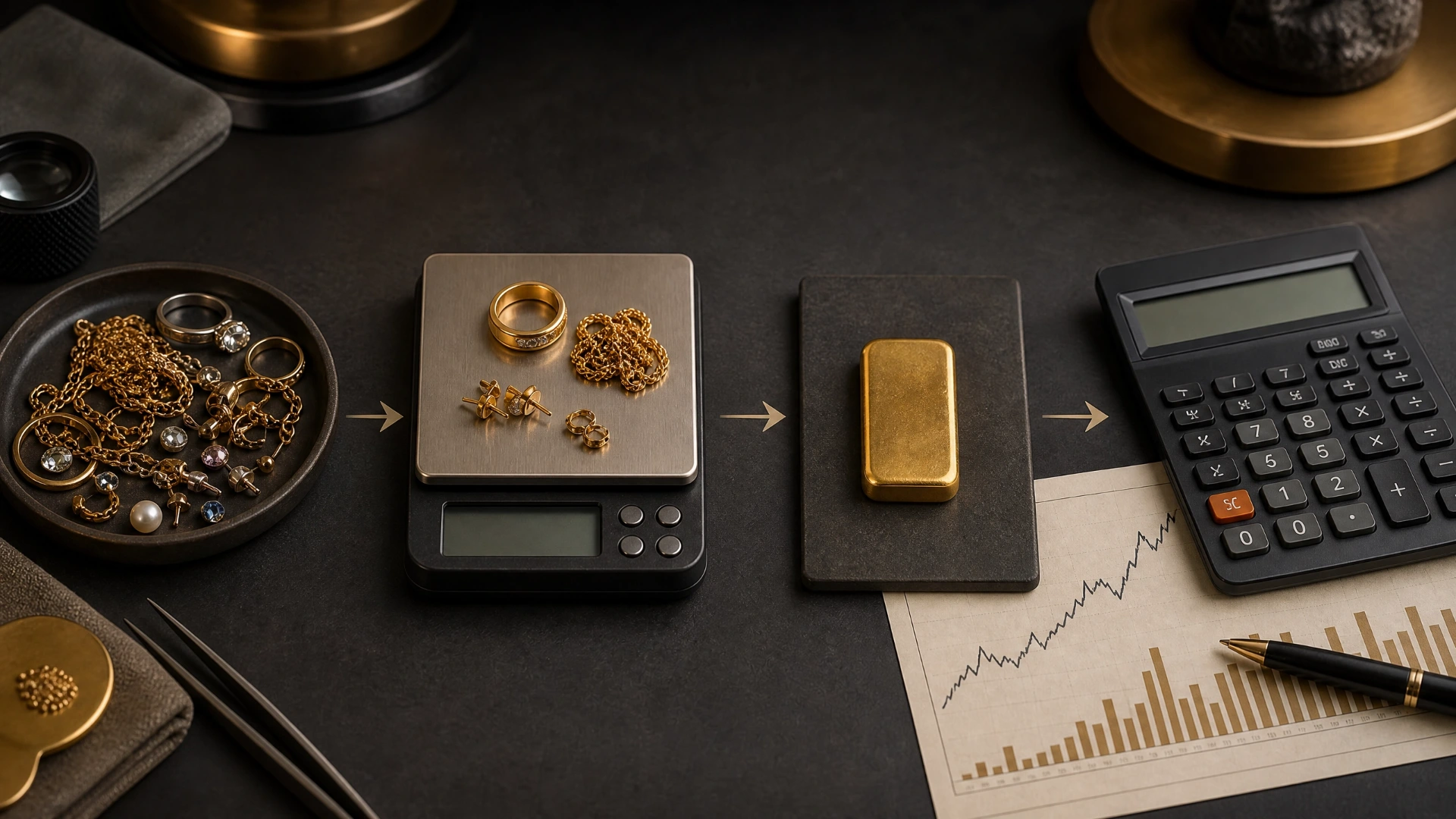
Four steps: strip out what is not gold, apply the fineness, convert to the pricing unit, apply the price and the payout. Here it is on a realistic lot, with the market price on the day written as P in dollars per troy ounce, since no evergreen article can print a live figure.
Step 1 — remove what is not gold.
A mixed lot weighs 41.2 g gross. Two stones and a steel spring clasp come out. The remaining gold weighs 37.4 g.
Step 2 — apply the fineness.
The pieces test as 14K, which is 58.33% gold.
37.4 g × 0.5833 = 21.82 g of fine gold.
Step 3 — convert to the pricing unit.
21.82 g ÷ 31.1034768 g = 0.7015 troy ounces.
(If your buyer quotes in pennyweights: 21.82 ÷ 1.55517384 = 14.03 dwt.)
Step 4 — apply the price and the payout.
Metal value = 0.7015 × P.
Offer = 0.7015 × P × the buyer's payout percentage.
Steps 1 to 3 are worth doing yourself on a kitchen scale before you go anywhere. You will not match a counter's numbers exactly — you cannot separate the solder or verify the karat at home — but you will know roughly the size of the figure you are discussing.
Where the buyer's margin sits, and why refining costs money
The gap between the fine metal value and the offer pays for refining, assay, lot handling and the price risk between buying and selling.
Refineries do not process a single ring. Scrap is accumulated into lots, melted, homogenised and assayed, and the refiner charges for treatment, assay and returned metal against that lot. A dealer buying across a counter is also carrying the market between the moment they pay you and the moment the metal is sold or hedged, and gold is quoted continuously — we set out how spot, premiums and dealer spreads work separately.
For scale, this is not a marginal supply channel: the USGS reports that in 2025 an estimated 90 tons of new and old gold scrap was recycled in the United States, equivalent to about 60% of reported consumption. The jewellery in a drawer is a meaningful part of the metal supply, and there is an established industrial process behind the offer.
What no article can honestly tell you is what percentage any given buyer pays, because it varies by buyer, by lot size and by what the material is. Ask for it as a number, and ask what it is a percentage of — the fine metal value, or something else.
What a written offer should show
A written offer should give you four lines: the gross weight, the karat or tested fineness, the resulting fine weight, and the basis of the price. With those four you can reconstruct the calculation in about a minute, in the room, before you accept anything. Without them you are working from a conclusion rather than a calculation, and plenty of buyers will produce them if you ask.
What Virginia law requires when you sell gold here
Selling gold in Virginia requires photo identification showing your current address, a second corroborating document, a photograph of the ID, and a report to law enforcement within 24 hours. Virginia regulates precious metals dealers closely, and all of what follows happens at every counter in the Commonwealth. Under the Code of Virginia, Title 54.1, Chapter 41:
- § 54.1-4102 — the dealer must obtain an unexpired government photo ID showing your current legal address, plus corroborating identification. Where the ID does not carry a current address, further verification is required.
- § 54.1-4101 — the dealer keeps records for 24 months, including a digital image of the identification, and delivers the record of purchase to local law enforcement within 24 hours.
- § 54.1-4103 — no purchases from sellers under 18.
- § 54.1-4108 — a permit is required from the chief law-enforcement officer of every jurisdiction in which a dealer operates.
- § 54.1-4104 — purchased items are retained at least 15 calendar days from law enforcement's receipt of the bill of sale, unaltered, unsold, and not removed from the jurisdiction.
That last one is routinely misread, so it is worth stating plainly: the 15-day period restricts what the dealer may do with the item. It does not delay payment to you. Your money and the item's holding period are separate matters.
None of the above is anybody's shop policy. It is the statute, it applies to every permitted dealer in the Commonwealth, and it is why you will be asked for two forms of identification to sell a broken chain.
How it works at our counter
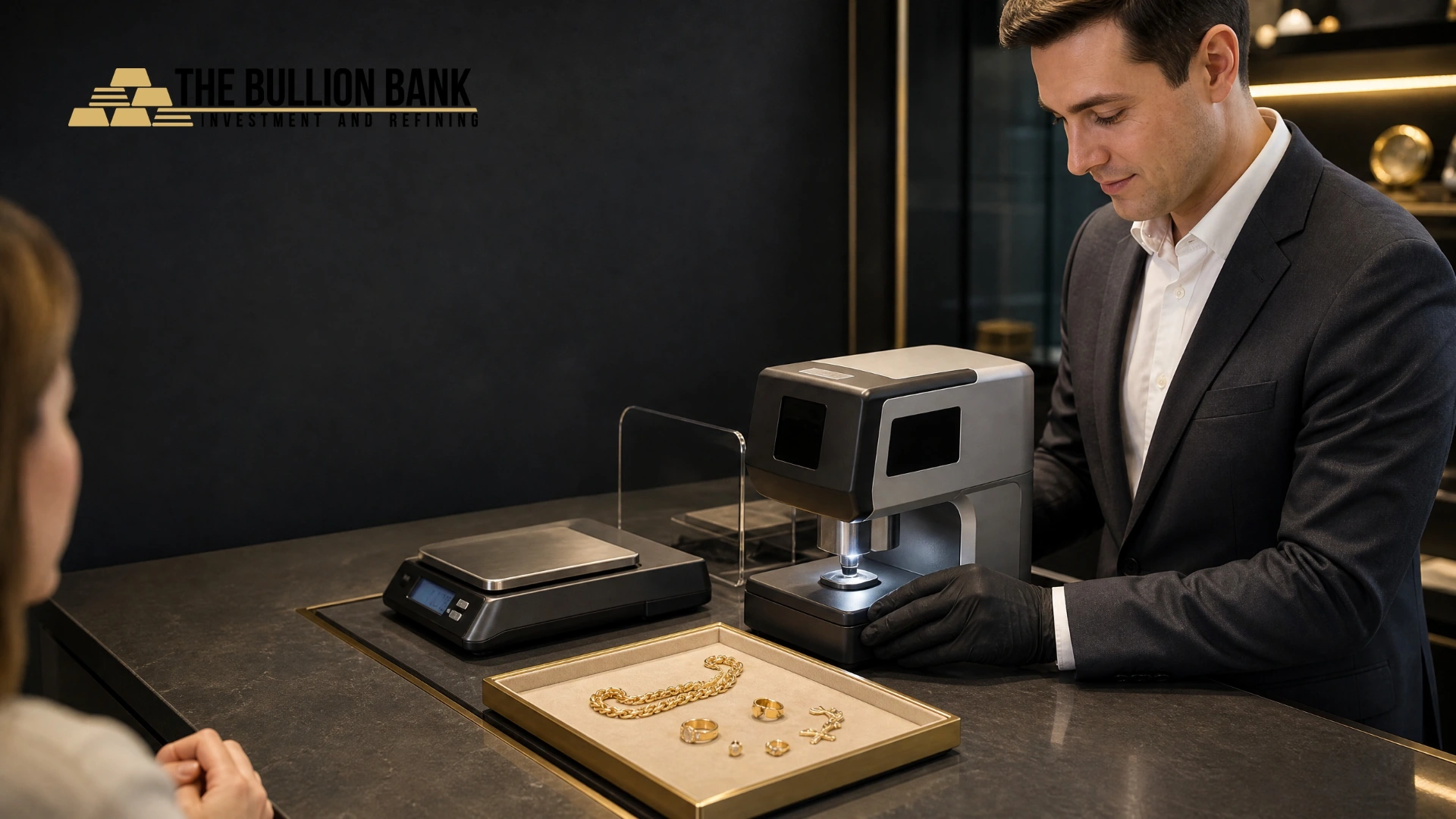
The Bullion Bank has been buying and selling precious metals in Northern Virginia since 2008, across two locations in Chantilly and Vienna. What the counter accepts runs to gold jewellery, coins and scrap, silver flatware and jewellery, estate pieces, dental gold, and — though they are a different conversation from this one — diamonds and luxury watches. Testing is done with X-ray fluorescence while you watch, which is the part of the process most worth seeing rather than being told about.
This article is educational and reflects general information about precious metals and collectible coins. It is not investment, tax or legal advice, and The Bullion Bank is not a registered investment adviser, broker-dealer or tax professional. Metal prices fluctuate and past performance does not indicate future results. Consult a qualified professional about your own situation.
Frequently asked questions
How is scrap gold price calculated?
Gross weight of the gold, multiplied by its fineness, gives the fine gold weight. That is converted into troy ounces and multiplied by the market price of gold on the day, and then by the buyer's payout percentage. Anything that is not gold — stones, clasps, base-metal findings — comes out before the first step.
What does 585 mean on gold jewellery?
It means 585 parts gold in 1,000, or 58.5% gold, which is the conventional European mark for 14 karat. Fourteen twenty-fourths is exactly 58.33%, and both 583 and 585 appear on genuine 14K pieces.
What is 14K gold worth per gram?
One gram of 14K contains 0.5833 g of fine gold, so the value of the metal is 0.5833 multiplied by the price of gold per gram on the day you check. No article can print the figure itself, because the market price moves continuously — the useful thing to memorise is the multiplier, not the answer.
Is my gold jewellery worth more sold as jewellery or as scrap?
It depends on whether the piece has value beyond its metal. A signed piece, a period design, or one set with stones of consequence may be worth more intact, because the metal value ignores everything except weight and purity. A broken chain, a single earring or a worn wedding band generally has no value above its metal. Both routes are worth understanding before you commit to either.
Do gold buyers pay for the stones?
Not as part of a scrap calculation, which values gold by weight and purity only. Stones are usually removed and returned, or assessed separately if they are worth assessing. If someone weighs a stone-set ring gross and quotes you a gold price on the whole weight, ask how the stones were treated.
What is a pennyweight?
A pennyweight, abbreviated dwt, is a troy unit equal to 1.55517384 grams, with 20 pennyweights to the troy ounce. Some buyers still quote in pennyweights, so it is worth confirming which unit a quoted price refers to before comparing two offers.
Why is the offer less than the melt value?
Because the metal has to be refined before it is metal anyone can sell. Refiners work in accumulated lots and charge for treatment, assay and returned metal, and the buyer also carries the market between paying you and selling the gold on. The size of that gap varies by buyer, which is why it is worth asking for it as a percentage.
Does the buyer keep the difference between karat and the marked fineness?
There is very little difference to keep. The National Stamping Act tolerances referenced by the FTC Jewelry Guides allow three parts per thousand of variance without solder and seven parts per thousand with it, so a marked piece testing slightly under its stamp is within a permitted range rather than a discovery. An offer is normally quoted on the tested fineness rather than on the stamp, which is why asking what fineness was used in the calculation is a reasonable question.
Do I need ID to sell gold in Virginia?
Yes. Section 54.1-4102 of the Code of Virginia requires an unexpired government photo ID showing your current legal address, plus corroborating identification, and § 54.1-4101 requires the dealer to keep a digital image of it and report the purchase to local law enforcement within 24 hours. This applies to every permitted dealer in the Commonwealth.
Does Virginia's 15-day holding period delay my payment?
No. Section 54.1-4104 requires the dealer to keep the purchased item unaltered, unsold and within the jurisdiction for at least 15 calendar days after law enforcement receives the bill of sale. It governs what the dealer may do with the item; it has nothing to do with when the seller is paid.
Where can I sell scrap gold in Chantilly or Vienna?
We buy at our Chantilly and Vienna locations — 4086 Airline Pkwy, Chantilly, VA 20151, (703) 705-5151, and 131 Maple Ave W, Vienna, VA 22180, (703) 705-5252. Both are open Monday to Friday 11:00–18:00 and Saturday 11:00–17:00, closed Sunday.
Bring It In and See How the Offer Is Built
If you have gold you are thinking about selling, bring it in and we will test it with XRF in front of you, make an offer against live market pricing the same day, and pay on acceptance. Bring photo identification showing your current address and a second form of ID — Virginia law requires both, from every dealer.
Chantilly
The Bullion Bank
4086 Airline Pkwy
Chantilly, VA 20151
(703) 705-5151
Vienna
The Bullion Bank
131 Maple Ave W
Vienna, VA 22180
(703) 705-5252
Hours at both locations: Monday–Friday 11:00–18:00 · Saturday 11:00–17:00 · Sunday closed