Published by
Gold Expert
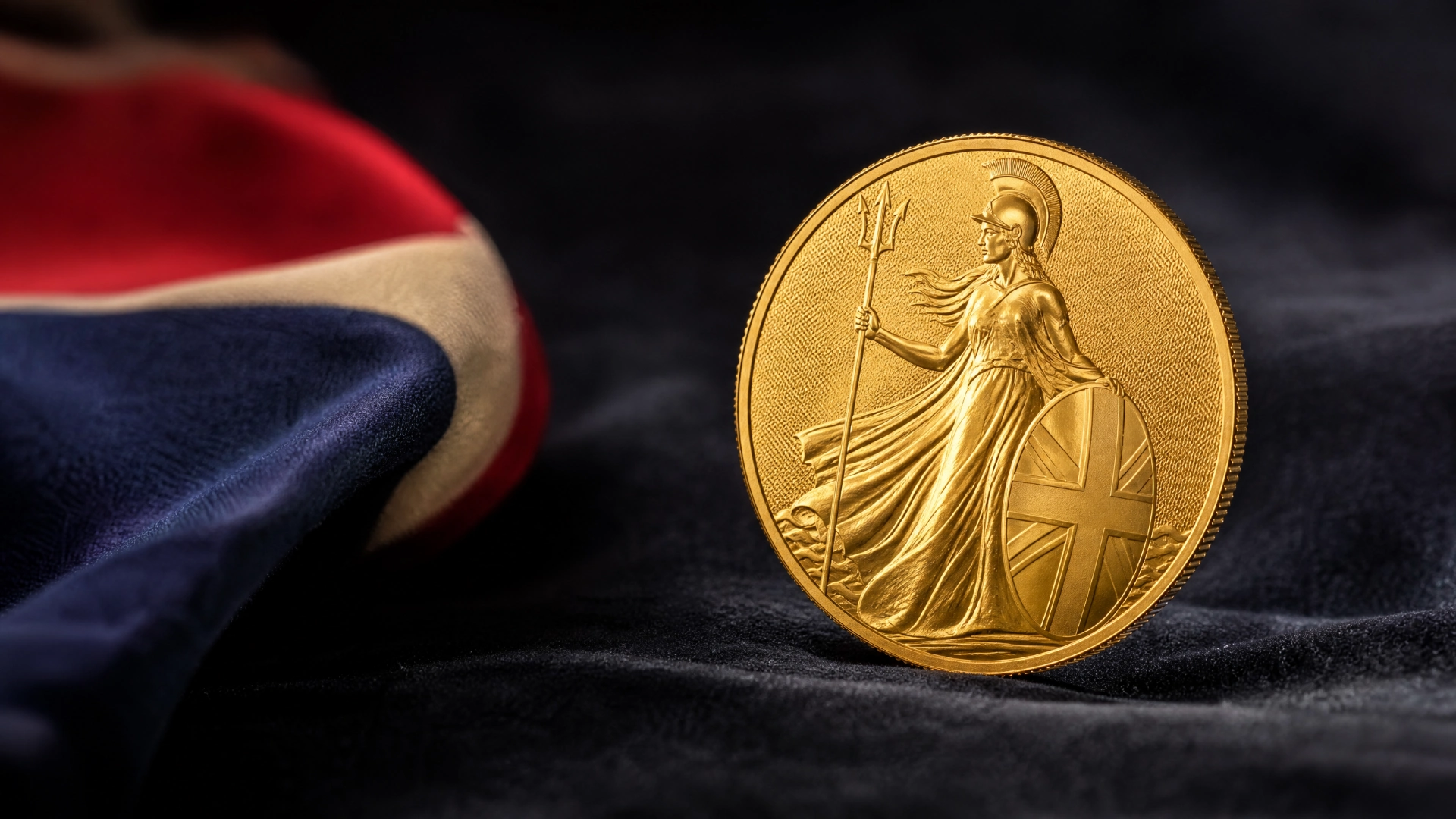
The Britannia is the Royal Mint's flagship gold bullion coin, issued since 1987 and named for the figure of Britannia on its reverse. The single most important fact about any Britannia you are handed is its year, because the coin changed specification partway through its life: struck in 22 carat gold from 1987 through 2012, and in 999.9 fine gold from 2013 onward. (This article uses the Royal Mint's spelling, "carat," where a US dealer would write "karat" — same measure, twenty-fourths of pure gold.) Two coins with the same name, each holding a full troy ounce of gold, with different weights, different alloys and different eligibility under US retirement account rules.
This is what the Britannia is, what the 2021 security features actually do, and what changes hands when one trades.
What the Britannia is
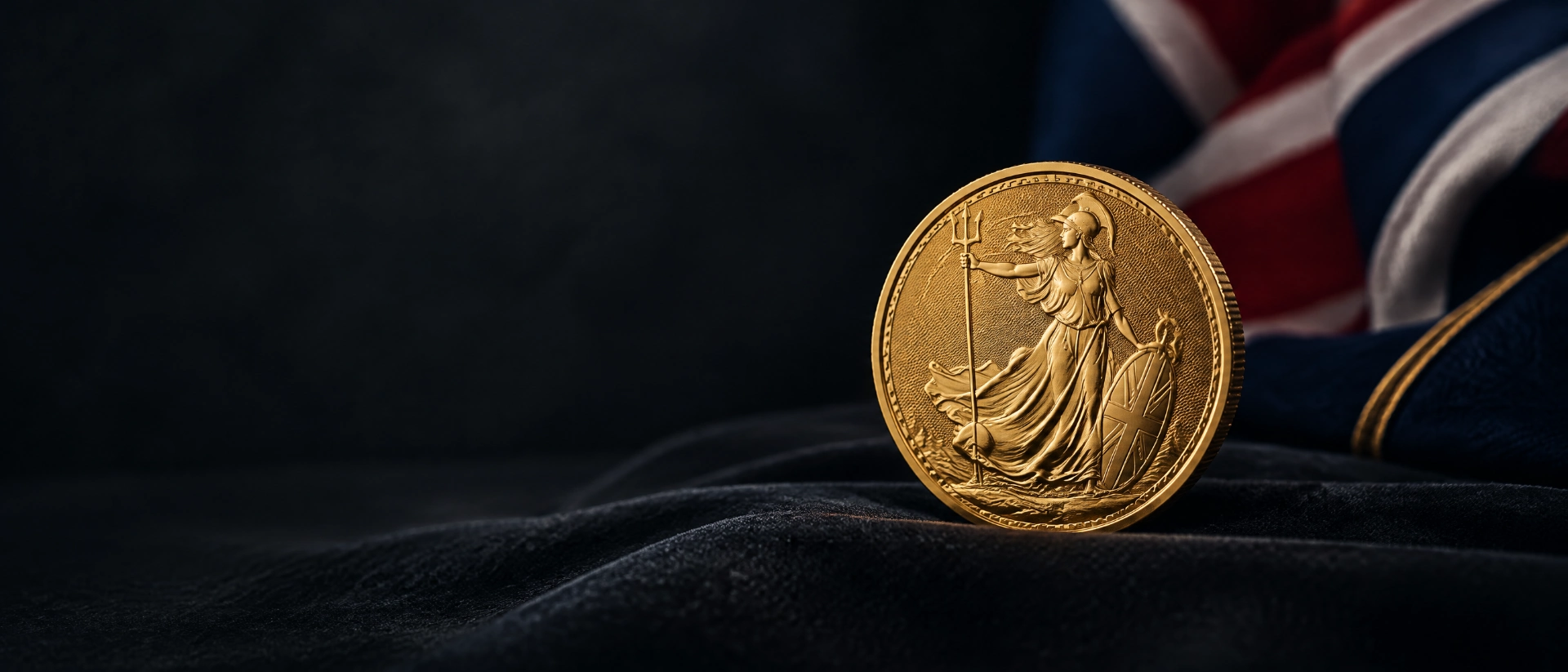
The Royal Mint introduced the Britannia range in 1987 as Britain's answer to the sovereign bullion coins already established elsewhere. Per the Mint's published specification for the one-ounce gold coin, it carries a face value of £100 and measures 32.69 mm across, with Philip Nathan's standing Britannia — helmeted, trident in hand, shield at her side — on the reverse of current issues and the reigning monarch on the obverse. The range extends below one ounce, and there are silver and platinum Britannias alongside the gold.
Because it is a coin of the realm rather than a private product, it goes through the Trial of the Pyx, the annual test in which the Royal Mint's output is checked for weight and quality. The Mint says Britannia coins have their weight and quality verified at that centuries-old annual trial, held at Goldsmiths' Hall. That is an unusual layer of external verification for a bullion product, and it is part of why the coin travels well between markets.
The 2013 purity change, and why it is the first thing to check
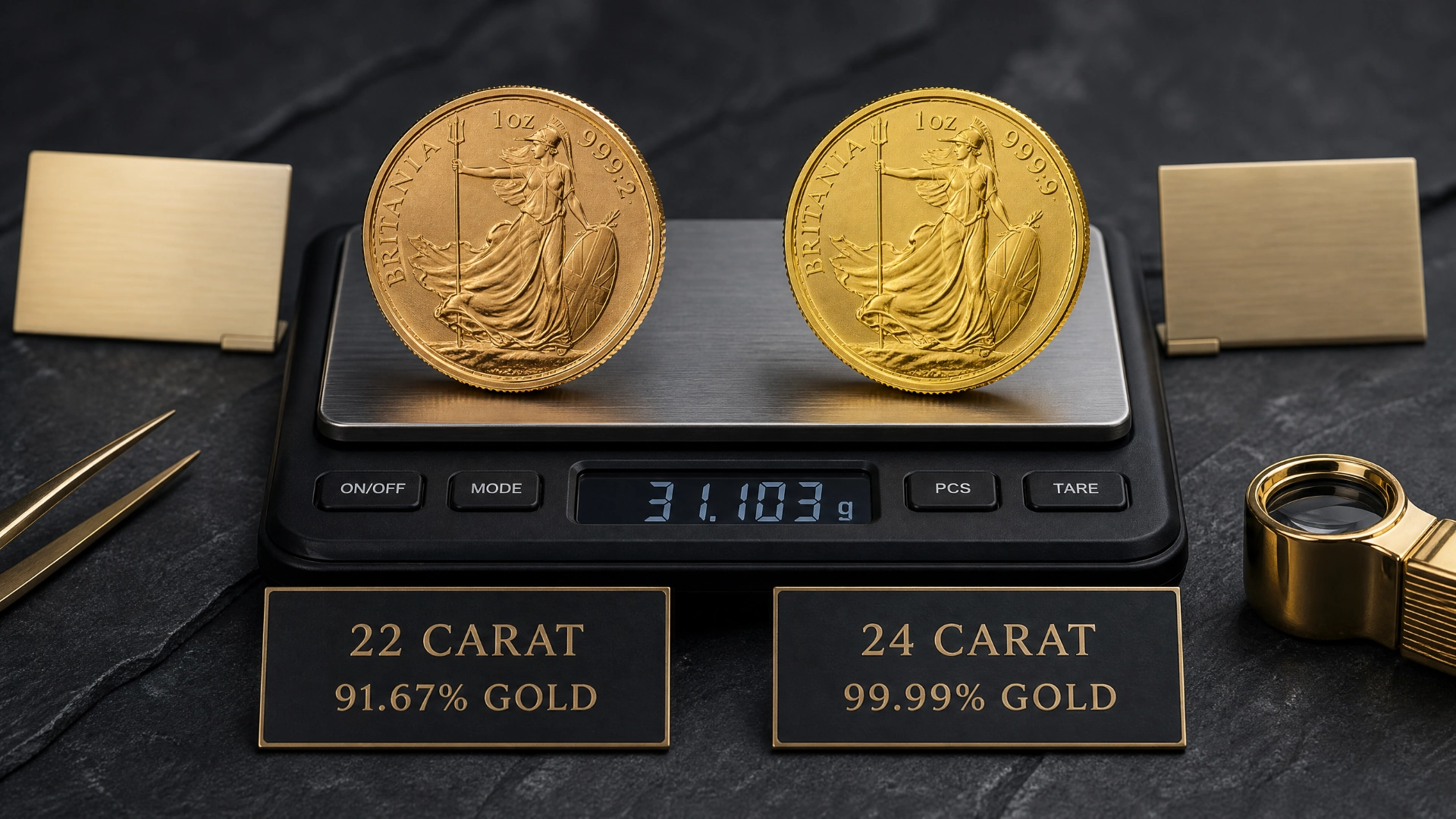
The Royal Mint states the change plainly on its page on the benefits of the Britannia bullion coin: "initially struck in 22 carat gold when it was introduced in 1987, the Britannia bullion coin has been struck in 24 carat gold since 2013, giving it a purity of 999.9."
Both versions contain one troy ounce of fine gold. The difference is what else is in them. A 22 carat coin is 916.7 parts gold per thousand, with the balance made up of other metals, so the older Britannia is physically heavier overall than the modern one and has a slightly different color and feel. A 999.9 coin is essentially all gold, which makes it softer and easier to mark, so handling matters more than it did with the 22 carat version.
This matters at a counter for three practical reasons. A gross weight that looks wrong may simply mean you are holding the other version, so check it against the published specification for that coin's year rather than against the modern one. The two do not always trade at the same premium, because they appeal to different buyers. And the purity difference decides eligibility under the US retirement account rules described below — which is the one place where the distinction has a hard legal consequence rather than a cosmetic one.
The four security features, and what they actually do
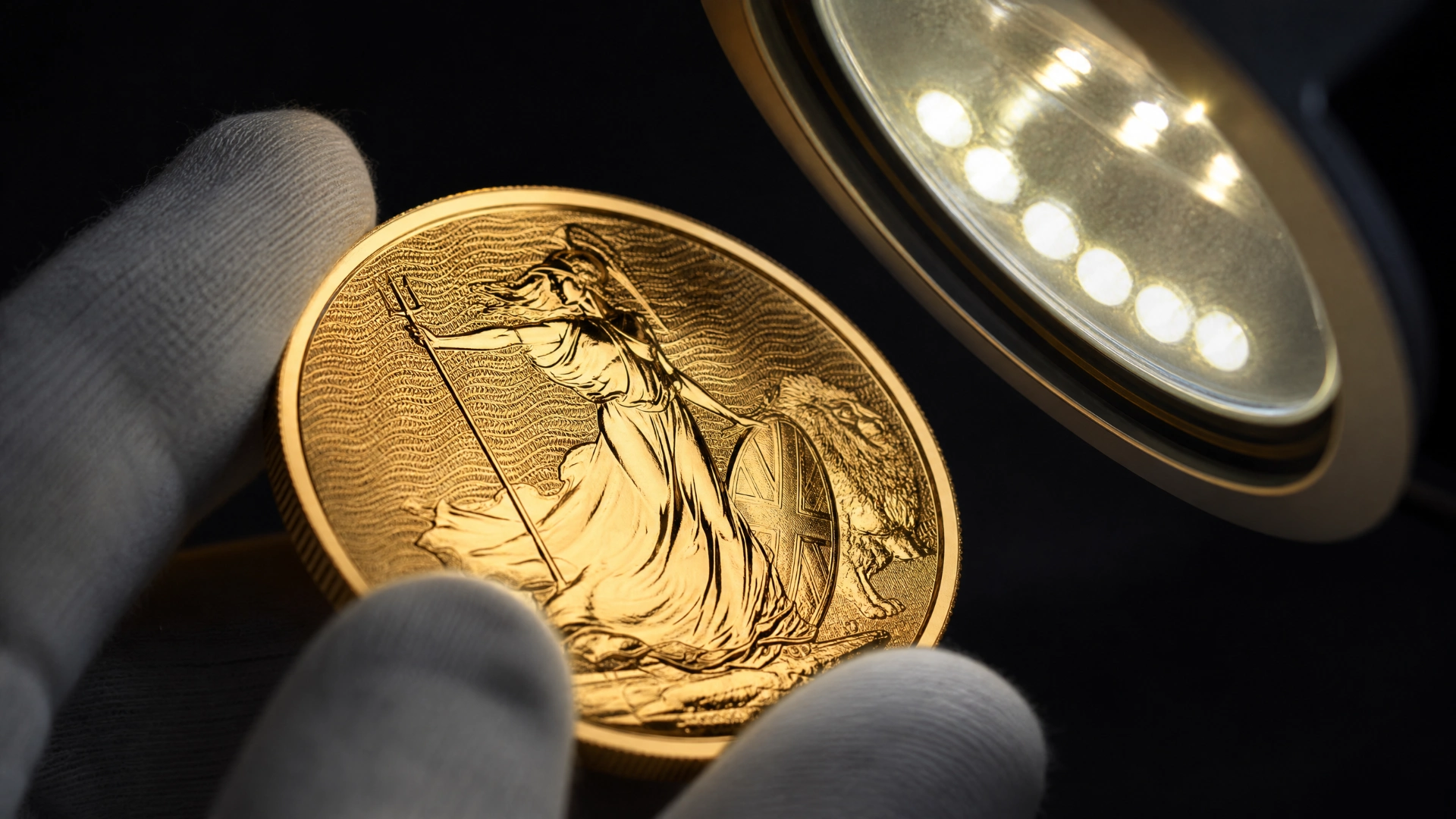
The Royal Mint added four visual security features to the Britannia, first carried on the 2021-dated bullion coins and set out on its own page on Britannia security features. They are worth learning because they are checkable by eye, with no equipment, by anyone willing to tilt a coin under a light.
- Latent image. An element that "changes from a padlock to a trident when the coin is seen from different angles."
- Surface animation. "Micro details on the coin combine to create the illusion of waves rolling behind the figure of Britannia."
- Micro-text. The inscription DECUS ET TUTAMEN — "an ornament and a safeguard" — which "surrounds the figure of Britannia, and is created using specialist lasers."
- Tincture lines. The heraldic convention of representing color through engraved line patterns. The Mint's specification for the 2021 one-ounce gold coin describes Union Flag accents with tincture lines on Britannia's shield.
The Mint's own account of how these were produced explains why they are hard to copy: these are cut with picosecond lasers, and the indents involved are described as "200 times narrower than the width of a human hair." Reproducing that needs the equipment, not just the intent.
Two limits are worth stating, because the features are easy to over-read. First, they appear on 2021 and later coins. Their absence on a 2016 Britannia tells you nothing at all — the feature did not exist yet — so the check is only meaningful once you have established the year. Second, a visual feature confirms that the surface was struck the way the Mint strikes surfaces. It does not confirm what is underneath it. Plated and filled fakes are defeated by density and composition testing, not by looking, which is why a counter check normally pairs the visual inspection with an instrument. We have set out how that side works in our explanation of XRF gold testing.
Pre-2013 and post-2013 at a glance
| 1987–2012 | 2013 onward | |
|---|---|---|
| Purity | 22 carat, 916.7 fine | 24 carat, 999.9 fine |
| Fine gold content | One troy ounce | One troy ounce |
| Gross weight | Heavier — alloy adds to the ounce of gold; check the year's own specification | Essentially the ounce itself |
| Face value (1 oz gold) | £100 | £100 |
| Surface hardness | Harder; more forgiving of handling | Softer; marks more easily |
| 2021 security features | Not present | Present on 2021 and later issues |
| Meets the § 408(m)(3)(B) fineness test | No — below 995 | Yes — 999.9 exceeds 995 |
How the Britannia trades
Liquidity in a bullion coin comes from recognition, and the Britannia has it: a sovereign issue from a mint with a long institutional record, sold internationally, with a two-way market wherever gold coins are traded. A dealer who knows the coin does not need to research it before making an offer, and that is most of what liquidity means in practice.
Premium — the amount above the metal value that a coin costs to buy — is a function of fabrication, distribution and demand rather than of the gold itself, and it moves. Premiums on any given coin change with wholesale availability and with what is happening in the market that week, which is why no article should print one. The mechanics of how spot, premium and dealer spread fit together are covered in our guide to reading gold and silver prices, and current pricing sits on our bullion pages.
One structural factor is specific to this coin and explains a good deal about its home market. The Royal Mint states that "due to their status as UK legal tender, Britannia bullion coins are exempt from Capital Gains Tax (CGT) for UK residents," and that its gold bullion coins and bars are also exempt from Value Added Tax. That is British tax law applying to British taxpayers. It says nothing whatever about how a US buyer is treated, and it is not a reason for a US buyer to prefer the coin. What it does explain is why UK demand for Britannias is deep and persistent, which supports the coin's international liquidity — including on this side of the Atlantic. For your own tax position, in either country, talk to a tax professional.
Britannia and IRA eligibility: a purity test, not an approval
There is no such thing as an IRS-approved coin. What exists is a statutory test, and the Britannia's relationship to it is decided entirely by the 2013 change.
Under 26 U.S.C. § 408(m)(3)(B), the collectible treatment that otherwise applies to coins and metals does not apply to "any gold, silver, platinum, or palladium bullion of a fineness equal to or exceeding the minimum fineness that a contract market… requires for metals which may be delivered in satisfaction of a regulated futures contract, if such bullion is in the physical possession of a trustee." For gold, that reference point is the COMEX contract, and CME Group's gold futures specification states that "gold delivered under this contract shall assay to a minimum of 995 fineness."
So a 999.9 Britannia clears the fineness threshold and a 916.7 Britannia does not. Note the second half of the statutory sentence as well: the metal has to be in the physical possession of a trustee. A qualifying coin sitting in a drawer at home is not in a retirement account, whatever its purity.
This article describes the statutory purity test and nothing beyond it. Whether a particular account can hold a particular coin, and what the tax consequences would be, are questions for that account's custodian and for a tax professional, not for a coin dealer.
What to look at before you buy or sell one
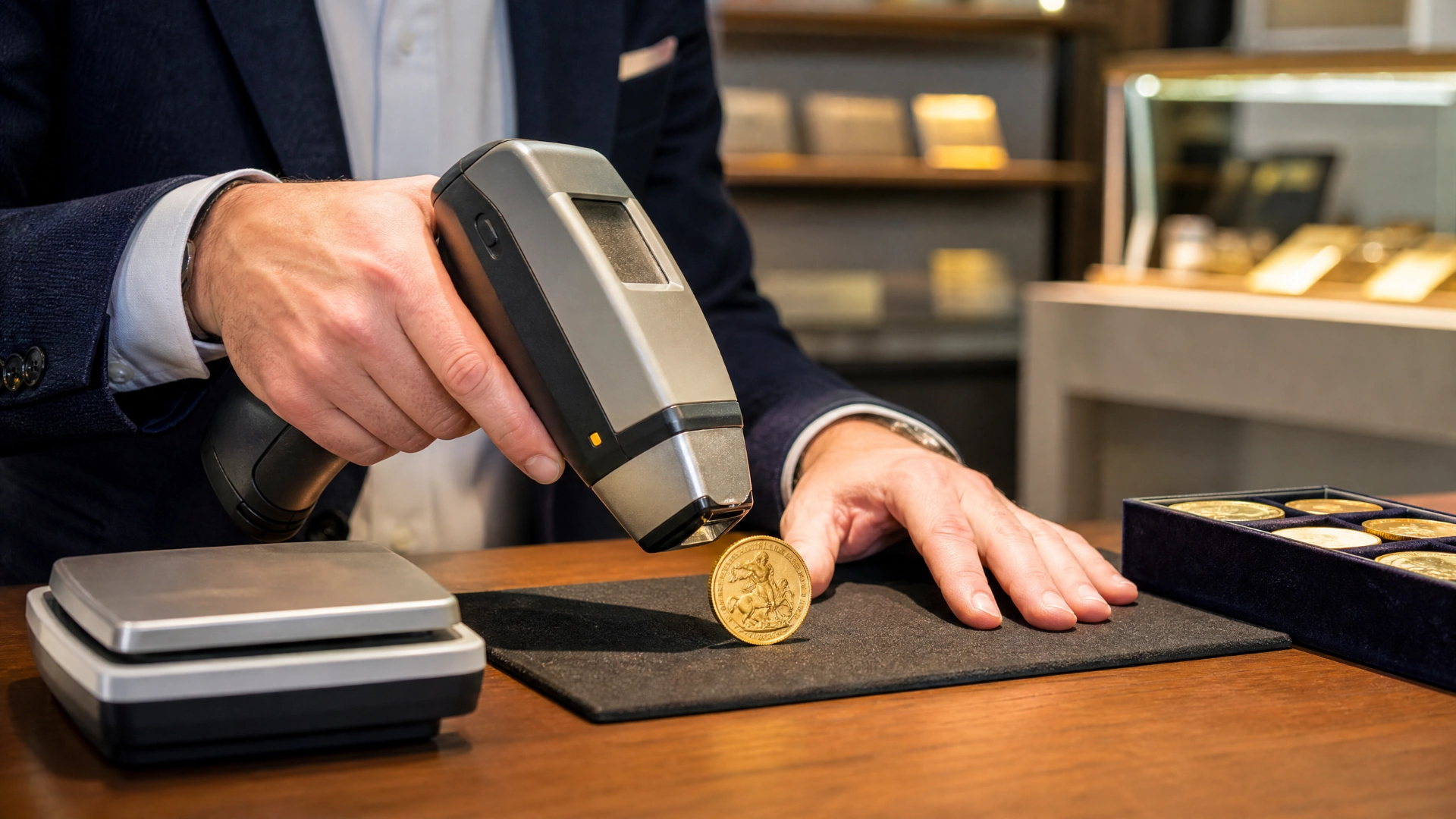
Start with the year, since it settles purity, weight and whether the security features should be there at all. Check the coin against the published specification — 32.69 mm for the one-ounce gold piece — because diameter is one of the hardest things for a counterfeit to get right alongside weight. On a 2021 or later coin, tilt it under a light and look for the padlock-to-trident transition and the wave animation; on an earlier coin, rely on weight, dimensions and instrument testing instead.
Then look at how it is packaged. Modern Britannias are soft, and a coin that has been out of its capsule and loose in a drawer will show it. For bullion sold as bullion that is a cosmetic matter and not a pricing one, but it is worth knowing which conversation you are having before you start.
Finally, ask whether the testing happens in front of you. A dealer who will put a coin under an analyzer while you watch is showing you something a certificate cannot, and it is a fair question to ask at any counter.
Where The Bullion Bank fits
We have been buying and selling precious metals in Northern Virginia since 2008, from two stores in Chantilly and Vienna. On the buy side, metal content and purity are assessed by X-ray fluorescence analysis in front of you, with a same-day offer against live market pricing and payment on acceptance — the process set out on our cash for gold page. No appointment is necessary and walk-ins are welcome during normal business hours.
On the buy-and-sell side we trade gold, silver, platinum and palladium coins, bars and rounds, alongside numismatic US and world coins. Stock of any individual sovereign coin changes with what is available at wholesale, so if you are looking for a particular Britannia year or size, call the store and ask what is in the case rather than assuming.
This article is educational and reflects general information about precious metals and collectible coins. It is not investment, tax or legal advice, and The Bullion Bank is not a registered investment adviser, broker-dealer or tax professional. Metal prices fluctuate and past performance does not indicate future results. Consult a qualified professional about your own situation.
Frequently asked questions
How can I tell a 22 carat Britannia from a 24 carat one?
The date is the reliable test: 1987 through 2012 are 22 carat and 2013 onward are 999.9 fine. Gross weight confirms it, since the older coin carries alloy on top of its ounce of gold and therefore weighs more overall. Color is a supporting clue rather than proof — the 22 carat coin reads slightly warmer against a 999.9 piece.
Does a Britannia without the security features mean it is fake?
No. The four features arrived with the 2021-dated bullion coin, which the Royal Mint describes as "now enhanced with four landmark features". Earlier coins do not carry them, so their absence proves nothing about a 2015 or a 2003 issue. Establish the year first. On a 2021 or later coin the features should be present, and a coin of that date without them is worth a closer look.
Is the Britannia eligible for a precious metals IRA?
The 999.9 coins struck from 2013 meet the fineness test in 26 U.S.C. § 408(m)(3)(B), since COMEX requires a minimum of 995 fineness for deliverable gold; the pre-2013 22 carat coins at 916.7 do not. The statute also requires the metal to be held by a trustee. Whether your own account can hold one is a question for your custodian and a tax professional.
Is a Britannia a better buy than an American Gold Eagle?
They are built to different specifications rather than to different standards of quality: the modern Britannia is 999.9 fine, and the Gold Eagle is a 22 karat coin containing one ounce of fine gold. Recognition, premium and availability all vary by market and by week. The useful comparison is the one you can make on the day, against live pricing, for the sizes actually in stock.
Do UK tax rules affect me as a US buyer?
No. The Royal Mint's statement that Britannias are exempt from Capital Gains Tax describes UK legal tender treatment for UK residents, and it has no bearing on a US taxpayer's position. It is relevant here only because it helps explain why the coin has a deep home market, which supports its liquidity internationally. Your own treatment is a question for a tax professional.
Come and look at one
Bring a Britannia in and we will check the year, the specification and the metal with you at the counter, and tell you what we see either way. Both stores are open six days a week.
Chantilly
The Bullion Bank
4086 Airline Pkwy
Chantilly, VA 20151
(703) 705-5151
Vienna
The Bullion Bank
131 Maple Ave W
Vienna, VA 22180
(703) 705-5252
Both locations: Monday–Friday 11:00–18:00 · Saturday 11:00–17:00 · Sunday closed