Published by
Gold Expert
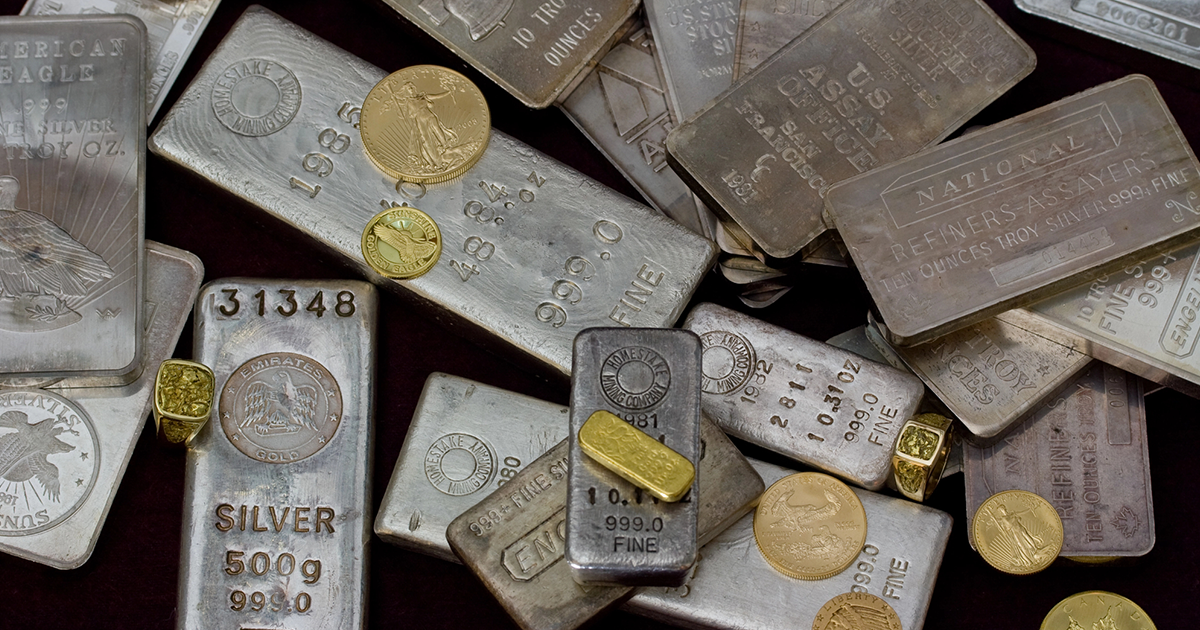
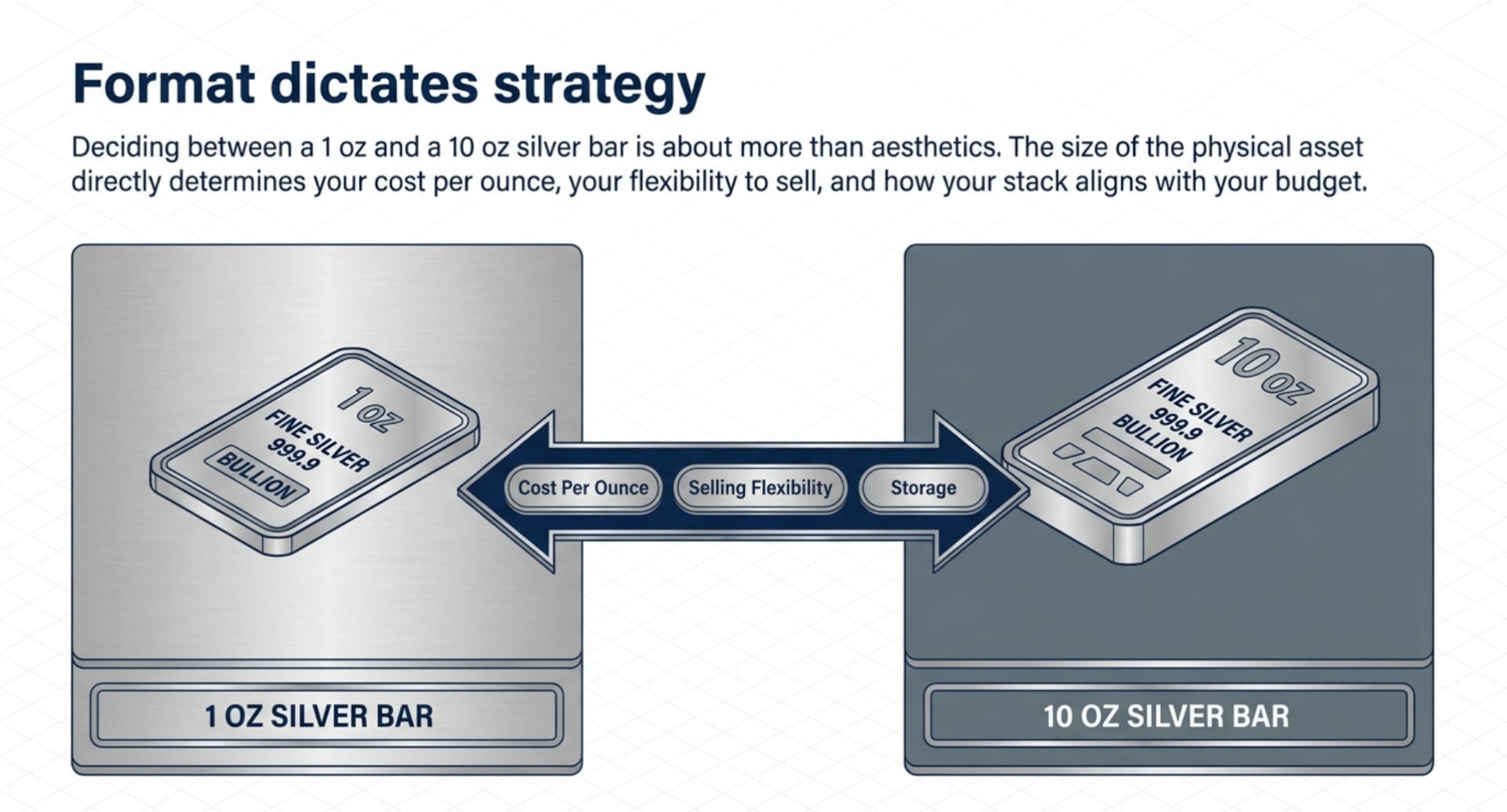
If you are trying to decide whether it is better to buy 1 oz or 10 oz silver bars, you are already ahead of most new buyers by focusing on size, not just price. The size of each bar directly affects your cost per ounce, how easy it is to sell, and how well your silver stack fits your budget and goals.
This guide explains which silver bar size is best for first time buyers, how bar size affects silver premiums and resale options, how coins compare to bars, and how to choose silver bar sizes based on your budget and time horizon. It also touches on whether silver is a good investment and how to start investing in silver in a practical, step‑by‑step way.
TL;DR for beginners (ultra‑short)
- 1 oz bars = maximum flexibility, higher premiums.
- 10 oz bars = better cost per ounce, less granular selling.
- Beginners: start with 1 oz or mix 1 oz + 10 oz.
- Long‑term stackers: lean toward 10 oz, keep some 1 oz.
- Bars and coins can work together in one silver strategy.
Key definitions: premiums and liquidity
What is silver premium?
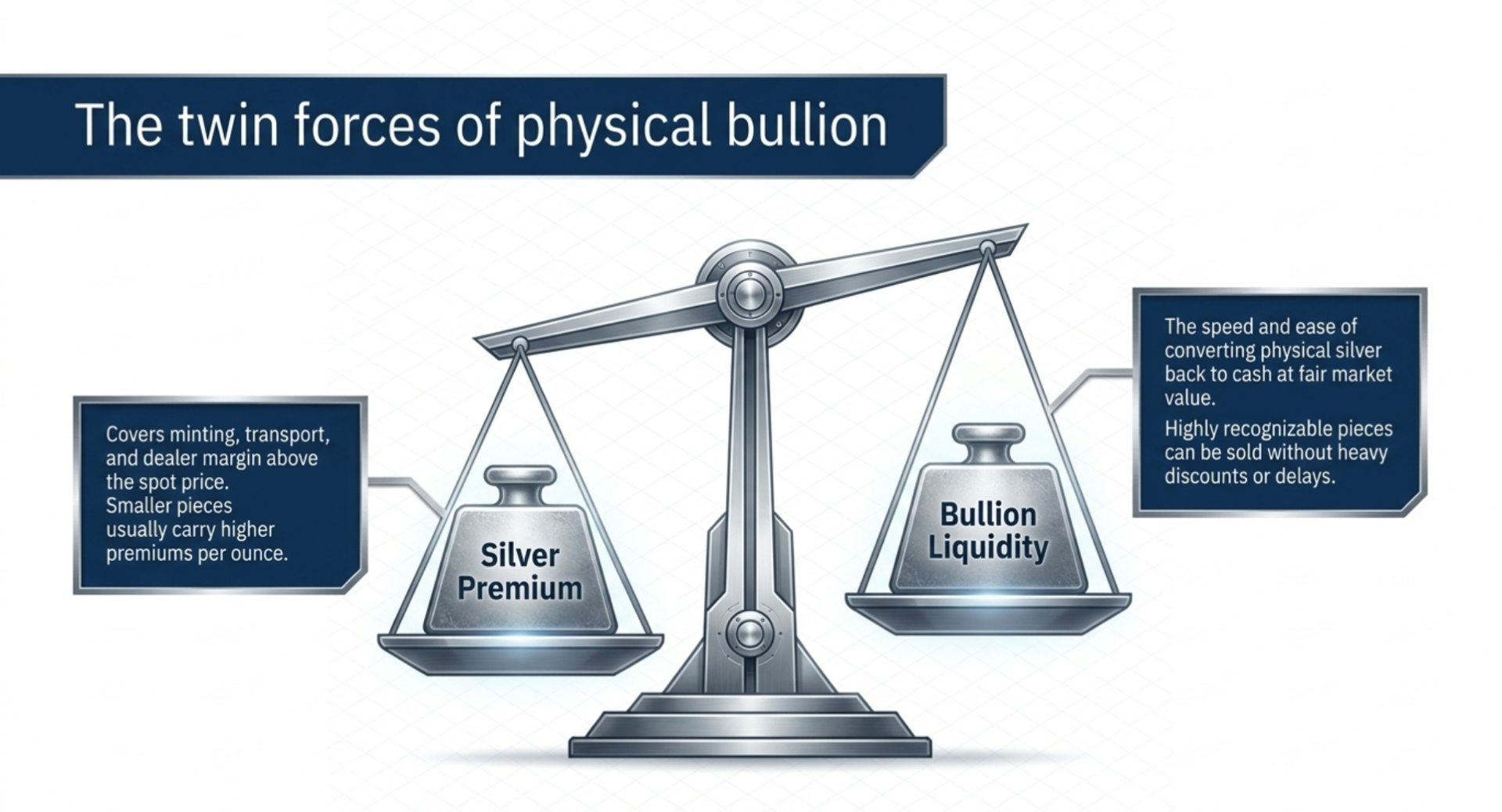
A silver premium is the extra amount you pay above the silver spot price for a bar or coin. It covers minting, transport, and dealer margin, and it is usually higher for smaller pieces and lower for larger ones on a per‑ounce basis.
What is liquidity in bullion?
Liquidity in bullion is how quickly and easily you can turn your silver into cash at a fair market price. High‑liquidity pieces are widely recognized and commonly traded, so you can sell reasonable amounts without heavy discounts, delays, or complex arrangements.
Is silver a good investment for you?
Silver is often used as a hedge against inflation, currency risk, and financial stress, because it is a tangible asset with a long history of monetary use. It tends to be more volatile than gold but also more affordable per ounce, which makes it attractive for smaller investors who want to build a position gradually.
Whether silver is a good investment for you depends on your risk tolerance, time horizon, and expectations: it is better viewed as a long‑term store of value and portfolio diversifier, not a guaranteed short‑term trade. Physical silver bars and coins add the extra benefit of removing counterparty risk, since you hold the metal directly rather than relying on a paper claim.
How to start investing in silver step by step
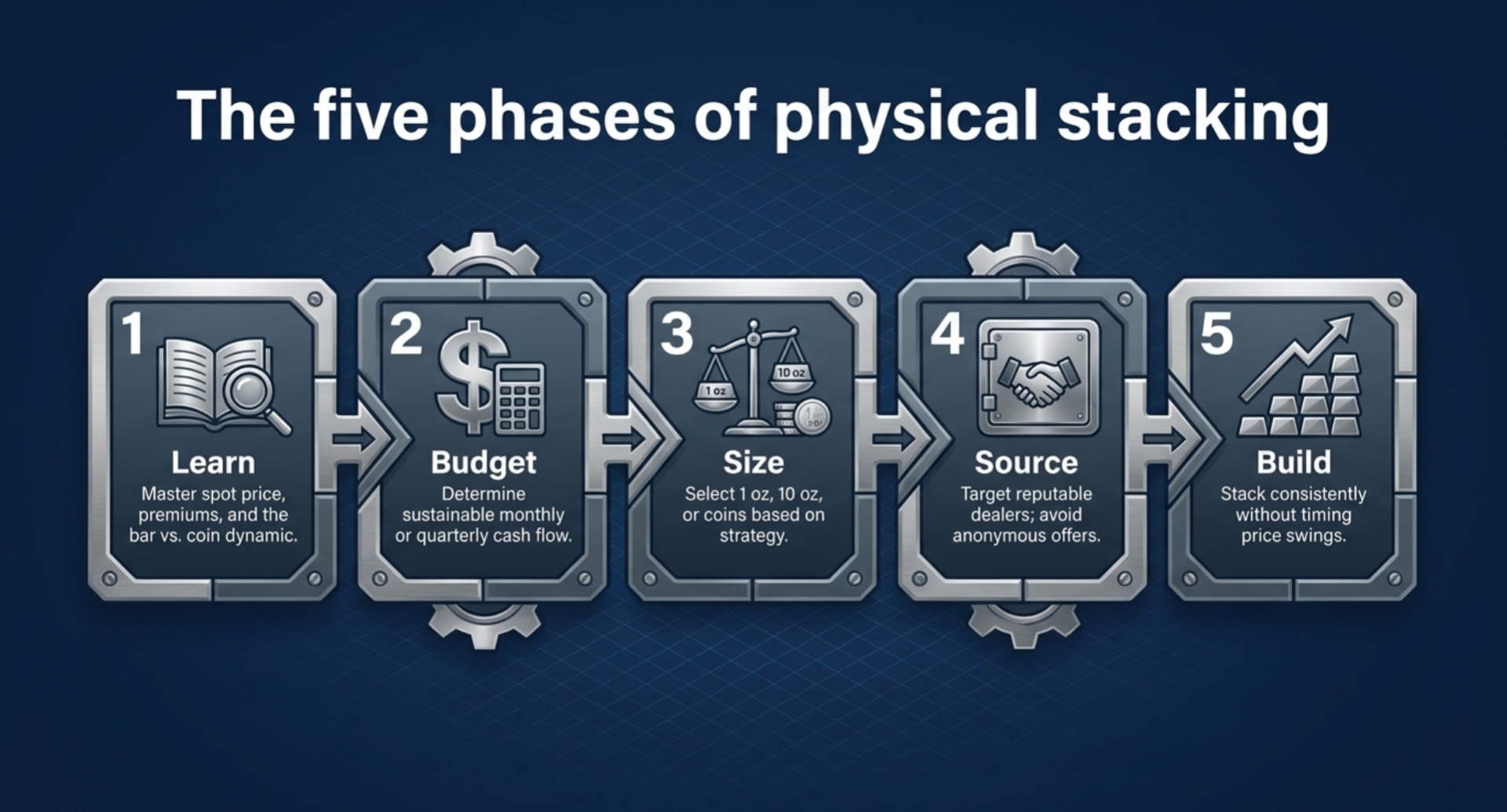
If you are wondering how to start investing in silver, a simple sequence works well:
- Learn the basics: Understand spot price, premiums, and the difference between bars and coins.
- Set a budget: Decide what you can comfortably invest monthly or quarterly without stressing cash flow.
- Choose format and size: Start with common sizes (1 oz and 10 oz silver bars, plus possibly some coins).
- Pick trusted sources: Focus on reputable bullion dealers and recognizable brands; avoid anonymous or unclear offers.
- Build consistently: Add to your position over time rather than trying to time every price swing.
For broader context on how silver fits into a safe‑haven strategy alongside gold, pair this article with a bullion primer.
Silver bar size basics: what really changes when you size up?
How bar size affects premiums and cost per ounce
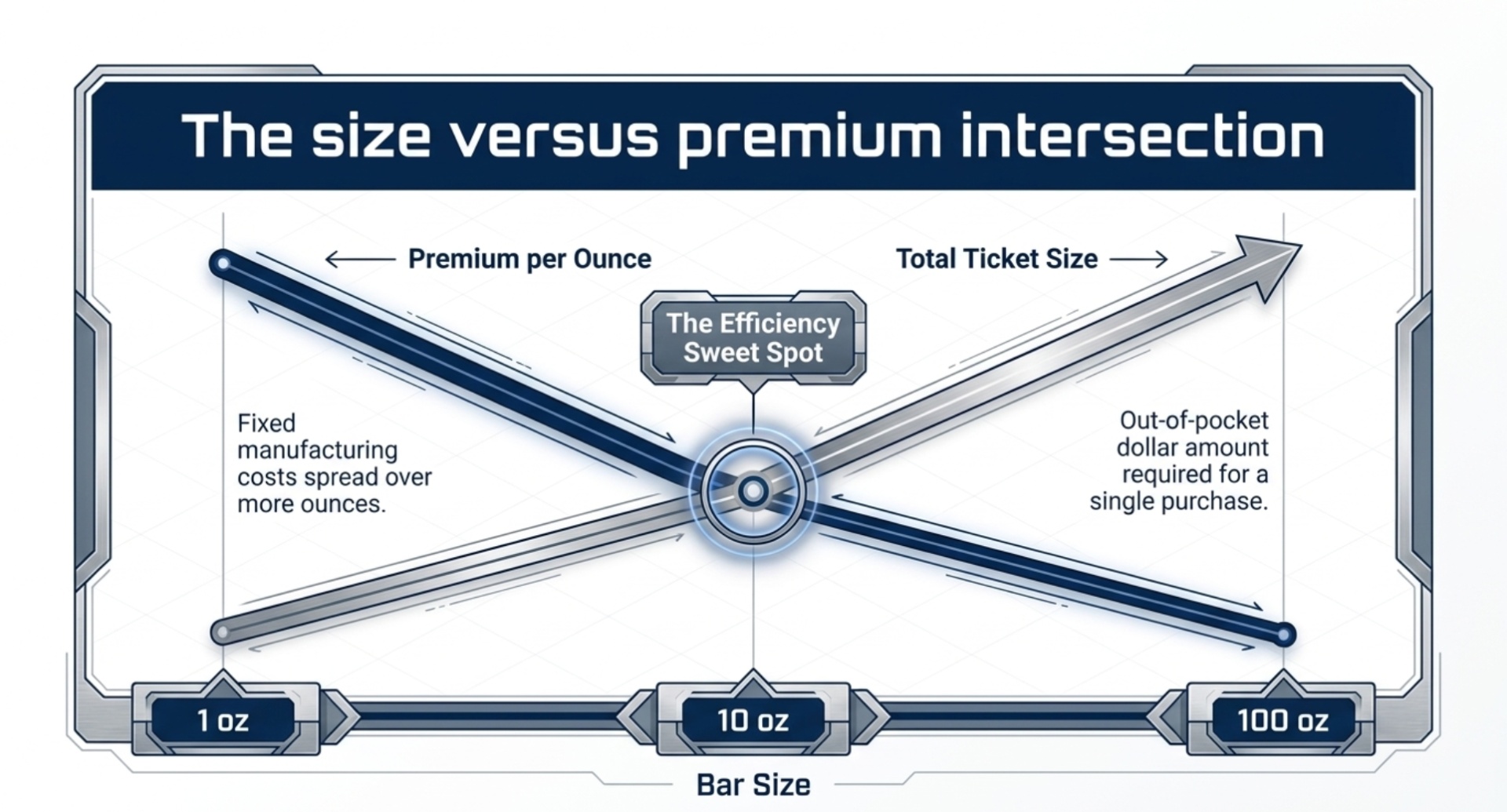
Premiums are one of the main reasons 1 oz vs 10 oz silver bars behave differently. Smaller bars tend to have higher premiums per ounce because fixed costs are spread over fewer ounces, while larger bars usually have lower premiums per ounce.
In practice, a 10 oz bar often lets you acquire more silver for the same total dollars than buying ten separate 1 oz bars, simply because the per‑ounce markup is lower. However, paying the absolute lowest premium is not the only goal—you also need to think about flexibility, storage, and how comfortable you are tying more money into each unit.
If you want a deeper dive into how spot price and premiums interact before you choose sizes, review a dedicated pricing guide.
Liquidity, resale, and “breakability”
Bar size also changes how precisely you can raise cash when you need it. One of the key trade‑offs is breakability—how small a piece of your stack you can sell at a time.
- 1 oz bars make it easy to sell small amounts for modest cash needs or gradual rebalancing.
- 10 oz bars are also widely recognized and resellable, but each bar represents a larger value, so each sale is a bigger move.
- Very large bars (like 100 oz) offer good cost efficiency but limit your ability to sell in small pieces.
These liquidity differences do not depend on any single dealer—they stem from basic facts about how much value is inside each bar and how buyers typically transact.
Storage, transport, and handling
From a storage standpoint, consolidated weight in larger bars uses space more efficiently and means fewer pieces to track. On the other hand, many smaller bars are easier to spread across different storage locations or to move discretely in small quantities.
A common pattern is to treat 10 oz bars as a balance between storage efficiency and individual bar size that still feels manageable to move and store outside institutional vaults.
What never changes when choosing silver bar size
There are a few universal principles that apply no matter which market you live in or which dealer you use:
- Silver content is what ultimately matters: Over the very long term, the main driver of value is how many ounces of silver you own, not the exact format.
- Smaller units mean more flexibility: Owning some smaller pieces (like 1 oz bars or coins) always makes it easier to adjust your position gradually.
- Larger units mean lower cost per ounce: As you go up in size, the per‑ounce premium generally falls; this is true in every major bullion market.
- Recognizable products are easier to sell: Well‑known sizes and brands are consistently easier to move than obscure formats, independent of any single shop’s preferences.
- Your plan matters more than perfection: A clear budget, a consistent buying habit, and sensible diversification across sizes usually beat trying to pick the “perfect” size every time.
These principles hold across different countries, dealers, and economic cycles, because they reflect basic realities of how physical bullion works, not temporary local quirks.
1 oz silver bars: pros, cons, and best use cases
Why 1 oz silver bars appeal to first‑time buyers
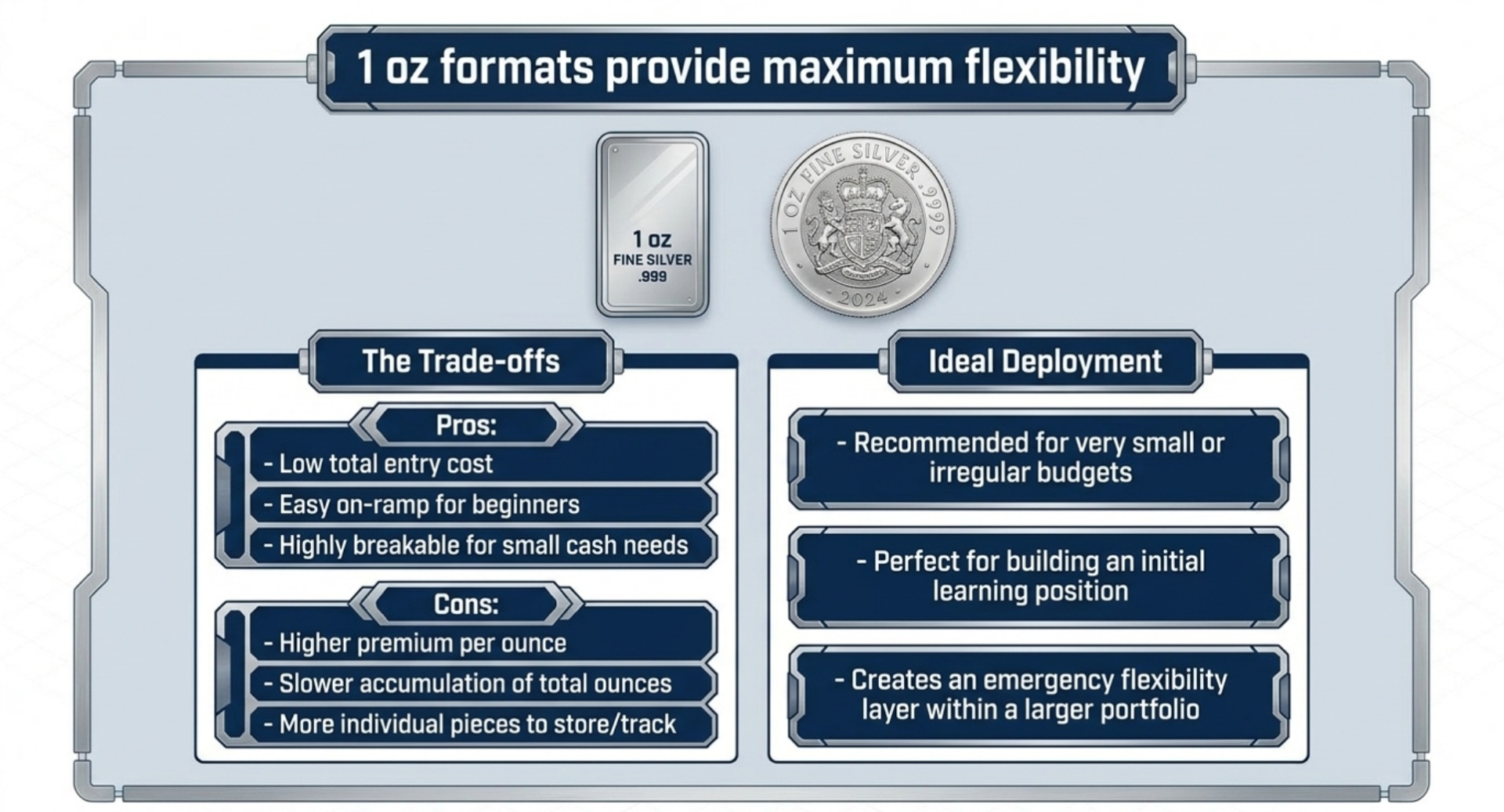
For first‑time buyers wondering which silver bar size is best, 1 oz bars offer an easy on‑ramp. Each bar has a low total cost, so you can start small, learn the process, and build a habit of buying without overcommitting in one shot.
Because they are such a common size, 1 oz bars are simple to resell in small quantities, which is helpful if you plan to adjust your holdings gradually or use silver as a form of “emergency cash.” Many stackers keep at least some 1 oz pieces throughout their journey for this reason, even after adding larger bars.
Downsides: higher premiums and slower stacking
The main trade‑off with 1 oz bars is paying higher premiums per ounce than you would on larger bars. Over years of investing, that difference can reduce your total ounces compared to a strategy that includes bigger bars at lower premiums.
It can also mean more individual pieces to store, track, and move, especially if your stack grows substantially. That is why many people start with 1 oz bars and then incorporate 10 oz bars as their comfort and budget increase.
When 1 oz bars make the most sense
1 oz bars are particularly suited to:
- Very small or irregular budgets.
- Building an initial position while you learn the market.
- Holding some silver specifically for small, incremental sales or emergencies.
For a broader foundation on how bars and coins fit together in a silver plan, combine this with an introductory bullion guide.
10 oz silver bars: pros, cons, and best use cases
Cost efficiency: lower premiums per ounce
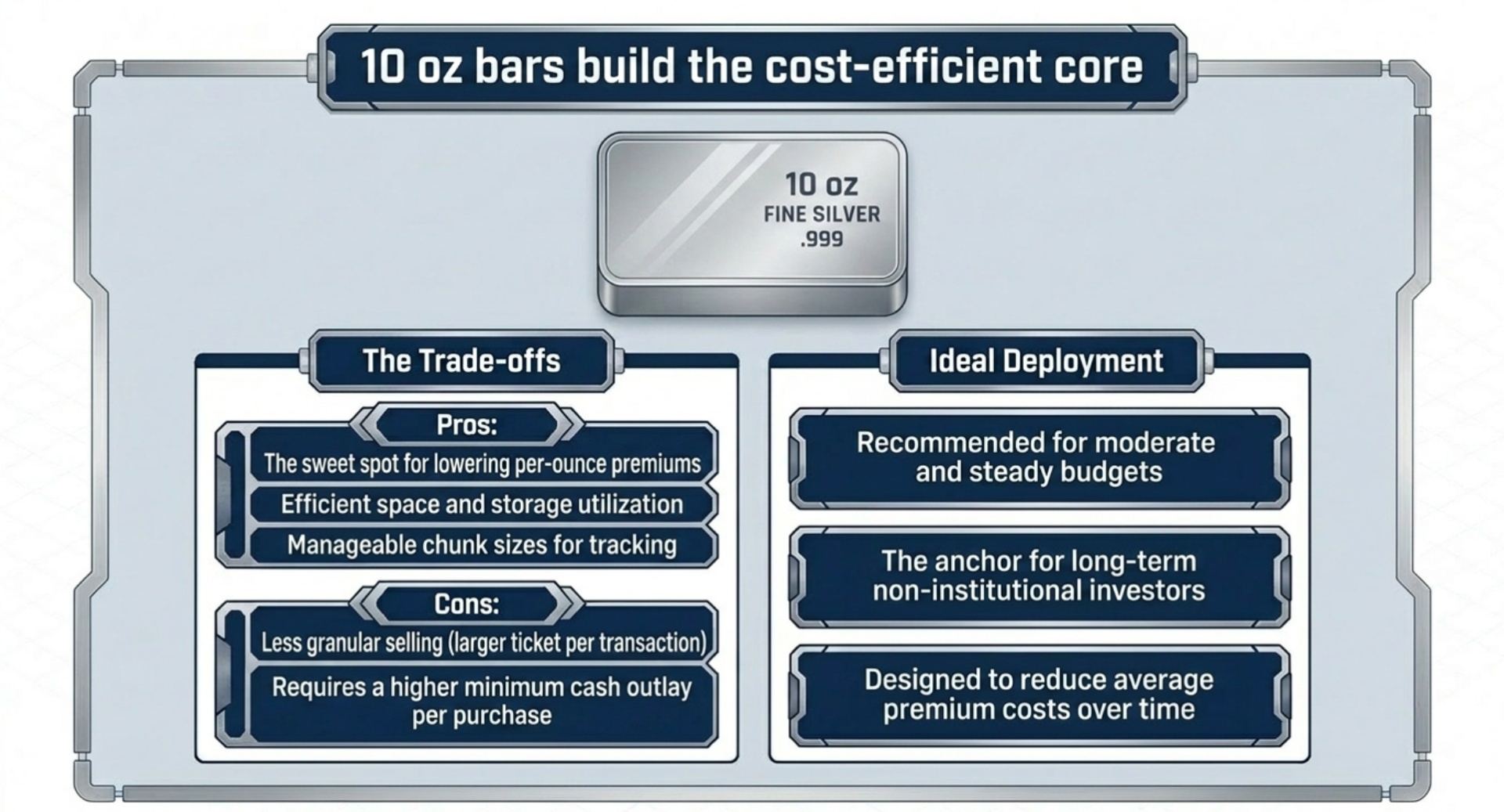
When comparing 1 oz vs 10 oz silver bars, 10 oz bars stand out for cost efficiency. In many markets, they hit a “sweet spot” where the per‑ounce premium clearly drops compared with 1 oz bars, but each individual bar is still manageable for an individual investor.
By concentrating more silver into each bar, you spread minting and handling costs over more ounces, which improves the number of ounces you accumulate per dollar invested.
Liquidity: still popular, but larger chunks
10 oz bars from recognizable mints are widely traded and generally easy to buy and sell, but you deal in larger chunks when you move them. That is rarely a problem for planned sales, but it is worth considering if you might need to raise very small amounts of cash quickly.
Because of this, many long‑term stackers combine 10 oz bars for the core of their holdings with a layer of smaller units for fine‑tuning.
When 10 oz bars are the better choice
10 oz silver bars are often the better fit if you:
- Have a moderate, steady budget.
- Plan to hold silver for the long term rather than trading frequently.
- Want to lower your average premium without jumping all the way to 100 oz bars.
This combination of cost efficiency and practicality is why 10 oz bars are frequently recommended as a go‑to size for serious but non‑institutional silver investors.
1 oz vs 10 oz vs 100 oz: quick comparison table
Size, premium, liquidity, and best use
Below is a high‑level comparison of common silver formats, without locking into specific prices that change daily:
| Size / Type | Premium (per oz) | Liquidity | Best for |
|---|---|---|---|
| 1 oz bar | High | Very high | First‑time buyers, small budgets, emergency flexibility |
| 10 oz bar | Medium | High | Long‑term stacking, moderate budgets, cost‑efficient core holdings |
| 100 oz bar | Low | Medium | Large lump‑sum investors with existing smaller pieces |
| 1 oz coin (round sovereign) | High–medium | Very high | Beginners, gifts, maximum recognizability and flexibility |
This table illustrates the basic pattern: as size increases, premiums usually fall but each unit becomes a larger “ticket” to buy or sell.
1 oz vs 10 oz silver bars vs coins
Bars are not your only option—coins also play an important role, especially when you are just getting started.
- 1 oz silver coins (sovereign bullion like American Silver Eagles or Maple Leafs) often have higher premiums than generic bars but offer top‑tier recognizability and very strong liquidity.
- 1 oz silver bars usually cost less per ounce than premium sovereign coins but slightly more than large bars, making them a middle ground between cost and recognizability.
- 10 oz silver bars provide better cost efficiency than most coins and small bars, and are especially attractive once you already hold some smaller pieces for flexibility.
A simple approach for many investors is to treat coins as a highly liquid, easily recognizable component of their silver allocation, while using 1 oz and 10 oz bars to build bulk exposure at a lower average premium.
Should I stack smaller silver bars or larger bars?
Matching bar size to your budget
Your budget is one of the strongest drivers of which silver bar size is best for you:
- Very small or irregular budget → mostly 1 oz bars.
- Stable, moderate budget → blend of 10 oz bars plus some 1 oz bars.
- Large lump‑sum → 10 oz and possibly 100 oz bars, plus a buffer of smaller bars and coins.
This structure lets you keep stacking silver consistently while matching your bar sizes to what you can realistically afford and hold over time.
Time horizon, exit plan, and universal principles
Your time horizon and exit plan are just as important as your entry strategy:
- Shorter or uncertain horizon → prioritize flexibility; hold more 1 oz pieces and some 10 oz bars.
- Long‑term stacking mindset → emphasize 10 oz bars and possibly larger bars to reduce average premiums.
- Desire for maximum optionality → maintain a mix of bars and coins, with at least some smaller units regardless of total stack size.
These guidelines remain valid across different markets because they are built on universal dynamics: smaller units can always be split and sold more granularly, while larger units always consolidate value and lower cost per ounce.

For a sense of how these principles play out when selling, it helps to see real‑world examples of how offers are calculated.
Example stacking strategies by budget
Here are example paths you can adapt:
- $100–$200 per month:
Focus mainly on 1 oz bars and possibly some low‑premium 1 oz coins; occasionally save up for a 10 oz bar. - $500–$1,000 per quarter:
Use 10 oz bars as your core purchase size; add a few 1 oz bars or coins for flexibility and gifting. - Larger lump‑sum (several thousand dollars):
Build a base of 10 oz and, if appropriate, 100 oz bars for efficiency, then layer in 1 oz bars and coins to keep your exit options flexible.
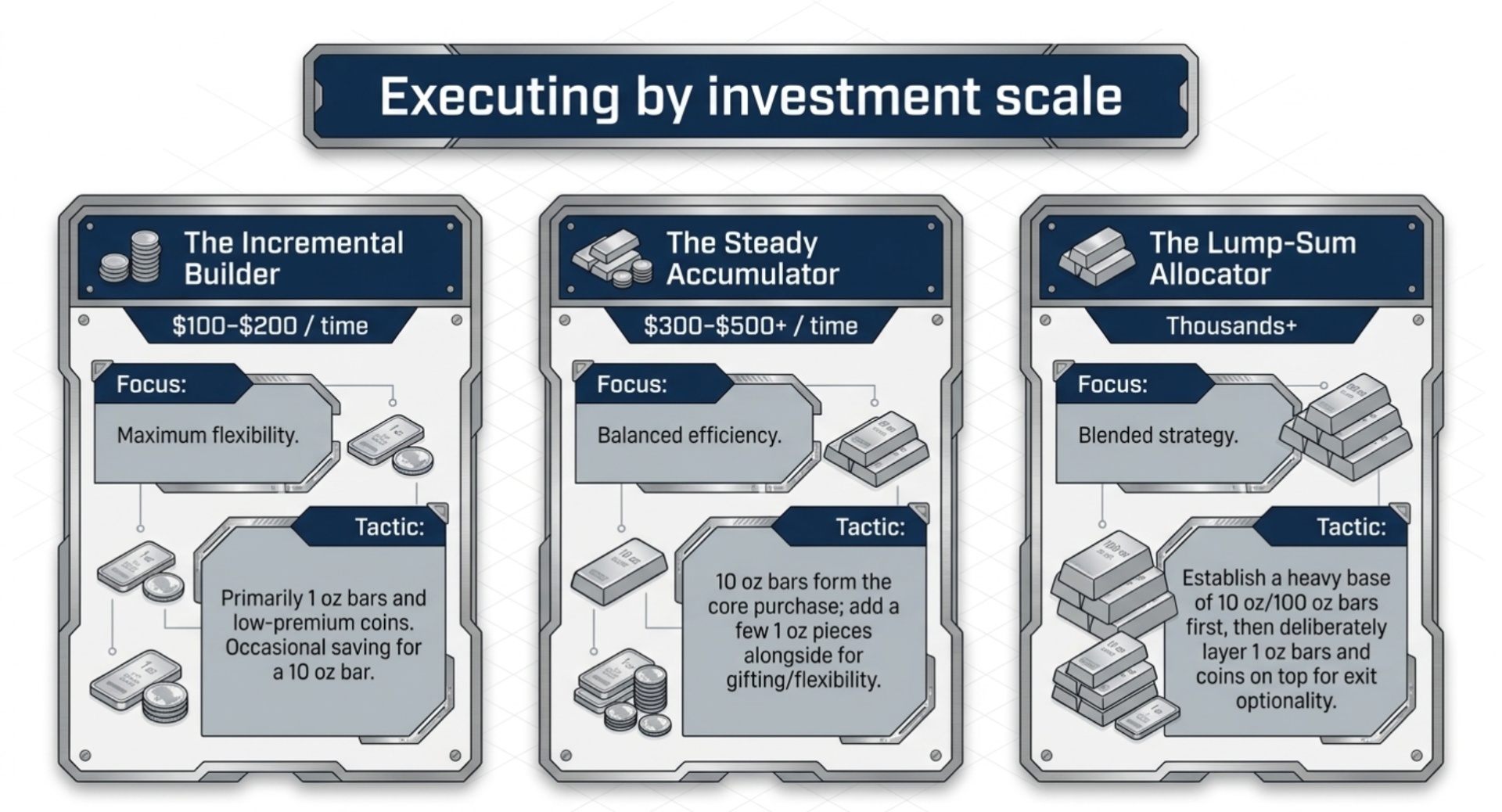
These scenarios are not rigid rules, but they show how to choose silver bar sizes based on your budget, time horizon, and need for flexibility.
Quick decision rule
If you want a shortcut while you learn the details, use this simple rule of thumb:
- If you have under $200 to invest at a time → choose 1 oz bars (and/or 1 oz coins).
- If you invest for the long term and can commit $300–$500+ at a time → prioritize 10 oz bars, plus a few 1 oz pieces.
- If you are building a large, multi‑year position → combine 10 oz bars for your core with smaller bars and coins for flexibility; consider larger bars only after you have a solid base.
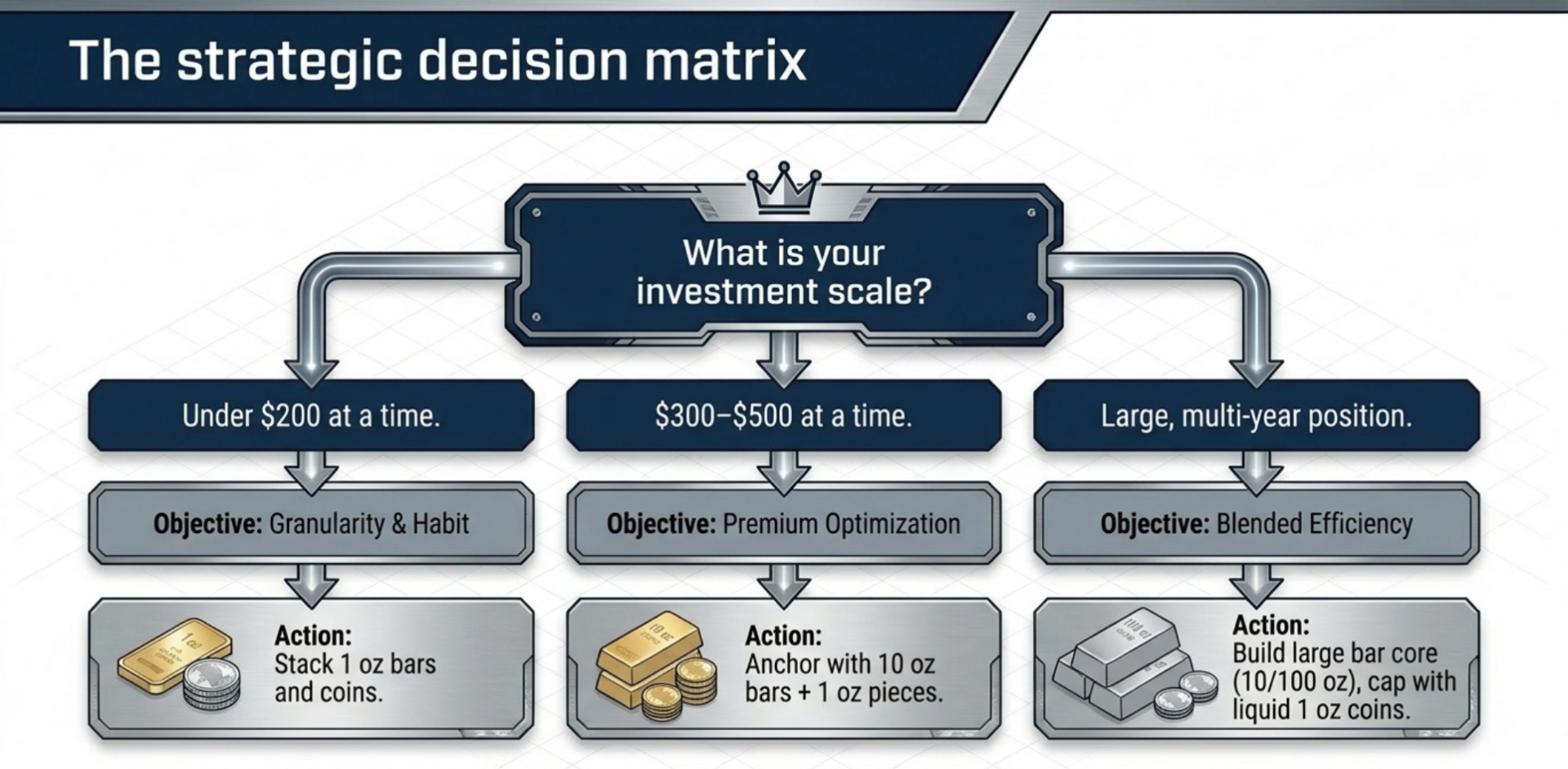
This quick decision rule will not be perfect in every situation, but it keeps you moving while staying aligned with sound, universal bullion principles.
FAQs: choosing silver bar sizes (1 oz vs 10 oz)
Is it better to buy 1 oz or 10 oz silver bars?
Neither size is automatically better; 1 oz bars provide maximum flexibility and very high liquidity, while 10 oz bars generally offer lower premiums per ounce and more efficient stacking. For many investors, the best approach is to start with 1 oz bars and then add 10 oz bars as the budget and time horizon increase.
Which silver bar size is best for first time buyers?
For first‑time buyers, 1 oz silver bars and 1 oz coins are often the easiest and most comfortable starting point because each piece is inexpensive, easy to understand, and simple to resell in small amounts. Once you gain confidence, adding 10 oz bars helps reduce your average premium without giving up the advantages of smaller units.
How does silver bar size affect premiums and resale options?
Smaller bars, such as 1 oz, usually carry higher premiums per ounce because production and handling costs are spread over fewer ounces, while larger bars like 10 oz and 100 oz spread those costs more widely and tend to be cheaper per ounce. At the same time, smaller bars and coins make it easier to sell in small steps, while larger bars require bigger, less frequent transactions even though they remain recognizable to buyers.
Should I stack smaller silver bars or larger bars if I’m on a budget?
If your budget is tight or unpredictable, smaller bars and coins let you participate without overextending yourself and give you more control over when and how you sell. As your budget stabilizes and your stack grows, you can gradually incorporate 10 oz bars to lower your average premium while still maintaining some smaller pieces for flexibility.
Are 10 oz silver bars harder to sell than 1 oz bars?
Both 1 oz and 10 oz bars from widely recognized mints are generally easy to sell, but 1 oz bars are more flexible because they let you raise smaller amounts of cash at a time. 10 oz bars are still popular and liquid, but each sale is a larger move, which is fine if you plan ahead and keep some smaller units alongside them.
Can I mix 1 oz and 10 oz silver bars in the same stack?
Yes, mixing 1 oz and 10 oz silver bars is often one of the most effective ways to build a flexible and cost‑efficient stack. Many investors treat 10 oz bars as the core of their holdings and 1 oz bars (plus some coins) as a flexible buffer for small purchases, gifts, and partial sales.
What is the best silver bar size for long‑term stacking?
For long‑term stacking, 10 oz silver bars are frequently considered a sweet spot because they usually provide lower premiums than 1 oz bars while remaining easier to handle and trade than very large bars. Over time, many long‑term investors combine 10 oz bars for core exposure with 1 oz bars and coins for flexibility and fine‑tuning.
If you are ready to move from research to action, start by deciding how much you can comfortably invest and how flexible you need your silver to be. Then use this guide, a simple pricing explainer, and—if helpful—a quick conversation with a bullion specialist to choose the right mix of 1 oz and 10 oz silver bars and coins for your budget, goals, and time horizon.