Published by
Gold Expert
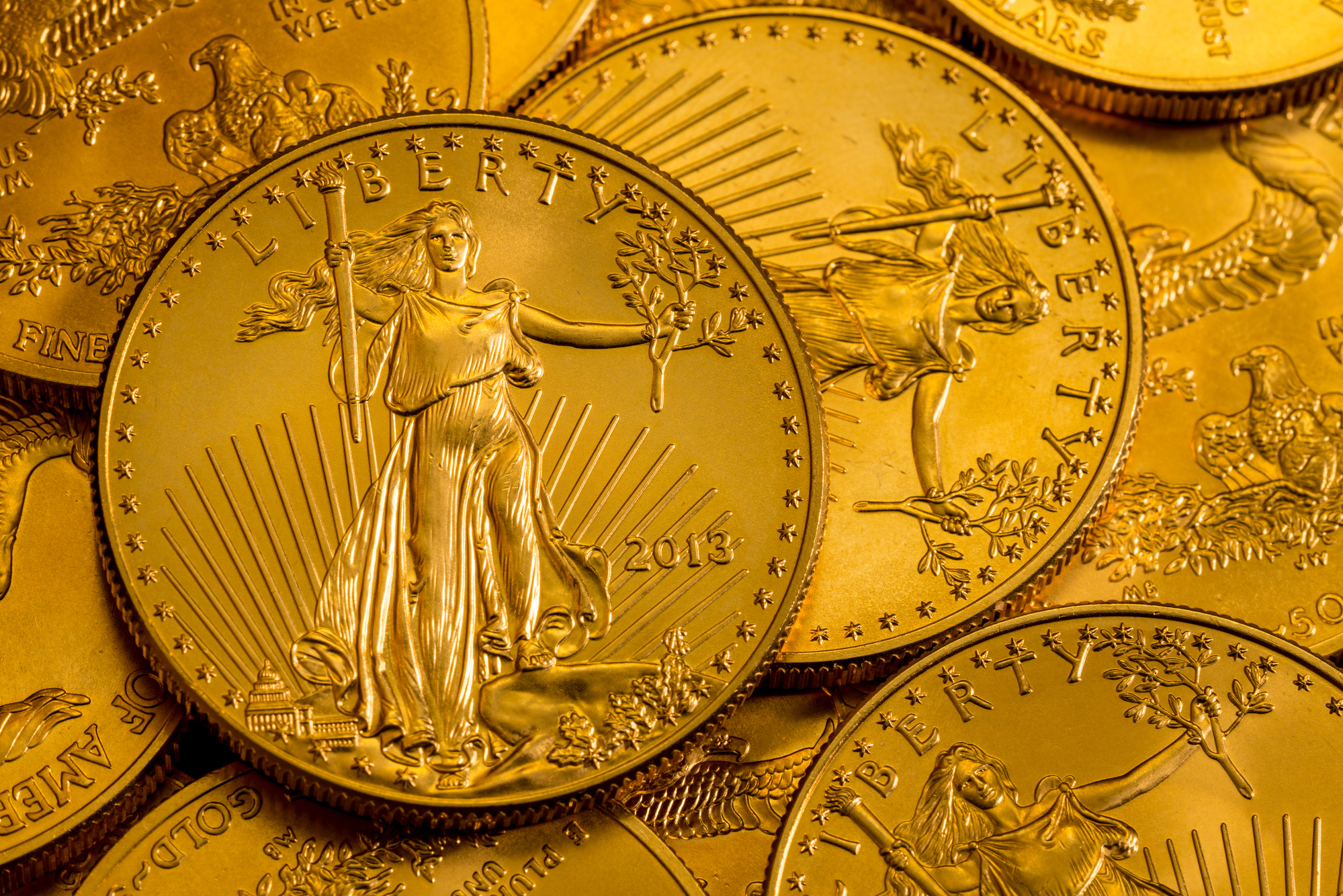
If you are wondering what are the most popular gold bullion coins for beginners, you are not alone—and you are asking the right question. The right first coin should be easy to recognize, simple to resell, and straightforward to compare on price, not a mysterious “collector piece” with hidden premiums.
This guide walks you through American Gold Eagles, Canadian Maple Leafs, and other leading gold bullion coins, explains the difference between government‑minted gold coins and private‑mint rounds, and gives you a practical framework for how to choose your first gold bullion coin—and where to buy recognized gold bullion coins near you.
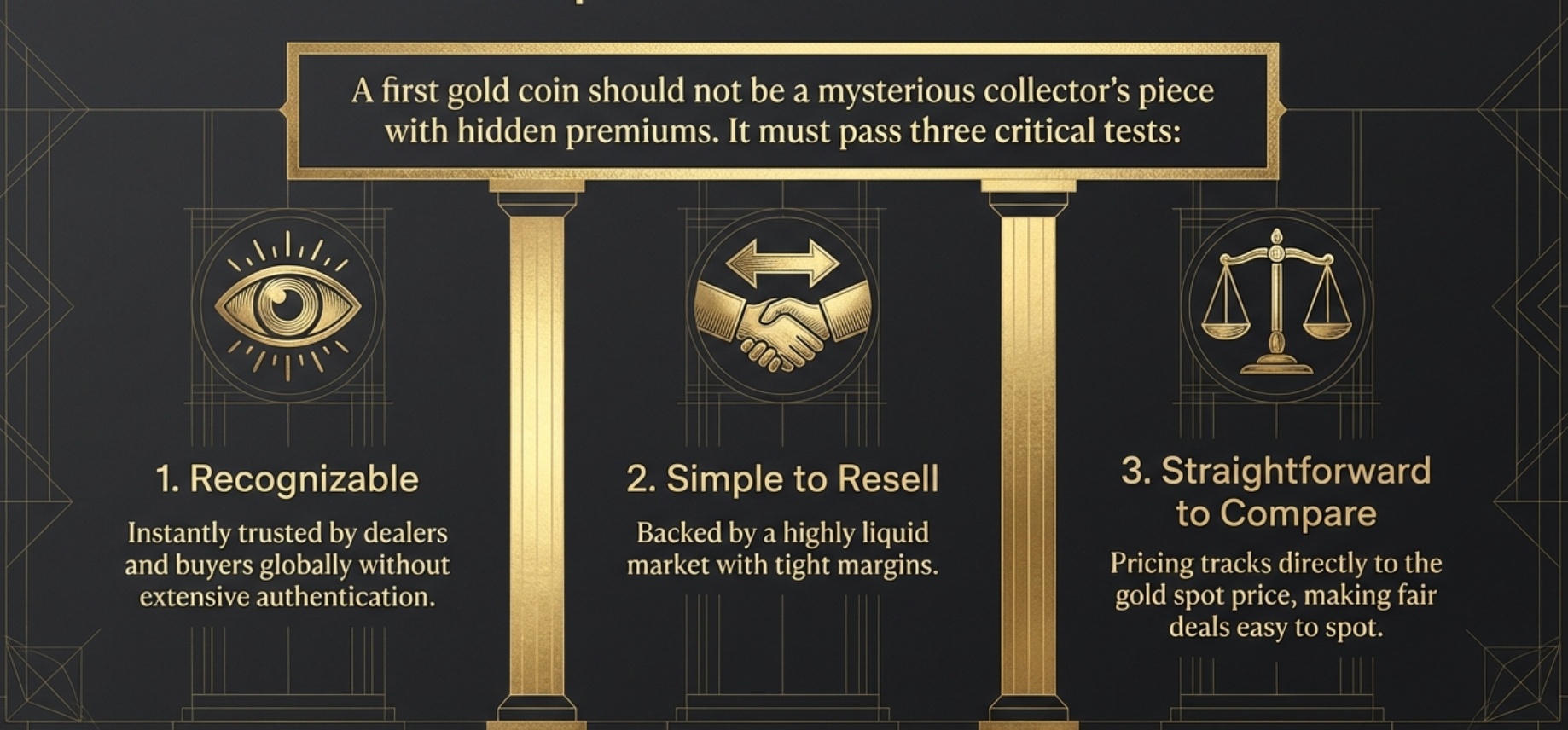
TL;DR for beginners
- The most popular gold bullion coins for beginners are American Gold Eagles, Canadian Maple Leafs, South African Krugerrands, British Britannias, and Austrian Philharmonics.
- American Gold Eagles are 22k (91.67%) and Canadian Maple Leafs are 24k (99.99%), but both contain 1 troy ounce of pure gold and are highly liquid.
- For a first purchase, most beginners choose a widely recognized government‑minted gold coin from their home market, then compare total cost (spot + premium + fees) across 2–3 reputable dealers.
- Government‑minted coins usually offer better recognition, easier resale, and stronger guarantees than private‑mint rounds, which can be cheaper per ounce but less liquid.
- To choose your first gold bullion coin, start with your goal (hedge vs pure ounces), shortlist 2–3 major coins, and use a transparent pricing guide and trusted dealer to complete the purchase.
Bullion basics: what makes a gold coin “popular”?
Bullion coin vs numismatic coin vs rounds
Before you compare Eagles vs Maple Leafs, you need a quick vocabulary check.
- Bullion coins are issued by governments, have a stated face value, and are meant primarily for investment; their prices track closely to the gold spot price plus a modest premium.
- Numismatic or collectible coins derive much of their value from rarity, condition, and collector demand rather than metal content; they are not ideal for beginners who just want bullion exposure.
- Private‑mint rounds are gold pieces made by private companies; they usually do not carry legal‑tender status but can offer lower premiums per ounce.
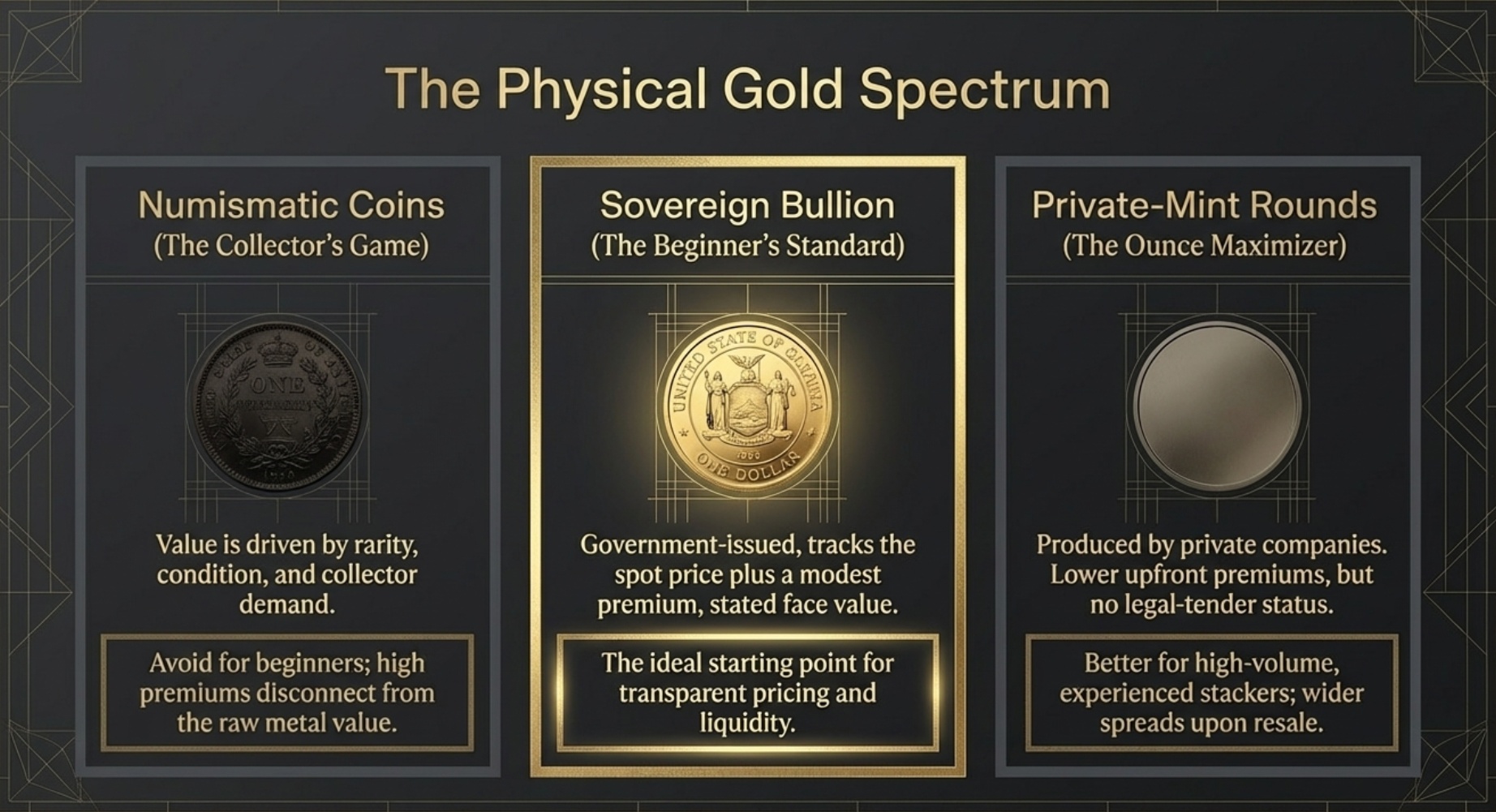
For this beginner’s guide, we focus on modern, investment‑grade bullion coins because they offer transparent pricing, strong global recognition, and simpler decisions than juggling numismatic premiums.
If you want to step back and see how gold coins fit into a bigger metals strategy, it helps to read a broader bullion primer alongside this article.
What drives popularity: recognition, purity, and premiums
Three factors tend to make some gold coins especially popular with beginners:
- Recognition: Coins like American Gold Eagles, Canadian Maple Leafs, and Krugerrands are widely known and trusted, which makes them easy to sell almost anywhere.
- Purity and specifications: Some coins prioritize 24k purity (Maples, Philharmonics), while others use 22k alloy for durability (Eagles, Krugerrands); either can be excellent depending on your priorities.
- Premiums and spreads: Popular coins usually have relatively tight spreads between what dealers charge and what they will pay to buy back, which matters a lot over time.
In practice, the most popular gold bullion coins for beginners are those that strike a good balance across all three.
The most popular gold bullion coins for beginners
American Gold Eagle – the US standard
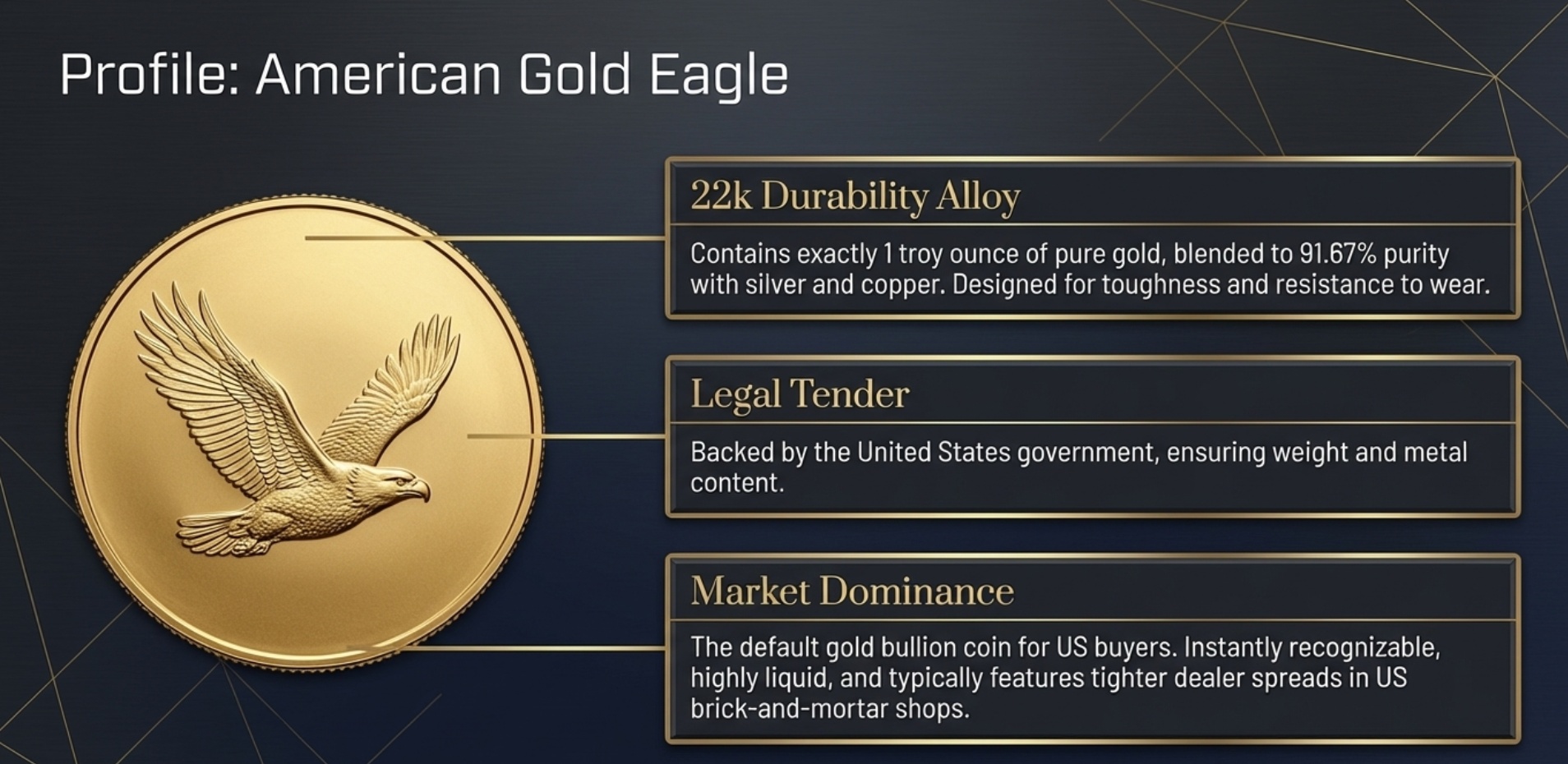
The American Gold Eagle is one of the most trusted and widely traded gold coins in the world, especially in the United States. It contains 1 troy ounce of pure gold but is minted as a 22k alloy (91.67%) with silver and copper added for durability, and it carries legal‑tender status backed by the US government.
Beginners like Gold Eagles because dealers know them instantly, they are easy to sell back in the US, and they benefit from deep, liquid markets over decades. The trade‑off is that their premiums are often a bit higher than some other sovereign coins or private rounds.
If you want a deeper dive into this particular coin’s history, design, and pricing behavior, you can read a dedicated piece.
Canadian Gold Maple Leaf – high‑purity workhorse
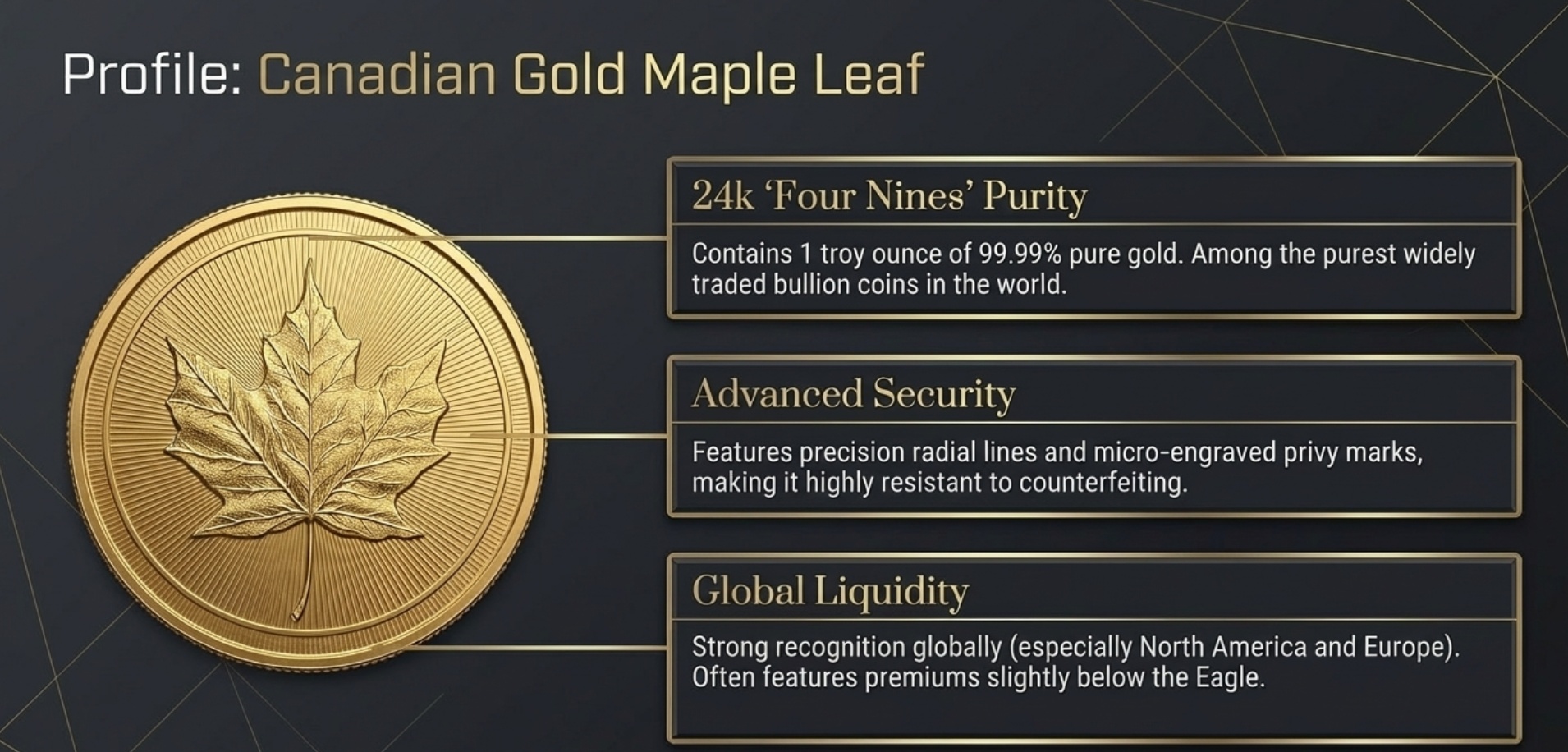
The Canadian Gold Maple Leaf is one of the earliest and most popular 24k (99.99%) bullion coins, known for its high purity and detailed maple leaf design. Modern Maples include advanced security features such as radial lines and micro‑engraved privy marks that help with anti‑counterfeiting.
For beginners, the Maple Leaf offers maximum purity and strong global recognition at premiums that are often competitive with or slightly below Eagles, depending on the market. The softer 24k gold can scratch more easily than 22k coins, but that typically matters more to collectors than to long‑term holders who keep coins in capsules or tubes.
South African Krugerrand – the original bullion coin
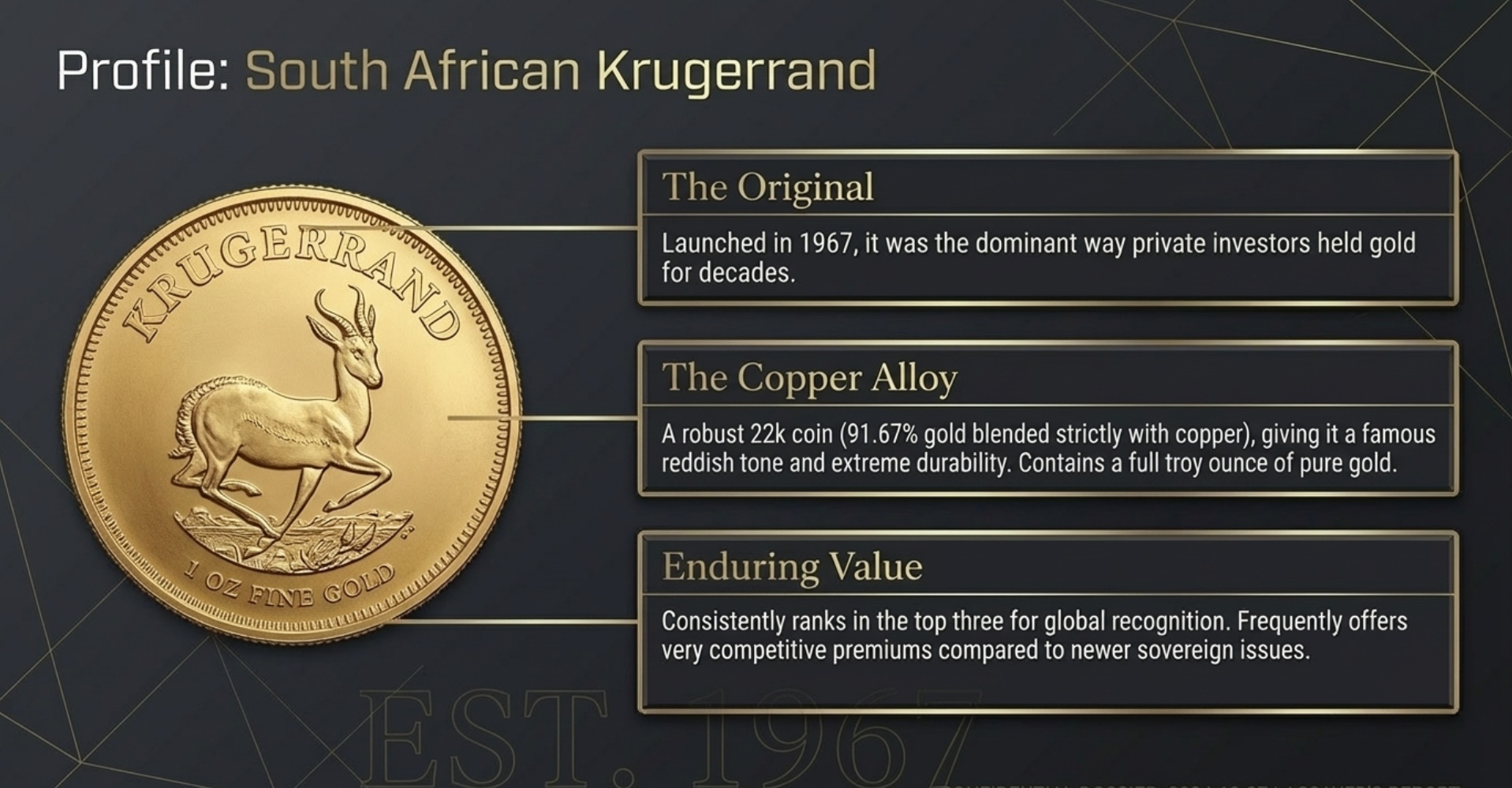
The Krugerrand is the original modern gold bullion coin, launched in 1967 and for many years the dominant way private investors held gold. It is also a 22k coin (91.67% gold with copper alloy), famous for its reddish tone and robustness, and it contains a full troy ounce of pure gold.
Krugerrands remain among the most traded gold coins worldwide and frequently offer very competitive premiums vs other sovereign coins, which is why many beginners and cost‑conscious buyers still consider them. Some markets prefer newer designs with additional security features, but Krugerrands still rank among the top three global bullion coins by recognition.
Other key players: Britannia, Philharmonic, and more
Beyond Eagles, Maples, and Krugerrands, several other sovereign coins are widely recognized and beginner‑friendly. British Gold Britannias and Austrian Gold Philharmonics, for example, both offer 24k purity and are popular across Europe and international markets.
American Gold Buffalo coins, a 24k alternative to the Eagle, are also attractive to US buyers who specifically want pure gold in a US‑minted format. While this article focuses on the biggest names, it is helpful to know that you have a bench of other strong options beyond the “big three.”
American Gold Eagles vs Canadian Maple Leafs: what’s the difference?
The difference between American Gold Eagles and Canadian Maple Leafs is one of the first comparisons new buyers make, and it is a useful way to think about your priorities.
Purity, durability, and specifications
- American Gold Eagle: 1 troy oz pure gold in a 22k alloy (91.67% gold, with silver and copper), designed for toughness and resistance to wear.
- Canadian Gold Maple Leaf: 1 troy oz of 24k (99.99%) gold, among the purest widely traded bullion coins.
For most investors, both are equally effective ways to own an ounce of gold; the choice between them is more about preference for purity vs durability and which coin is more dominant in your local market.
Design, recognition, and liquidity
American Gold Eagles carry iconic US designs and are extremely recognizable in the US retail and dealer ecosystem, often treated as the “default” gold bullion coin by American buyers. Canadian Maple Leafs combine the maple leaf motif with security features and have strong recognition globally, particularly in North America and Europe.
In practice, both coins are highly liquid, and either can be a top‑tier choice for a first purchase. Local preferences may nudge the decision—for example, US brick‑and‑mortar shops might quote slightly tighter spreads on Eagles, while some international dealers highlight Maples as their flagship coin.
Premiums, spreads, and which is better for beginners
Typical patterns (not fixed rules) are that Eagles carry slightly higher premiums than Maples, but both maintain strong resale demand. A practical way to decide is to compare total cost (including shipping and payment fees) for the same size Eagle and Maple from a few reputable dealers and pick the combination of trusted source and best all‑in price.
To understand how spot price, premiums, and dealer spreads factor into that “all‑in” calculation, it helps to read a dedicated pricing explainer.
Are government‑minted gold coins better than private‑mint rounds?
Whether government‑minted gold coins are better than private‑mint rounds depends on what you value most: trust and liquidity, or raw ounces per dollar.
Why beginners tend to start with government coins
Government‑minted coins like Eagles, Maples, Krugerrands, Britannias, and Philharmonics offer several advantages:
- Legal‑tender status and a government guarantee of weight and purity.
- High recognizability among dealers and investors around the world.
- Lower counterfeiting risk relative to generic rounds and typically easier authentication.
- Stronger liquidity and, in many cases, better resale pricing relative to initial cost.
These benefits explain why most lists of the most popular investment coins are dominated by sovereign issues.
When private‑mint rounds can make sense
Private‑mint rounds can be appealing if you are very focused on accumulating ounces and you are buying from top‑tier private mints with strong reputations. They often carry lower upfront premiums than sovereign coins, which can be attractive for high‑volume stackers who understand their local resale options.
However, rounds generally lack legal‑tender status, may be less immediately recognizable to all buyers, and can experience wider spreads when you resell. That’s why, for a first gold bullion coin, a widely recognized government‑minted coin is usually the more straightforward choice.
For a broader perspective on mixing coins and rounds inside a metals portfolio, you can cross‑reference your main bullion strategy piece.
How to choose your first gold bullion coin
Clarify your goal: hedge, collection, or pure ounces?
Before you decide what are the most popular gold bullion coins for beginners, be clear on why you’re buying:
- Hedge and store of value: You want a simple, recognizable inflation hedge and crisis asset. Sovereign coins like Eagles, Maples, Krugerrands, Britannias, or Philharmonics are ideal here.
- Long‑term stacker, ounce‑maximizer: You care mainly about accumulating as much gold per dollar as possible, and you are comfortable navigating different products and dealers. Well‑priced sovereigns or reputable rounds can both work.
- Collector‑investor hybrid: You want some bullion plus a few pieces with design or numismatic appeal; focus on flagship sovereign issues first, then explore proofs or special editions once your base is in place.

Factors to compare: purity, premiums, liquidity, and taxes
When you compare specific coins, use a short checklist:
- Purity: 22k vs 24k; both can be fine, but 24k may appeal if you specifically want “four nines” gold.
- Premiums and spreads: Look at both the purchase premium and estimated buy‑back prices to understand the full round‑trip cost.
- Liquidity in your region: What do local dealers and peers trade most? In many US markets it’s Eagles; elsewhere Maples, Krugerrands, or Britannias dominate.
- Tax considerations: Some jurisdictions treat certain coins more favorably; always check local regulations or speak to a tax professional.
In practice, most beginners do well by shortlisting 2–3 major sovereign coins and then choosing whichever offers the best combination of trust and all‑in price from a reputable dealer.
Common beginner mistakes to avoid
- Paying collectible‑level premiums for proof or special‑finish coins when you really just want bullion.
- Choosing obscure or illiquid coins that may be harder to sell later.
- Focusing only on design or purity while ignoring dealer reputation, spreads, and buy‑back policies.
Where to buy recognized gold bullion coins near you

Local coin and bullion dealers
For many first‑time buyers, the safest answer to “where to buy recognized gold bullion coins near me” is a reputable local coin and bullion shop. Local dealers let you:
- See and verify coins in person.
- Pay and take delivery on the spot.
- Ask questions and build a relationship for future buys and sell‑backs.
Look for established businesses with transparent pricing, clear references to current spot prices, and published buy‑back policies. A case‑study style article about how serious local buyers evaluate and price gold can help you know what to expect.
Reputable online bullion dealers
Reputable online dealers can offer broader selection and easy price comparison across many popular coins. When considering an online source, check:
- Years in business and reviews.
- Clear, up‑to‑date pricing benchmarked to spot.
- Transparent shipping, insurance, and payment policies.
- Explicit buy‑back or repurchase terms.
Comparing “total landed cost”—coin price plus shipping, insurance, and any payment surcharges—across 2–3 dealers is often the best way to find fair deals on recognizable coins.
How to compare offers and avoid red flags
Red flags include:
- Prices that seem “too good to be true” relative to spot and other dealers.
- Vague product descriptions or unbranded coins with no clear specifications.
- High‑pressure tactics, especially around “rare” or “limited” coins when you asked for bullion.
If you want guidance on comparing offers or structuring your first purchase, giving readers a way to speak directly to your team or book a quick call fits the funnel stage.
FAQs: popular gold bullion coins for beginners
What are the most popular gold bullion coins for beginners?
The most popular gold bullion coins for beginners are American Gold Eagles, Canadian Maple Leafs, South African Krugerrands, British Britannias, and Austrian Philharmonics. These coins combine strong recognition, solid liquidity, and relatively tight spreads, which makes them easier to buy and resell than more obscure issues.
What is the main difference between American Gold Eagles and Canadian Maple Leafs?
American Gold Eagles are 22k coins with 1 troy oz of pure gold alloyed with silver and copper for durability, while Canadian Maple Leafs are 24k coins with 99.99% pure gold. Both are legal‑tender, widely recognized, and highly liquid; the choice often comes down to whether you prioritize maximum purity or the default US coin with especially strong domestic recognition.
Are government‑minted gold coins really better than private‑mint rounds?
Government‑minted coins generally offer stronger recognition, legal‑tender status, and official guarantees of weight and purity, which can mean easier resale and higher buyer trust. Private‑mint rounds can be cheaper per ounce but are typically less liquid and more dependent on dealer relationships, so most beginners start with sovereign coins and only add rounds once they understand their market.
How do I choose my first gold bullion coin?
Start by clarifying your goal (hedge vs maximum ounces vs collector interest), then shortlist 2–3 widely recognized sovereign coins that are common in your region. Compare total delivered cost and resale conditions across reputable dealers and choose the combination of coin and seller that offers the best balance of trust, price, and liquidity.
Is 24k (99.99%) gold always better than 22k gold coins like Eagles or Krugerrands?
24k coins give you slightly higher purity, which some investors and markets prefer, but 22k coins like Eagles and Krugerrands still contain a full troy ounce of pure gold and often offer improved durability. For most beginners, both are excellent; liquidity, premiums, and dealer reputation matter more than the difference between 22k and 24k.
Where is the safest place to buy recognized gold bullion coins near me?
The safest places are established local coin and bullion dealers and well‑known online bullion retailers with transparent pricing, clear policies, and strong reputations. Avoid anonymous sellers, pop‑up shows, or deals that seem far below market; a modest premium from a trusted source is usually cheaper than fixing a problem later.
Should I buy proof or collectible versions of these coins as a beginner?
Most beginners are better off starting with standard bullion versions, which track the gold price more closely and are easier to value. Proofs and special editions add numismatic complexity and higher premiums that only make sense once you understand both bullion and collector markets.
If you are ready to move from research to action, start by shortlisting one or two popular sovereign coins—such as American Gold Eagles or Canadian Maple Leafs—then compare real‑time prices and buy‑back policies from a handful of reputable dealers. Once you have your shortlist, use a transparent pricing guide and, if needed, talk to a bullion specialist to make sure your first gold bullion coin aligns with your goals, your budget, and your local market.