Published by
Gold Expert
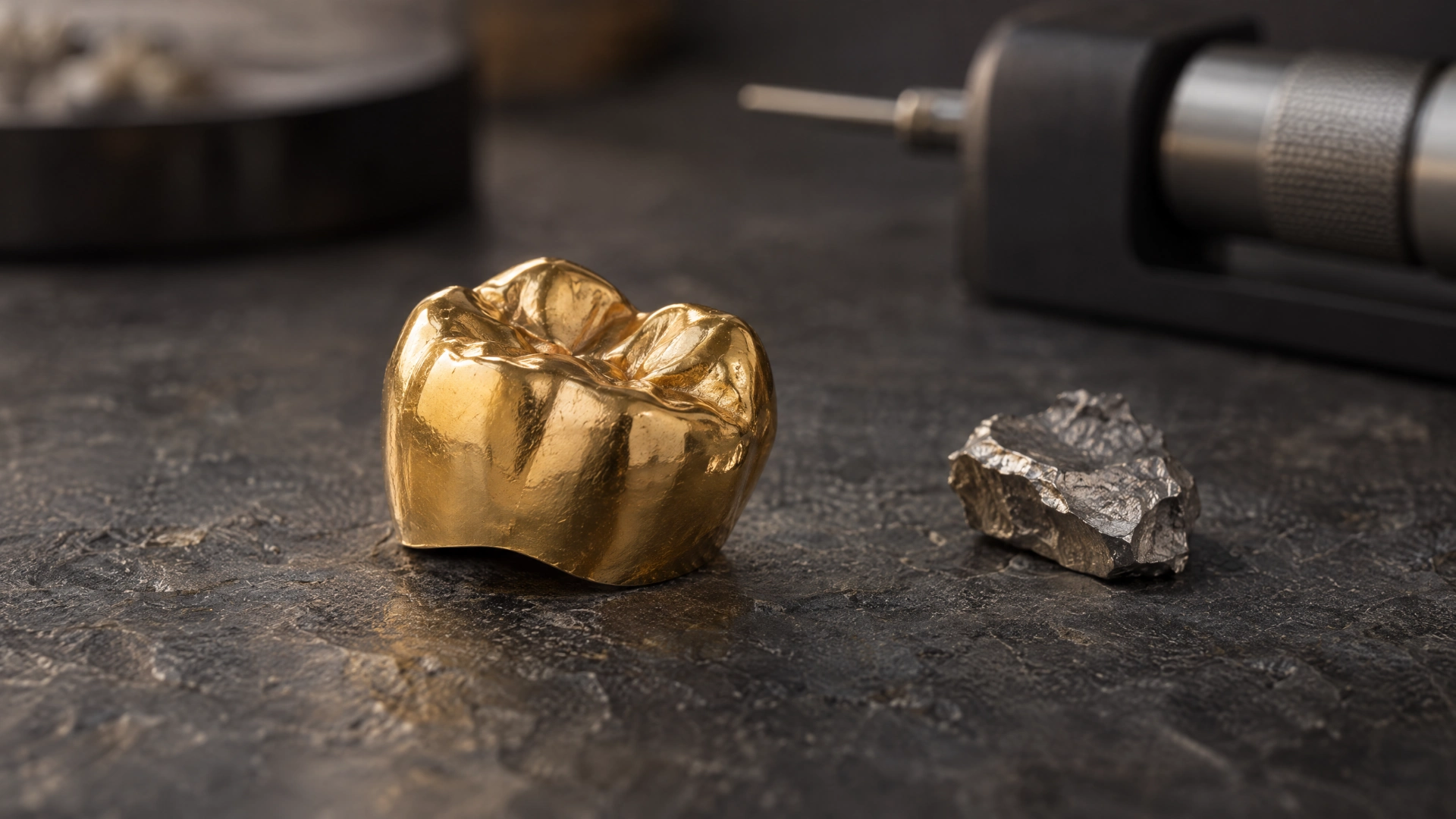
Dental gold is not pure gold. It is an alloy, a mixture of gold with other metals such as palladium, platinum, silver, copper and zinc. What a piece is worth to a seller turns on three questions: how much of what is on the scale is metal, what share of that metal is gold, and whether any platinum-group metals in it are counted in the offer. None of the three can be answered from the color of a crown, which is why dental gold is tested before it is priced.
This guide explains what dental alloys contain, how the dental industry classifies them, what the arithmetic looks like, and what happens when you bring a crown or bridge to a counter in Virginia.
What dental gold actually is
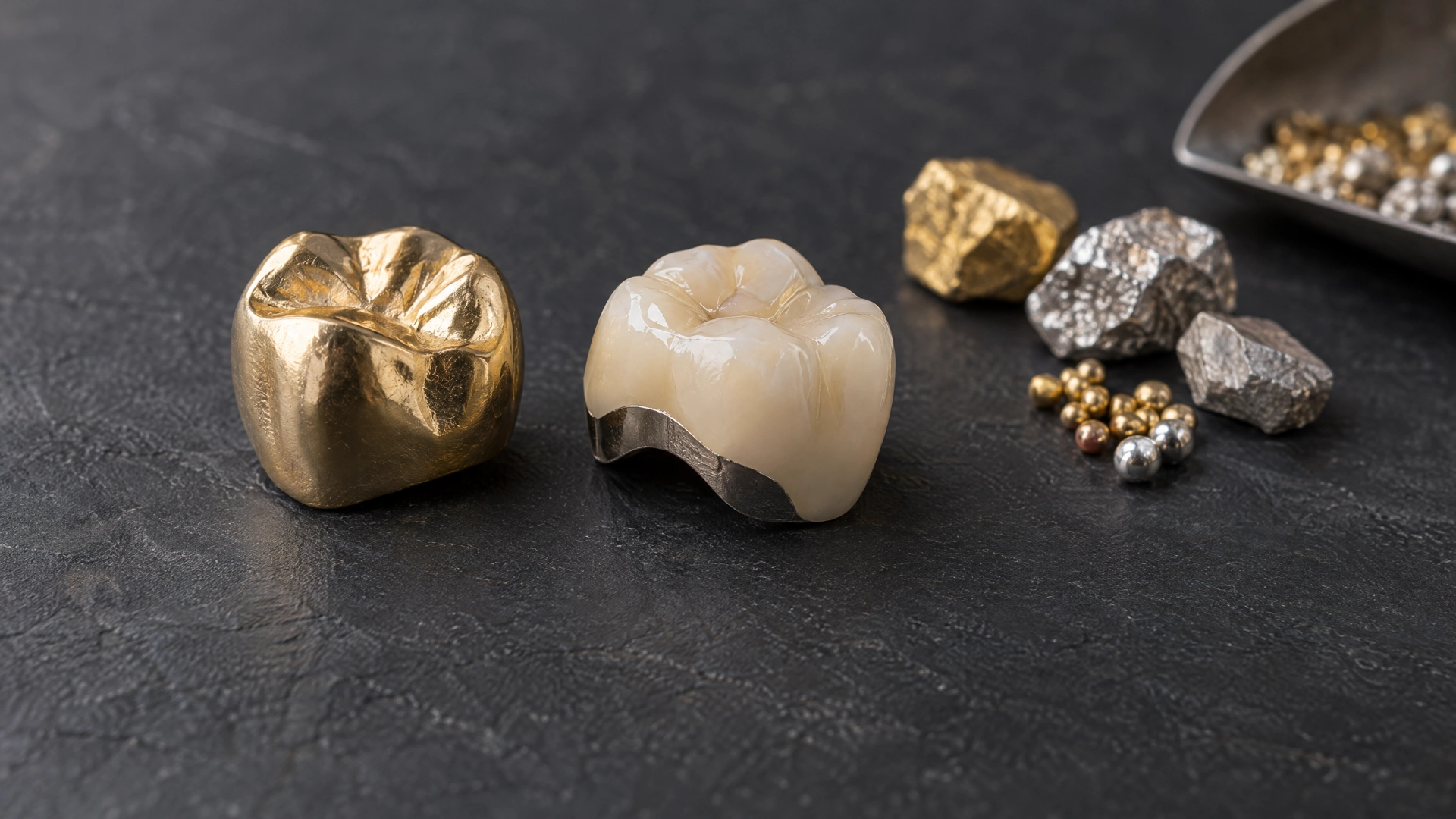
Dental gold is a gold-bearing dental alloy, and federal regulation classifies dental noble metal alloys as medical devices. Under 21 CFR 872.3060, as set out in the FDA's guidance on dental noble metal alloys, a noble metal alloy is a device composed primarily of noble metals such as gold, palladium, platinum or silver, intended for cast or porcelain-fused-to-metal crowns and bridges. The FDA adds that these alloys may contain lesser amounts of other elements such as copper and zinc.
Two terms in that definition matter at a scrap counter. A cast restoration is metal all the way through, such as a full gold crown or an inlay. A porcelain-fused-to-metal crown, often shortened to PFM, is a metal framework with tooth-colored porcelain bonded over it, so the metal may be hidden almost entirely.
The alloy classes on a dental bill
Dental billing codes describe alloys by noble metal content, not by karat. The classification used in the American Dental Association's Code on Dental Procedures and Nomenclature, the CDT Code, is reproduced in the 2017 edition of the American Academy of Pediatric Dentistry's coding manual. For this purpose, noble metal means gold plus the platinum group: platinum, palladium, rhodium, iridium, osmium and ruthenium.
| CDT class | Noble metal content (gold + platinum group) | Gold content |
|---|---|---|
| High noble | 60% or more | At least 40% |
| Noble | 25% or more | No separate gold minimum |
| Predominantly base | Less than 25% | No separate gold minimum |
| Titanium and titanium alloys | Not defined by noble metal; titanium 85% or more | No separate gold minimum |
Three things follow from the table. First, even the top class requires only 40% gold, which is below 10 karat. Second, a "noble" crown can meet its class mostly on palladium, with little gold in it. Third, the classes are minimums, so two crowns billed in the same class can contain quite different amounts of gold.
Note that the two definitions do not quite match. The FDA lists silver among the noble metals in its device definition; the CDT classification counts only gold and the platinum group. Silver in a dental alloy is real metal, but it does not help an alloy reach a CDT class.
If you still have the paperwork from the dental work, the procedure description may name the class, for example a full cast high noble metal crown. That tells you the minimum, not the actual composition, and it is a useful starting point rather than a substitute for testing.
What is on the scale is not all metal
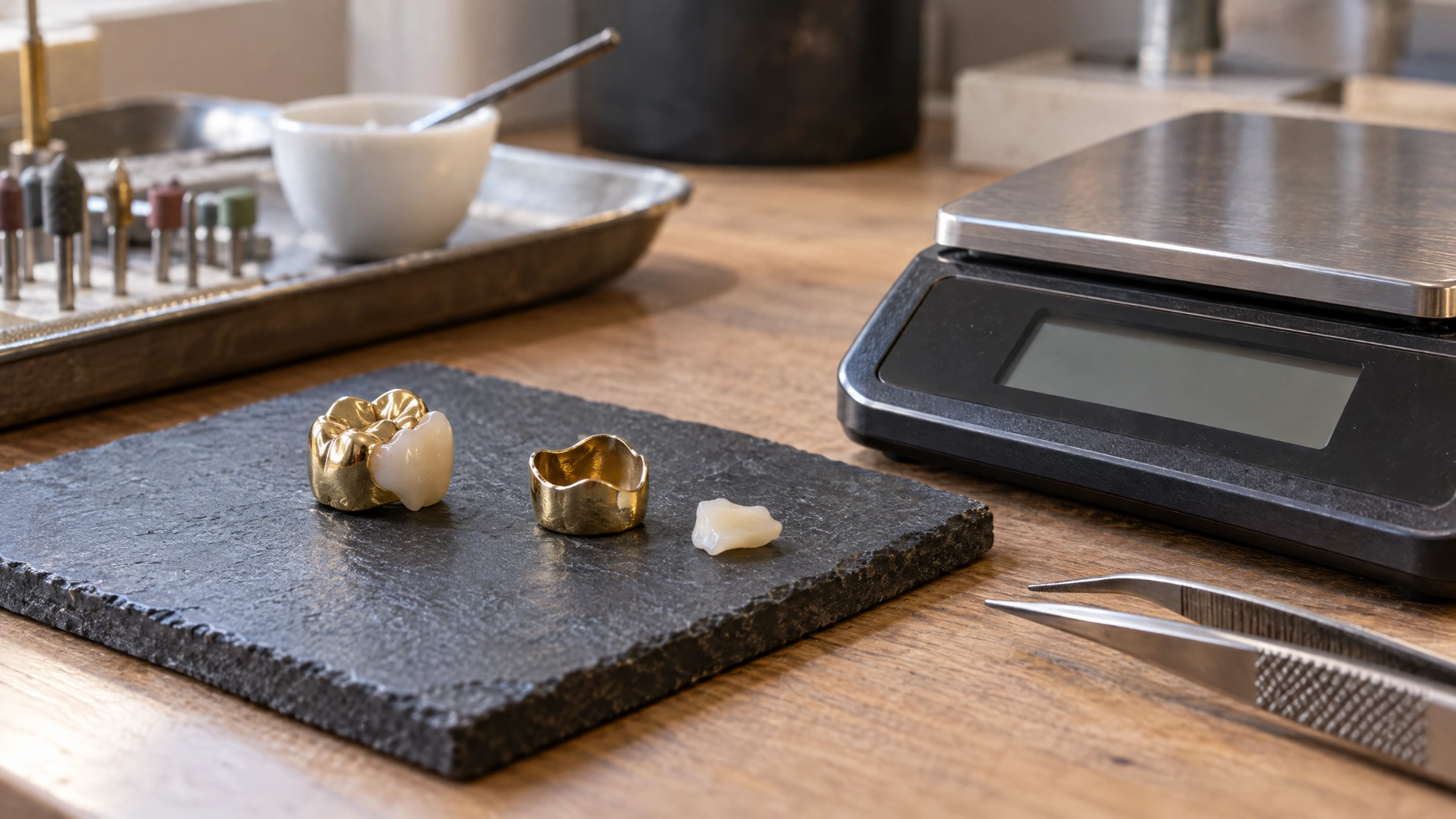
A crown that comes out of a mouth often arrives with more than metal attached. It may still carry part of the tooth, dental cement, or porcelain fused over the framework. All of that weighs something, and none of it is gold.
This is the dental version of gross weight versus fine weight. Gross weight is everything on the scale. Fine weight is the pure gold inside the metal, found by multiplying the metal's weight by its gold fraction. Our article on how a scrap gold offer is calculated, step by step works through that arithmetic in full for jewelry, and the same method applies here once the metal content is known.
How a counter accounts for attached tooth or porcelain is worth asking before the piece is weighed. Some material can be removed; some cannot without damaging the metal. The question to ask is simple: what weight is the offer based on?
How dental gold is tested
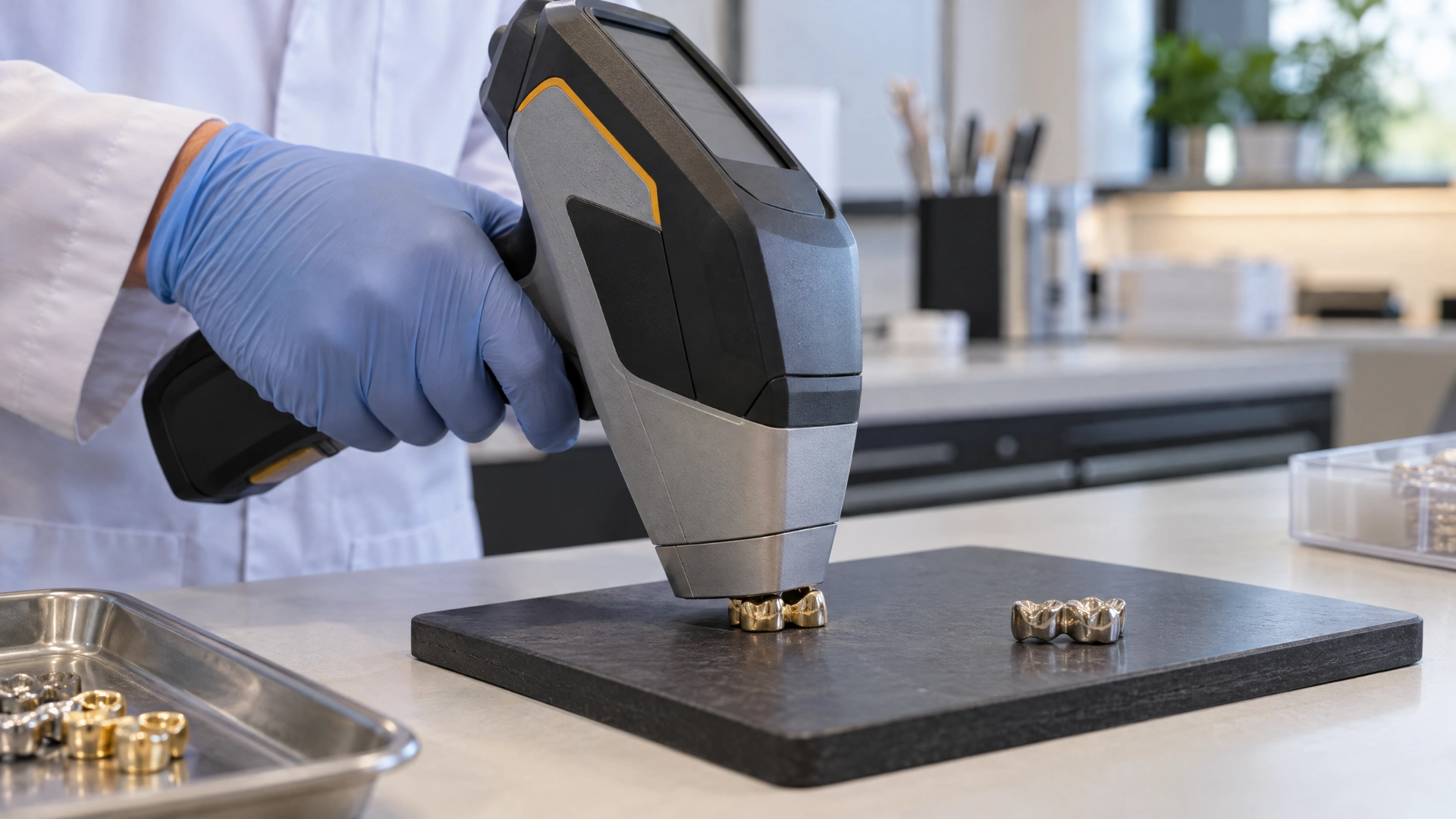
Because the class only sets a floor and the color proves nothing, dental gold has to be measured. At our counter that is done by X-ray fluorescence, or XRF, an analysis that reads which elements are present at the surface and in what proportion. Our cash for gold page says the analysis identifies 26 different metals, including gold, silver, platinum and palladium.
That matters for dental alloys because platinum-group metals can be a meaningful share of the metal, so the reading shows what a piece contains beyond its gold; whether those metals count toward an offer is a separate question, covered below. XRF also has limits worth understanding: it measures the surface it is pointed at, which is why coatings and plating need care. Our guide to what XRF gold testing measures and what it misses covers how the reading works.
How much is dental gold worth?
There is no fixed price per crown, because no two crowns contain the same metal. What is fixed is the method: the gross-to-fine calculation in the scrap gold guide linked above, applied to the gold fraction that testing finds in the alloy.
The class minimum shows why the test result matters. One gram of high noble alloy at exactly 40% gold contains 0.40 grams of fine gold, or about 0.0129 troy ounce at 31.1034768 grams to the troy ounce. A piece that tests at a different gold fraction gives a different figure, which is why the test result, not the class on the bill, sets the gold content.
Two parts of the offer are worth asking about directly:
- Platinum-group metals. Palladium and platinum can make up a large part of a dental alloy. Ask whether the offer includes them, and how they are priced, because a gold-only calculation leaves them out.
- The payout share. A buyer pays a share of melt value, the market value of the metal content, not all of it; the difference covers refining the alloy into separate pure metals and the buyer's margin. Ask what share applies and whether it is the same for every metal in the piece.
We do not print a dollar figure here because the gold price moves daily and any number would be out of date by the time you read it. The method stays the same; the live price is the variable.
Getting your dental work back
If a tooth with a gold restoration is being extracted, you can ask for it. The CDC's infection-control guidance on extracted teeth says extracted teeth can be returned to patients on request, and that once returned they are no longer covered by the OSHA bloodborne pathogens standard that applies to dental staff. The guidance does not address a crown or bridge removed on its own, so ask your dentist how their practice handles one before the procedure.
Amalgam fillings are not dental gold. The CDC notes that teeth with amalgam should not go into waste streams that are incinerated, because burning amalgam releases mercury into the air. That is a disposal question for your dentist, not something a gold counter buys as gold.
When you bring dental work in, a sealed bag is a simple way to carry it, and it helps to say what it is when you hand it over.
What Virginia law means for selling dental gold
Dental gold sits inside Virginia's precious metals dealer rules. Va. Code § 54.1-4100 defines "precious metals" as any item except coins composed in whole or in part of gold, silver, platinum or platinum alloys. A crown or bridge containing gold is not a coin, so the chapter's identification, record and holding rules apply to its sale.
In practice that means bringing an unexpired government-issued photo ID and a second form of identification, as Va. Code § 54.1-4102 requires. The ID must show your current legal address; if it does not, bring other documentation that verifies it. The holding period in the chapter governs what the dealer may do with the item afterward; it does not delay payment to you. Our guide to what Virginia law requires when you sell gold sets out the identification, records and holding period in full.
Selling dental gold at our counter
Dental gold is on the list of what we buy. Our cash for gold page names "gold dental items" alongside jewelry, coins and scrap, and says the only gold we do not buy is gold plate. Testing is done in front of you with XRF, we explain how your items are evaluated, and we make a same-day offer based on current precious metals prices. If you accept the offer, payment is provided the same day.
You do not need to book. In the page's own words: "No. Walk-ins are welcome during normal business hours." If your dental work includes platinum or palladium, or you have a large lot from an estate, call first and ask how those metals are handled.
This article is educational and reflects general information about precious metals and collectible coins. It is not investment, tax or legal advice, and The Bullion Bank is not a registered investment adviser, broker-dealer or tax professional. Metal prices fluctuate and past performance does not indicate future results. Consult a qualified professional about your own situation.
Frequently asked questions
How much gold is in a dental crown?
It varies by alloy. Under the CDT classification used in dental billing, a high noble alloy contains at least 40% gold and at least 60% gold plus platinum-group metals. Noble and predominantly base alloys have no separate gold minimum. Porcelain, cement or tooth attached to the crown adds weight but no gold, so only testing shows the real content.
Is dental gold 24 karat?
No. Dental gold is an alloy. Even the highest CDT class requires only 40% gold, which is below 10 karat, and the FDA describes dental noble metal alloys as combining gold, palladium, platinum or silver with lesser amounts of metals such as copper and zinc. Dental billing codes classify these alloys by noble metal content rather than by karat.
Can I ask my dentist to give me my old crown?
Yes, you can ask. The CDC's infection-control guidance says extracted teeth can be returned to patients on request, and that once returned they are no longer covered by the OSHA bloodborne pathogens standard. The guidance covers extracted teeth, not crowns or bridges removed on their own, so ask your dentist how their practice handles those before the procedure.
Does The Bullion Bank buy dental gold?
Yes. Our cash for gold page lists gold dental items among what we buy. Pieces are tested with XRF in front of you, and if you accept the offer, payment is provided the same day. Virginia’s dealer rules apply, so bring an unexpired government-issued photo ID and a second form of identification. If the ID does not show your current address, bring something else that verifies it.
Is palladium or platinum in dental alloys worth anything?
The metal itself has value, and in some dental alloys it can be a large share of the content. Whether it adds to a particular offer depends on how the buyer prices it. XRF can identify palladium and platinum alongside gold, so ask at the counter whether the offer includes the platinum-group content and how that part is calculated.
Bring it in and see what it contains
If you have dental gold from a recent treatment or an estate, bring it to either counter and we will test it with you and explain the offer.
The Bullion Bank - Chantilly
4086 Airline Pkwy
Chantilly, VA 20151
(703) 705-5151
Mon-Fri 11:00-18:00 · Sat 11:00-17:00 · Sun closed
The Bullion Bank - Vienna
131 Maple Ave W
Vienna, VA 22180
(703) 705-5252
Mon-Fri 11:00-18:00 · Sat 11:00-17:00 · Sun closed