Published by
Gold Expert
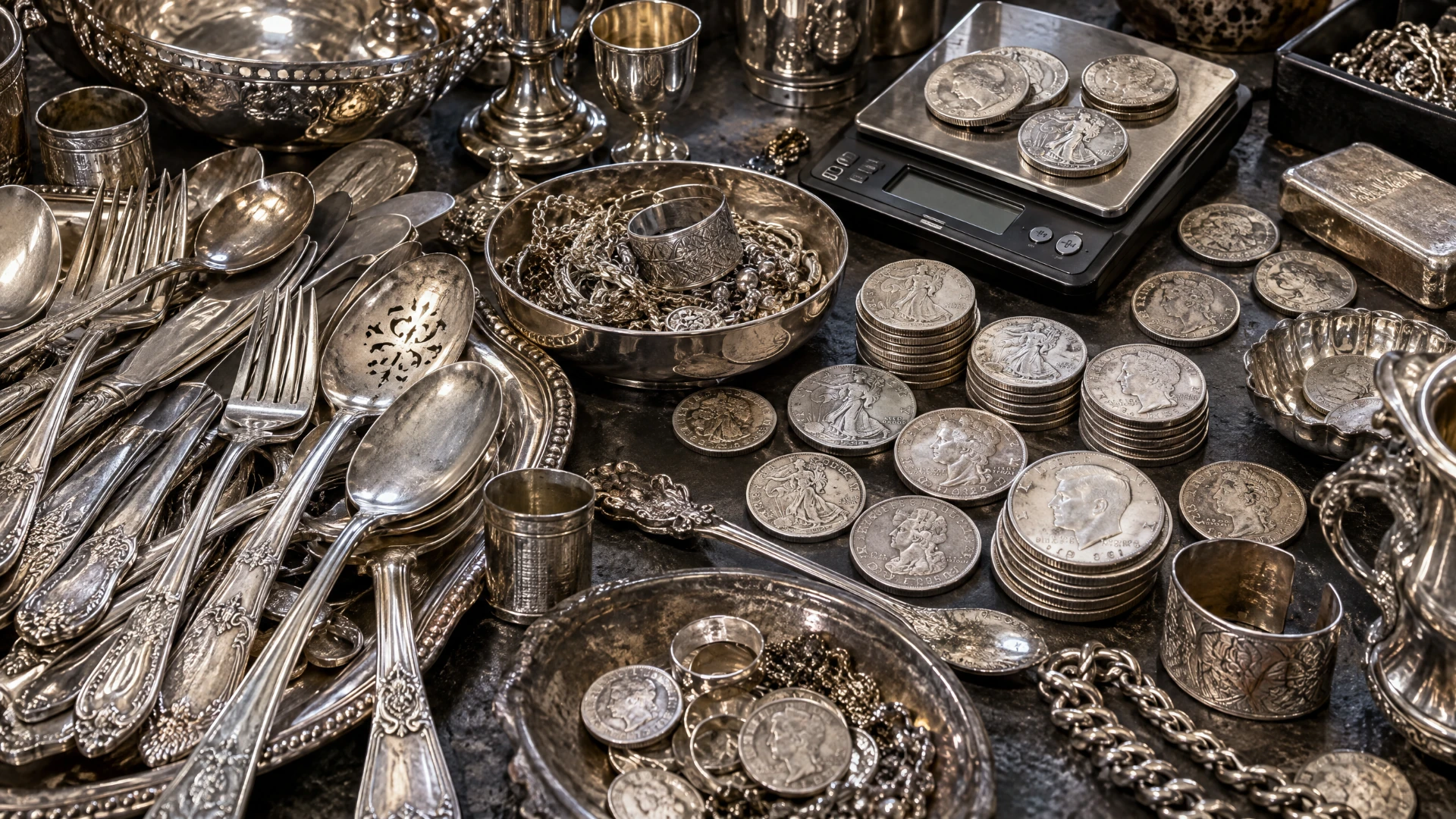
An offer on scrap silver is not the weight of your box multiplied by the silver price. It is the fine silver in the box — the actual metal, once fineness and non-silver parts are taken out — converted to troy ounces and priced against the live market, less the counter's spread. Two people can walk in with bags of the same weight and leave with very different numbers, and almost all of the difference is in that conversion.
This is the arithmetic a buyer runs on a mixed lot of flatware, holloware, jewellery and old US coins in Chantilly or Vienna, so you can run it yourself before you come in.
Gross weight, fine weight, and the unit that catches people out
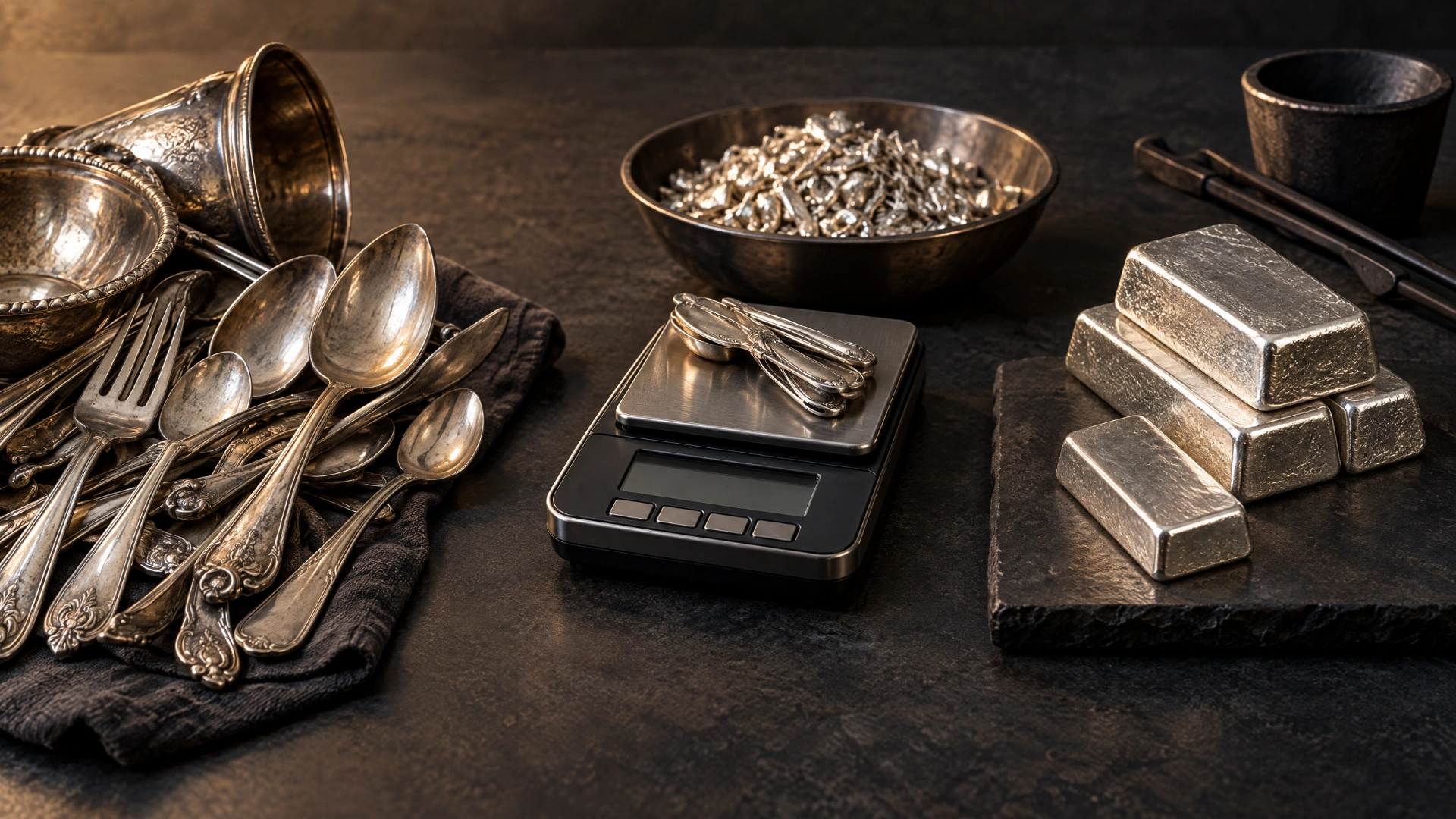
Every scrap silver offer starts with one calculation:
Gross weight × fineness = fine weight. Fine weight ÷ 31.1034768 = troy ounces of silver.
A hundred grams of sterling is not a hundred grams of silver. Sterling is 925 parts silver per thousand, so 100 g of sterling holds 92.5 g of fine silver, which is 2.97 troy ounces.
The unit matters more than people expect. Precious metals are weighed in troy ounces, and a troy ounce is heavier than the ounce on a kitchen scale. NIST's conversion chart for precious metal sales puts one troy ounce at 31.1034768 grams; the everyday avoirdupois ounce is 28.3495 grams. Weigh sterling at home on a postal scale and you will read roughly nine percent more "ounces" than a dealer's scale will, and conclude you were underpaid when you were not. The same guidance notes the pennyweight, still used in the jewellery trade: twenty pennyweights to the troy ounce.
What a scrap silver offer is actually paying for: fineness
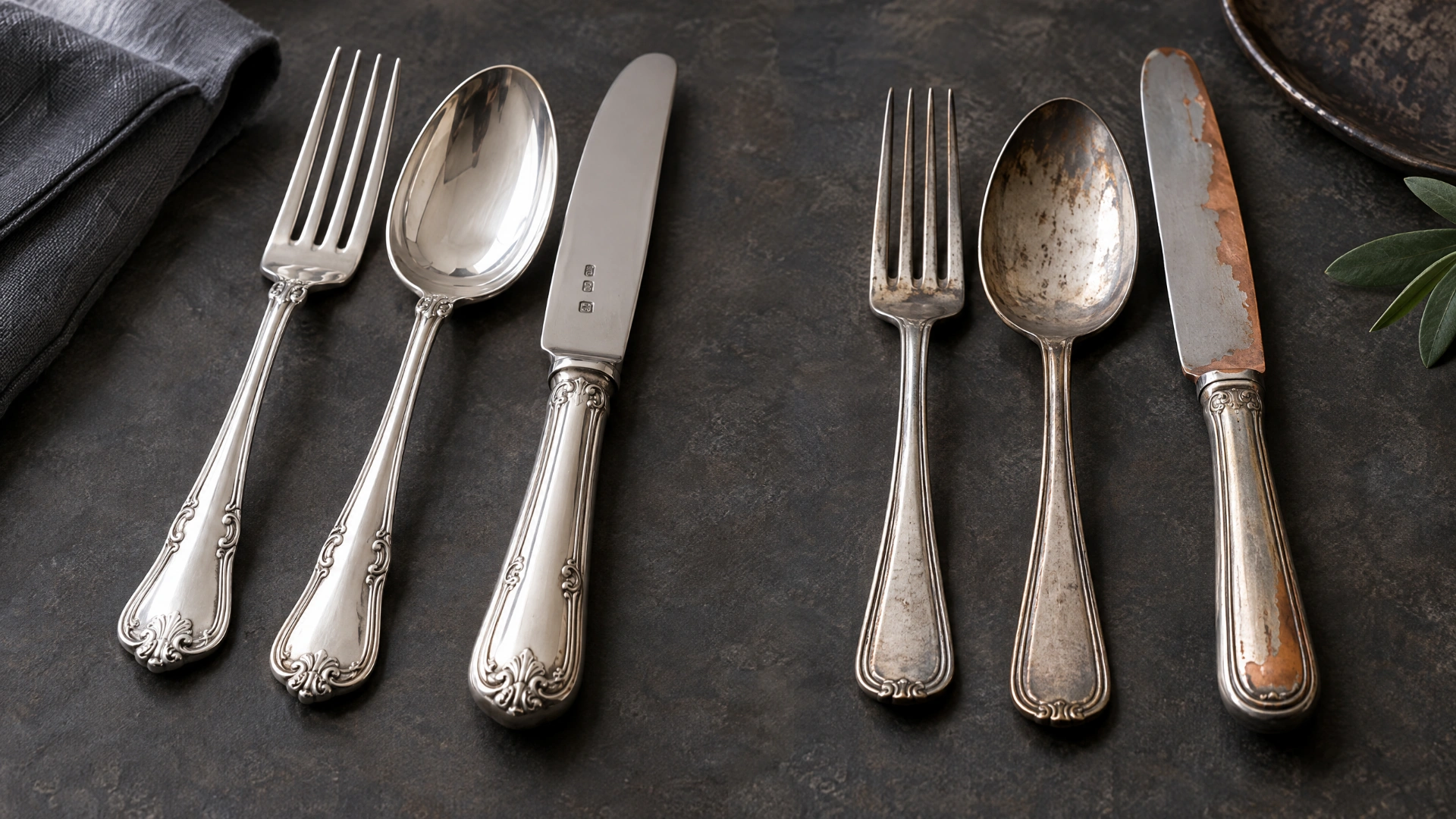
Fineness is the proportion of pure silver in an alloy, expressed in parts per thousand. It is where a mixed lot separates into piles. The marks on American and British silver are governed on the selling side by the Federal Trade Commission's jewellery guides, and those set the thresholds precisely. Under 16 CFR § 23.5, it is unfair to describe an item as "Sterling Silver", "Sterling" or "solid silver" unless it is at least 925/1,000ths pure silver, and "coin" or "coin silver" requires at least 900/1,000ths. The same section says an item with only a surface layer of silver cannot be called silver "unless the term is adequately qualified to indicate that the product or part is only coated."
| What the mark says | Fineness | What it means for an offer |
|---|---|---|
| Sterling, Ster., 925 | .925 | Priced on fine weight |
| Coin, Coin Silver, 900 | .900 | Priced on fine weight; common on pre-1870s American flatware |
| 800, 830, 835, 900 (Continental) | As marked | Priced on fine weight at the marked standard |
| EPNS, EP, A1, "triple plate", "silver on copper" | Surface layer only | Not bought by silver weight |
| No mark at all | Unknown | Tested before any number is quoted |
Silverplate is the piece of this that disappoints most often, and it is worth understanding before you carry a canteen across the county. We have written separately on how to tell sterling from silverplate, including what the marks look like and where to find them — read that one first if your set is unmarked.
Flatware has a catch: the handles
Sterling knife handles, candlesticks and some weighted bowls and trophies are hollow shells filled with pitch, plaster or cement to give them heft. The shell is sterling. The filling is not. A knife that weighs 60 grams may hold a small fraction of that in silver, and a buyer has to price the silver, not the ballast.
This is not a deduction invented at the counter — a filled handle is a manufacturing method, usually marked "weighted" or "sterling handle". Expect knives, candlesticks and anything unexpectedly heavy for its size to be weighed and quoted separately from spoons and forks.
Old US coins in the same box
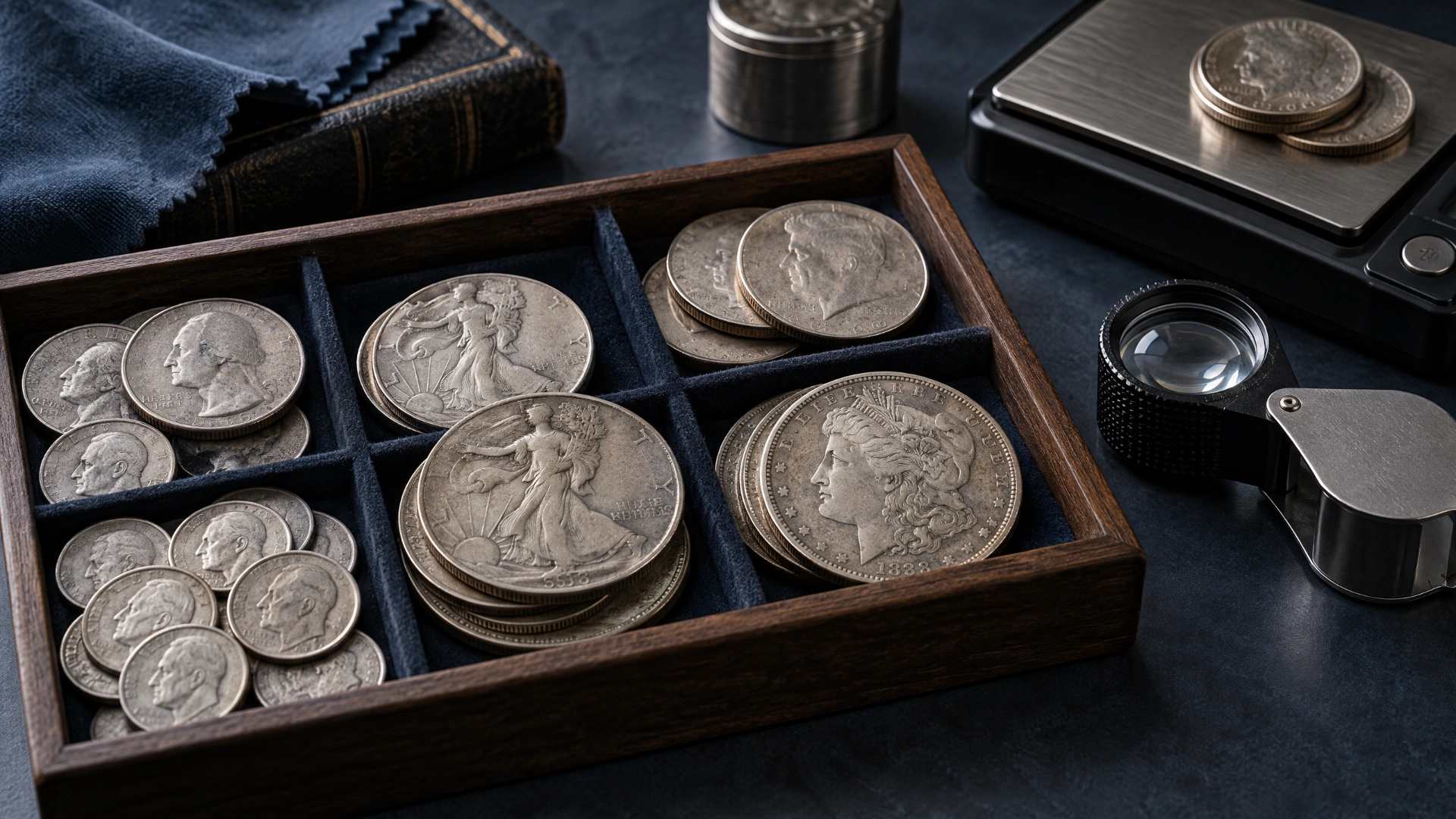
Almost every scrap silver lot in Northern Virginia has coins in it, usually from a drawer rather than a collection. American silver coinage is easy to price because the standards are statutory. Dimes, quarters and half dollars struck between 1873 and 1964 were made at 900 fine, at the weights recorded in the Treasury's own tables of United States coin standards. The US Mint's account of the 1965 changeover explains the next step: under the Coinage Act of 1965 the half dollar kept silver but dropped to 40 percent, with "outer layers of 80 percent silver" over a core of 21 percent, while the dime and quarter went to copper-nickel clad with no silver at all.
| Coin | Gross weight | Fineness | Fine silver |
|---|---|---|---|
| Dime, 1873–1964 | 2.5 g | .900 | 0.0723 troy oz |
| Quarter, 1873–1964 | 6.25 g | .900 | 0.1808 troy oz |
| Half dollar, 1873–1964 | 12.5 g | .900 | 0.3617 troy oz |
| Half dollar, 1965–1970 | 11.5 g | .400 | 0.1479 troy oz |
| Morgan and Peace dollar | 26.73 g | .900 | 0.7734 troy oz |
Wartime Jefferson nickels — the 1942–1945 issues carrying a large mintmark above the dome on the reverse — also contain silver. Ordinary 1942 nickels without that mintmark do not. Set them aside rather than leaving them in with the clad, and ask.
One important caveat: those figures are what the coins are worth as metal. A coin in high grade, a scarce date or mintmark, or an early type can be worth considerably more than its silver, and a scrap buyer pricing by weight is not the right process for it. If your coins look collectible rather than worn, read our piece on selling silver coins in Chantilly and Vienna and ask for them to be looked at separately. Sorting the two apart is the single most valuable thing that happens on the counter.
What Virginia requires when you sell flatware
Selling scrap silver in Virginia is regulated, and the counter's questions are statutory rather than optional. The requirements for precious metals dealers sit in Code of Virginia Title 54.1, Chapter 41, and we cover them in full in our guide to Virginia's precious metals dealer law. Two points bear directly on a silver sale.
First, the chapter does not apply to coins. § 54.1-4109(B) states that neither the chapter nor any local ordinance on its subject matter applies to the sale or purchase of coins. So the flatware in your box and the dimes in your box are handled under different rules at the same counter.
Second, for the flatware, § 54.1-4104 requires the dealer to retain what it buys for 15 calendar days from when the bill of sale reaches local law enforcement, without selling, altering or removing it from the locality. That holding period is an obligation on us, not a wait on your money — we pay when you accept the offer.
How we price it at our counter
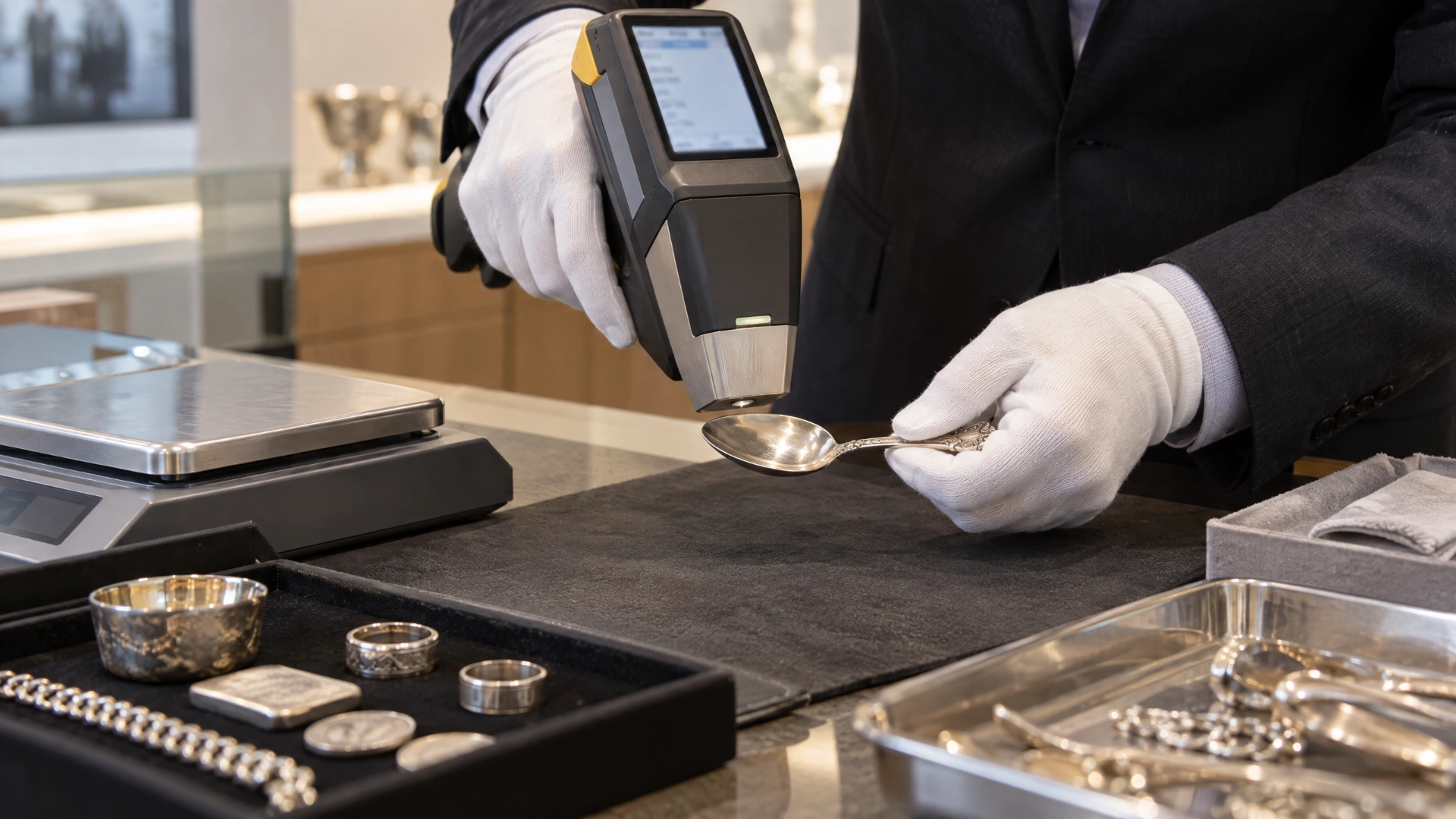
We assess metal content and purity by X-ray fluorescence, in front of you. Our XRF identifies 26 different metals, which is what separates sterling from plate from a white base alloy without cutting or acid-testing your pieces. Items are sorted by fineness, weighed, converted to fine troy ounces, and quoted against live market pricing the same day. You see the calculation. If you accept, you are paid on acceptance.
Our answer on appointments is the one on our site: "No. Walk-ins are welcome during normal business hours." A mixed estate box does not need separating before you arrive.
This article is educational and reflects general information about precious metals and collectible coins. It is not investment, tax or legal advice, and The Bullion Bank is not a registered investment adviser, broker-dealer or tax professional. Metal prices fluctuate and past performance does not indicate future results. Consult a qualified professional about your own situation.
Frequently asked questions
Do I get the silver price for my sterling?
You get a price based on the fine silver in it, which is 92.5 percent of the gross weight for sterling, minus the buyer's spread. The spread covers testing, handling and the cost of moving the metal on. Ask for the fine weight and the per-ounce figure separately, at any counter, so you can see how the total was reached.
Should I clean or polish flatware before selling it?
No. Polishing removes a small amount of metal and can damage the patina on a set worth more intact than melted. If your canteen is a complete service in a recognised pattern, say so before it is weighed — a complete set is sometimes worth more as a set than as scrap, and that is a different conversation.
What identification do I need to bring?
Bring a current government photo ID showing your address, and a second document that corroborates it. For precious metals other than coins this is a statutory requirement on the dealer rather than a house rule — the details are in our Virginia dealer law guide. A coin sale is treated differently, because the chapter excludes coins.
How long does an appraisal take?
For a typical box of flatware and loose coins, the offer is made the same day. A large estate lot with many patterns and possible collectible coins takes longer, because the sorting is the work. Walk-ins are welcome during normal business hours either way, so you can bring it in and see how far it gets.
Is silverplate worth anything at all?
Not as silver by weight — the coating is too thin to recover economically, which is why buyers do not price it. Plated pieces can carry value as tableware or for a maker or pattern, but that is an antiques question rather than a metals one, and a counter should say so rather than weighing it.
Bring the box in
You do not need to sort it, clean it or know what is in it. Bring the whole lot to either location, and we will test, separate and weigh it in front of you, and explain what we are pricing as metal and what should be looked at as something more than metal. Both stores are open six days a week.
Chantilly
The Bullion Bank
4086 Airline Pkwy
Chantilly, VA 20151
(703) 705-5151
Monday–Friday 11:00 a.m. – 6:00 p.m. · Saturday 11:00 a.m. – 5:00 p.m. · Sunday closed
Vienna
The Bullion Bank
131 Maple Ave W
Vienna, VA 22180
(703) 705-5252
Monday–Friday 11:00 a.m. – 6:00 p.m. · Saturday 11:00 a.m. – 5:00 p.m. · Sunday closed